Trump Orders "Total and Complete Blockade" on Venezuela's Sanctioned Oil Tankers, Escalating Pressure Campaign
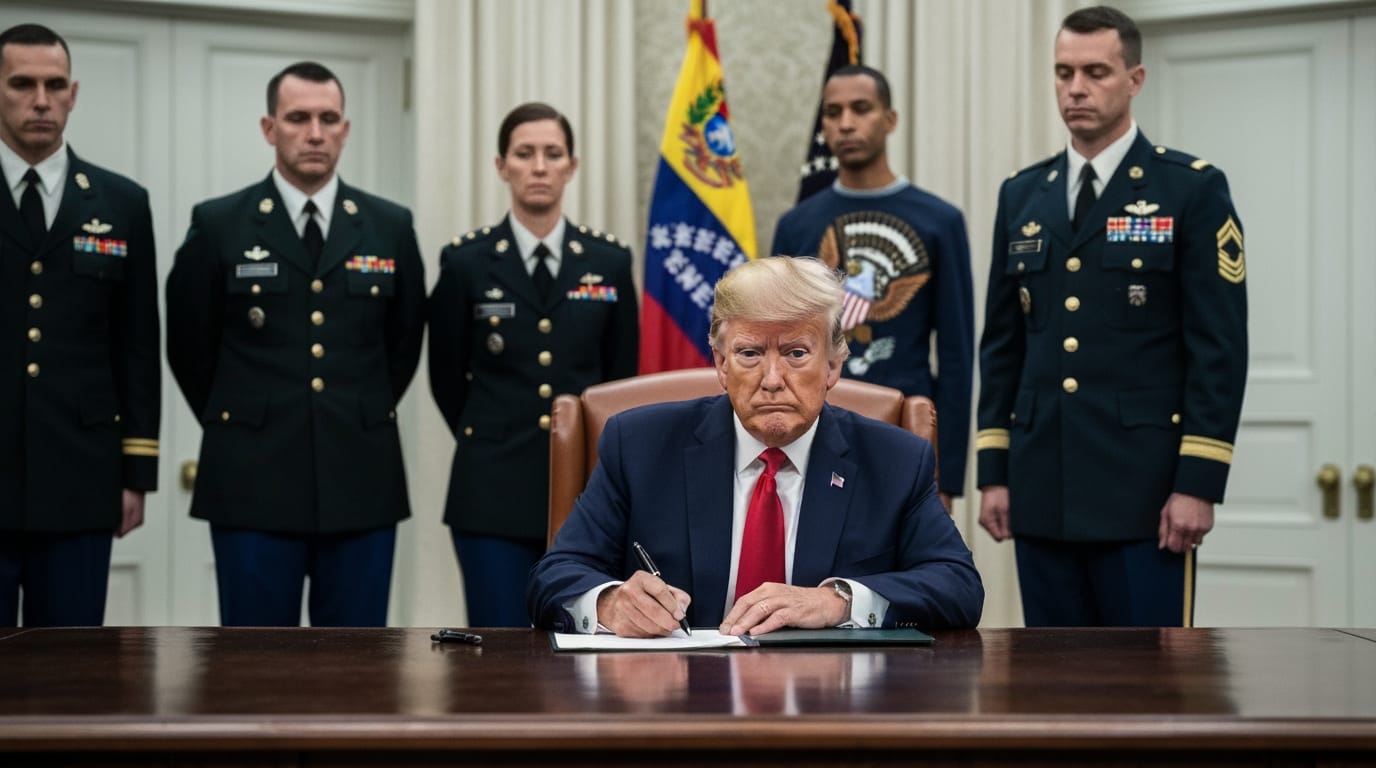
WASHINGTON D.C. — In a dramatic escalation of pressure against the government of Venezuelan President Nicolás Maduro, former U.S. President Donald Trump on Tuesday, December 16, 2025, ordered a "total and complete blockade" of all sanctioned oil tankers entering or departing Venezuelan waters. The directive, announced via his Truth Social platform, marks a significant intensification of efforts aimed at crippling Venezuela's primary source of revenue and forcing a change in leadership, drawing immediate condemnation from Caracas and raising concerns about international law and humanitarian consequences.
The order follows weeks of heightened military activity in the Caribbean and a series of targeted sanctions, underscoring a determined strategy by the Trump administration to dismantle the Maduro regime's financial lifelines. Venezuela, which boasts the world's largest proven oil reserves, relies almost entirely on crude exports to sustain its economy, making the latest measure a potentially devastating blow to the already struggling South American nation.
The Escalation of Pressure: A Multi-pronged Strategy
President Trump's declaration was couched in strong language, labeling the Venezuelan government a "FOREIGN TERRORIST ORGANIZATION" and accusing it of "Terrorism, Drug Smuggling, and Human Trafficking." He further asserted that the Maduro regime was using oil revenue to finance these illicit activities and demanded the immediate return of "Oil, Land, and other Assets that they previously stole from us," an apparent reference to Venezuela's nationalization of its oil industry decades ago.
This sweeping order did not emerge in a vacuum. It represents the apex of a meticulously intensified "maximum pressure" campaign against Caracas. Days prior to the blockade announcement, on December 10, 2025, U.S. forces seized the oil tanker Skipper off Venezuela's coast. The Skipper, a vessel previously sanctioned for its alleged involvement in an illicit oil shipping network, was reportedly transporting Venezuelan crude. This act was described by Venezuelan officials as "state piracy" and "blatant theft," and a clear indication of Washington's intent to seize Venezuelan natural resources.
Beyond naval actions, the U.S. Treasury Department had already levied new sanctions on December 12, 2025, targeting six shipping companies, six crude oil tankers, and individuals linked to the Maduro administration. These included three nephews of Venezuelan First Lady Cilia Flores and a Panamanian businessman accused of facilitating oil shipments. The Trump administration also deployed a significant military presence to the Caribbean in recent months, including thousands of troops, nearly a dozen warships, and an aircraft carrier, ostensibly for counter-narcotics operations. These operations have involved air attacks and the sinking of alleged drug smuggling boats, resulting in dozens of fatalities, but have been widely interpreted by Caracas as a thinly veiled threat of military intervention.
Venezuela's Economic Lifeline Under Siege
Venezuela's economy has been in a severe crisis for years, exacerbated by a combination of mismanagement, corruption, and an escalating series of U.S. sanctions first imposed in 2017. Oil exports constitute over 90 percent of Venezuela's export revenue and more than half of its fiscal income, making the oil sector the country's economic backbone. The initial sanctions aimed to prevent the Maduro government from benefiting from oil proceeds by blocking access to international financial markets and imposing an export ban.
In response to previous sanctions, the Maduro government largely circumvented restrictions by relying on a "shadow fleet" of often unflagged tankers that disguise their location, primarily selling crude to China at steep discounts. Analysts like Francisco Monaldi, director of the Latin America Energy Program at Rice University, indicate that approximately 80 percent of Venezuela's oil is sold on the black market, often through these sanctioned vessels. This new "total and complete blockade" specifically targets these sanctioned tankers, threatening to cut off what little economic oxygen remains.
Should the U.S. effectively enforce this blockade, the implications for Venezuela's economy could be catastrophic. Experts predict a "massive impact" on government revenue, leading to further economic contraction, increased inflation, and a deeper devaluation of the national currency. Economist Francisco Rodríguez of the University of Denver warned that cutting off all oil revenue could trigger "the first major famine in the Western Hemisphere in...". The country's oil output has already fallen to its weakest levels in over 50 years due to a combination of internal issues and sanctions, leading to a dramatic reduction in national income.
Geopolitical Fallout and Legal Challenges
The U.S. order immediately ignited a fiery response from Venezuela. Vice President Delcy Rodríguez condemned the move as "grotesque," "reckless and serious threats," and a "warmongering" act that violates international law and freedom of navigation. Caracas views the blockade as an attempt to "strangle Venezuela's economy and seize control of its natural resources," vowing to denounce the actions before the United Nations. Cuba, a close ally, also denounced the U.S. seizure of the Skipper as an "act of piracy and maritime terrorism" and a "serious violation of international law."
Legal experts in the United States have raised serious questions about the international legality and policy rationale of Trump's declaration. International law scholar Elena Chachko of UC Berkeley Law School noted that blockades have traditionally been treated as permissible "instruments of war," but only under strict conditions. She questioned the domestic and international legal basis for such an action, particularly if it extends beyond already sanctioned vessels. U.S. Representative Joaquin Castro (D-Texas) explicitly called the blockade "unquestionably an act of war" and stated that "Congress never authorized and the American people do not want" such a conflict. The ambiguity regarding the exact enforcement mechanisms of the blockade, and whether it would involve the U.S. Coast Guard or broader military interdiction of vessels, remains a critical point of uncertainty.
The global oil market reacted quickly to the news, with U.S. crude futures climbing over 1% after the announcement, reflecting anticipation of potential disruptions to Venezuelan exports. While Venezuela's oil production, currently around one million barrels per day, is a relatively small fraction of the global market, a complete halt to its exports could still impact market sentiment.
The Humanitarian Dimension: A Deepening Crisis
Venezuela has been grappling with a severe humanitarian crisis for years, characterized by widespread shortages of food, medicine, and essential goods, mass migration, and a collapsed healthcare system. U.S. sanctions, while nominally designed to target the government, have had a significant, if indirect, impact on the general population. While sanctions do not explicitly restrict humanitarian aid, they have made it exceedingly difficult for Venezuela to import critical supplies due to a lack of foreign currency and risk aversion from international financial institutions.
Economists and humanitarian organizations have repeatedly warned that further economic strangulation could push millions more Venezuelans into dire poverty and exacerbate the existing humanitarian emergency. Critics argue that an effective oil blockade, by further reducing the government's capacity to import food and medicine, risks deepening human suffering and accelerating the collapse of essential services, regardless of the political objectives. The U.S. government maintains that its sanctions are aimed at the Maduro regime to restore democracy and human rights, not at the Venezuelan people. However, the practical consequences of a total oil blockade could severely impact the daily lives of ordinary citizens, raising profound ethical questions about the costs of such a pressure campaign.
The newly imposed blockade represents a perilous new chapter in the long-standing confrontation between Washington and Caracas. With Venezuela's economy already teetering on the brink and its government denouncing the move as an act of war, the international community watches with bated breath to see how this unprecedented measure will be implemented and what its full ramifications will be for regional stability, global energy markets, and, most critically, the millions of Venezuelans caught in the crossfire. The path forward is fraught with uncertainty, signaling a period of intense geopolitical tension and potential humanitarian crisis.


