Trump's Taiwan Overture Risks Beijing's Fury, Reshaping Delicate US-China-Taiwan Dynamics
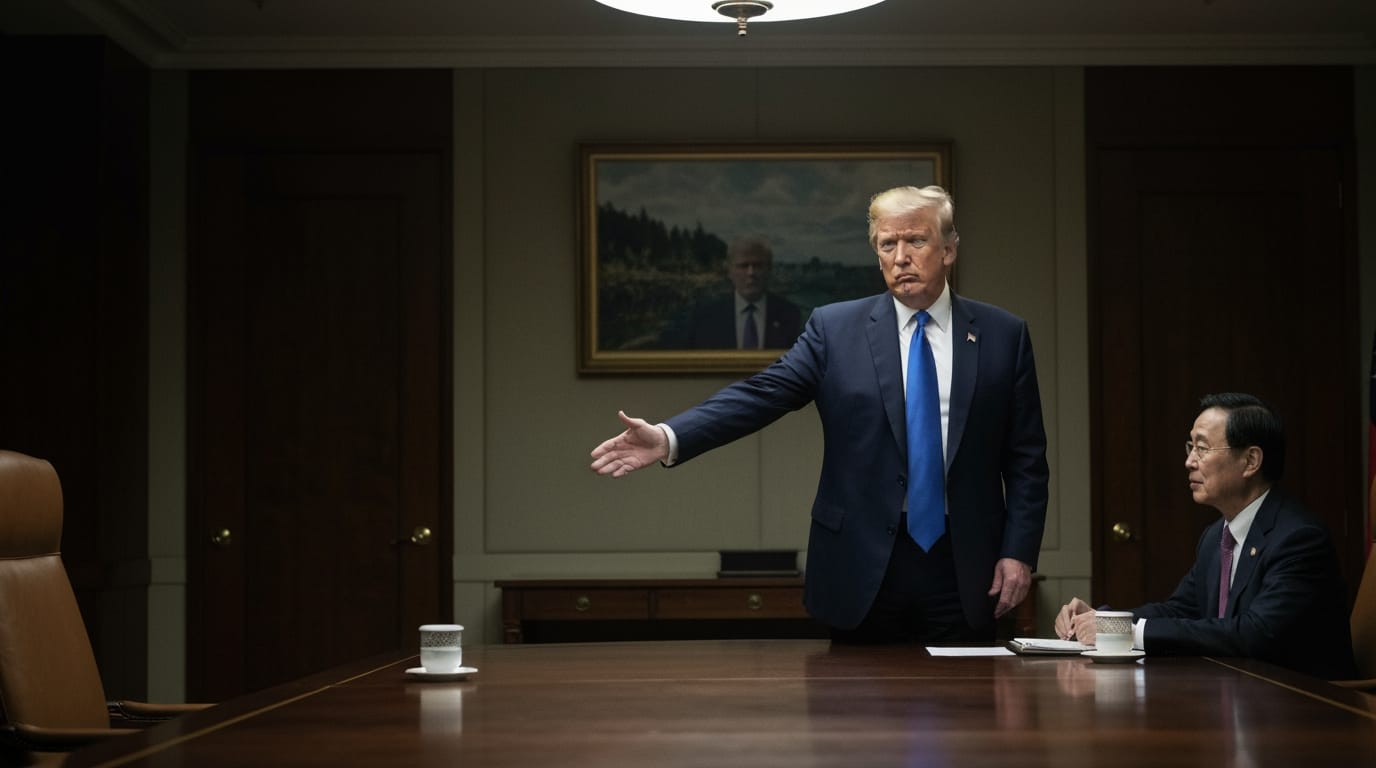
Donald Trump's recent public statements, suggesting he intends to engage directly with Taiwan's President Lai Ching-te and leverage prospective arms sales as a negotiating tool with Beijing, have sent ripples through the intricate geopolitical landscape of the Indo-Pacific. This potential shift in U.S. foreign policy, emerging in the aftermath of a high-stakes summit with Chinese President Xi Jinping, threatens to upend decades of carefully managed diplomatic protocol and ignite renewed tensions with an increasingly assertive China over the self-governing island.
The Unprecedented Offer and Its Precedents
In remarks following his recent summit with Chinese President Xi Jinping, Donald Trump indicated his readiness to speak directly with Taiwan's President Lai Ching-te. This declaration came as Trump weighed a substantial $14 billion arms sale package to Taiwan, which he described as a "very good negotiating chip" in his dealings with Beijing. He also stated that the U.S. was "not looking to have somebody say, 'Let's go independent'," a phrase that echoed Beijing's long-standing concerns regarding Taiwan's sovereignty.
Should such a direct conversation materialize, it would mark a significant break from diplomatic precedent. No sitting U.S. president has held direct talks with a Taiwanese leader since Washington shifted its diplomatic recognition from Taipei to Beijing in 1979. While not unprecedented for Trump himself, who took a congratulatory call from then-President Tsai Ing-wen after his 2016 election victory, any formal contact by a sitting president carries immense symbolic and political weight. His latest comments come just days after his discussions with President Xi, during which Taiwan was a central, and contentious, topic.
Beijing's Unwavering Red Line
China's reaction to any perceived challenge to its "One China" principle has historically been swift and unyielding. The principle asserts that there is only one sovereign state under the name China, with the People's Republic of China (PRC) as its sole legitimate government, and that Taiwan is an inalienable part of China. Beijing views Taiwan as a "breakaway province" and has consistently refused to renounce the use of force to bring the island under its control, if necessary.
During Trump's recent summit in Beijing, President Xi Jinping reportedly issued a stark warning, emphasizing that the Taiwan question is the "most important issue in China-U.S. relations" and cautioning that its mishandling could lead to "clashes and even conflicts". Following Trump's latest remarks, a spokesperson for China's foreign ministry reiterated Beijing's firm opposition to U.S. arms sales and official exchanges with Taiwan. The spokesperson urged the United States to handle the Taiwan issue with "extreme caution" and to cease sending "wrong signals to the separatist forces of Taiwan independence".
Taipei's Cautious Welcome and Firm Stance
For Taiwan, the prospect of direct high-level engagement with a U.S. president is met with a mix of cautious optimism and underlying concern. Taiwan's Deputy Foreign Minister Chen Ming-chi stated that Taipei would welcome a direct call between President Lai Ching-te and Donald Trump, if that were indeed Trump's intention. Chen acknowledged that Trump's initial comments had "caused some unnecessary concern" in Taiwan, even as the government maintained that "nothing has changed" regarding its steadfast commitment to peace.
President Lai Ching-te has consistently asserted that the Republic of China (Taiwan's official name) is already an independent country and that there is "no such thing as a so-called 'Taiwan independence issue'". Lai indicated that, should he speak with Trump, he would emphasize that China is actively undermining peace and stability in the Taiwan Strait. Taiwan remains committed to preserving the status quo in the Strait, balancing strong security ties with Washington while navigating the ever-present risk of military escalation from Beijing. However, there is an inherent anxiety in Taipei that Taiwan could become a "bargaining chip" in broader U.S.-China negotiations, rather than an equal party at the table.
Geopolitical Ripple Effects and Policy Divergence
The nuances of U.S. policy toward Taiwan are complex, marked by a delicate balance between acknowledging Beijing's "One China" position and maintaining unofficial relations with Taipei. The U.S. "One China Policy" acknowledges Beijing's claim that Taiwan is part of China but does not endorse it, allowing for a strategic ambiguity that contrasts sharply with China's "One China Principle". Central to this policy is the Taiwan Relations Act (TRA) of 1979, which legally obligates the U.S. to provide Taiwan with the means to defend itself and considers any effort to determine Taiwan's future by non-peaceful means a threat to regional peace and security.
Trump's latest comments, particularly his framing of arms sales as a "negotiating chip," signal a potential divergence from this long-standing framework. Such an approach could contradict the spirit and letter of the TRA and the Six Assurances made to Taiwan in 1982, which explicitly state that the U.S. would not consult with China on arms transfers to Taiwan. This shift raises concerns among allies in the Indo-Pacific region, who rely on the consistency and reliability of U.S. commitments to regional stability. Eroding trust in Washington's resolve could have far-reaching consequences for regional security architectures. The geopolitical landscape around Taiwan is already fraught with increased Chinese military activity, including naval patrols and air incursions, further underscoring the fragility of the status quo. Any perceived weakening of U.S. support for Taiwan also carries significant economic implications, particularly for global supply chains tied to Taiwan's critical semiconductor industry.
A High-Stakes Balancing Act
Donald Trump's willingness to engage directly with Taiwan's leadership, while simultaneously using arms sales as leverage with China, places the U.S. squarely in a high-stakes diplomatic balancing act. This approach, unprecedented in its directness since the formal establishment of U.S.-PRC relations, signals a potential new era in U.S.-Taiwan relations but also risks significantly escalating tensions with Beijing. The precise implications for regional stability, U.S. credibility among its allies, and the future of cross-Strait relations remain uncertain. As leaders in Washington, Beijing, and Taipei navigate these complex dynamics, the need for careful diplomacy and clear communication is paramount to prevent miscalculation in one of the world's most volatile geopolitical flashpoints.


