US Captures Venezuelan Leader Maduro, Alleging Narco-Terrorism
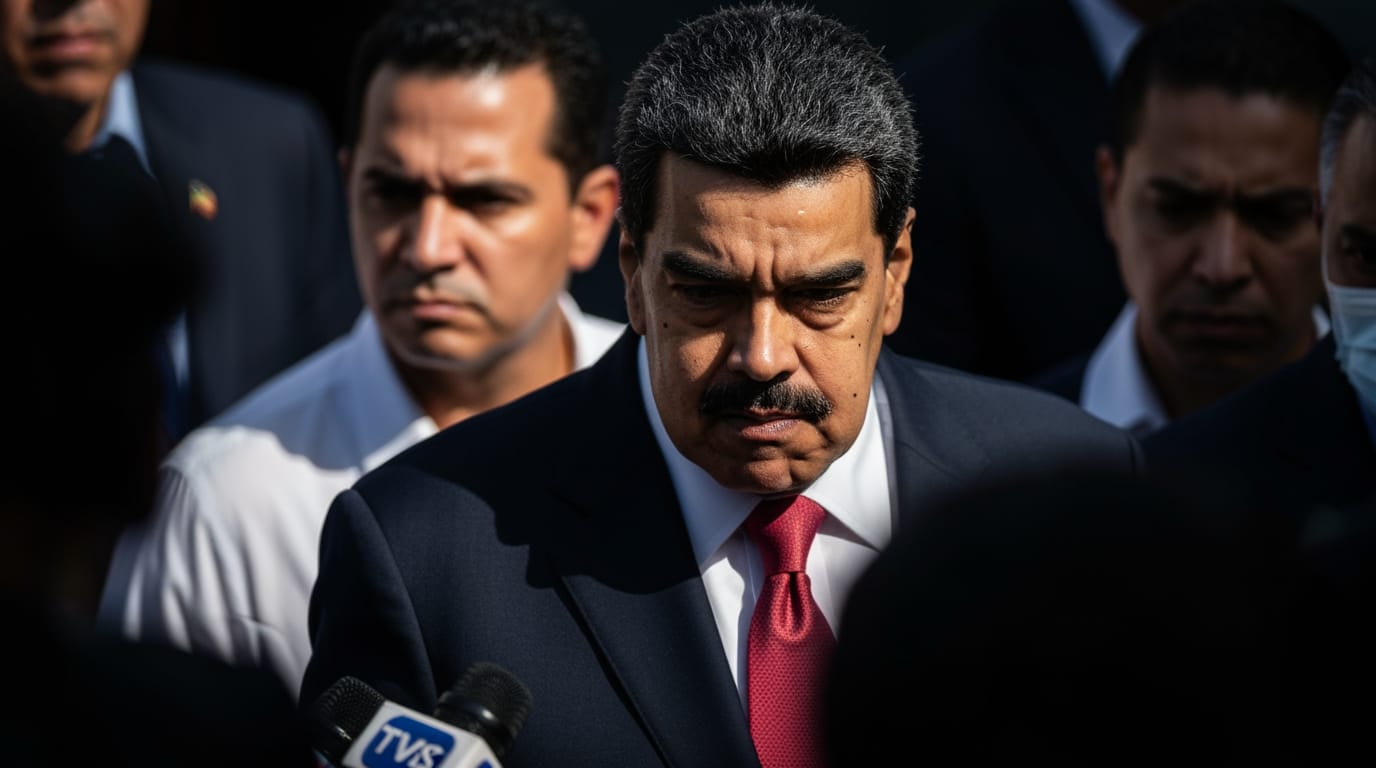
In a dramatic overnight operation on January 3, 2026, the United States executed a high-stakes military raid in Caracas, Venezuela, capturing Nicolás Maduro and his wife, Cilia Flores. The audacious operation culminated in their arraignment in a New York courtroom two days later, where both pleaded not guilty to a litany of federal drug trafficking and weapons charges, igniting a complex legal battle and sending ripples across the international political landscape. The unprecedented capture of a sitting (though unrecognised by the US) head of state on charges of narco-terrorism marks a significant escalation in the long-strained relationship between Washington and Caracas, prompting urgent questions about international law, sovereignty, and the future of Venezuela.
The Charges: Unraveling the "Cartel of the Suns" Allegations
The US Department of Justice (DOJ) initially unsealed an indictment against Maduro in March 2020, accusing him of participating in a large-scale narco-terrorism conspiracy. The charges laid out by federal prosecutors include narco-terrorism conspiracy, cocaine importation conspiracy, possession of machine guns and destructive devices, and conspiracy to possess machine guns and destructive devices. According to the indictment, Maduro, along with his wife, son, and other high-ranking Venezuelan officials, allegedly leveraged the nation's state institutions to facilitate drug trafficking operations. These alleged activities included providing protection for cocaine shipments, offering armed escorts, and permitting the use of clandestine airstrips for illicit transportation.
Central to the US allegations is the assertion that Maduro leads the "Cartel of the Suns," a purported organization composed of high-ranking Venezuelan military and government officials. Prosecutors claim this cartel collaborated extensively with the Revolutionary Armed Forces of Colombia (FARC) to funnel substantial quantities of cocaine into the United States. The scale of the alleged trafficking is staggering, with authorities estimating that as much as 250 tons of cocaine were trafficked through Venezuela annually by 2020. To underscore the gravity of the accusations, the US had initially offered a $15 million reward for information leading to Maduro's arrest in 2020, a bounty that was subsequently doubled to $50 million in August 2025. The charges paint a picture of a state deeply entwined with criminal enterprises, with its highest office allegedly orchestrating a global drug network.
"Operation Absolute Resolve": A High-Stakes Extraction
The capture of Nicolás Maduro was the culmination of "Operation Absolute Resolve" (also referred to as "Operation Resolve"), a meticulously planned military endeavor involving elite US special forces. Reports indicate that the operation, which commenced in the early hours of January 3, 2026, involved elements of the US Army's Delta Force and the 160th Special Operations Aviation Regiment, known as the "Night Stalkers," alongside FBI agents. US officials described the mission as a "surgical law enforcement operation" aimed at apprehending Maduro based on the existing criminal indictment.
Preparation for the high-risk mission included the construction of an exact replica of Maduro's compound, allowing special forces to meticulously rehearse their entry and extraction strategies. The operation unfolded rapidly, with helicopters reportedly coming under fire but responding with "overwhelming force" as they extracted Maduro and Flores. Following their capture in Caracas, the pair were transported via a US warship, the USS Iwo Jima, before being flown to New York to face justice. This dramatic capture immediately drew parallels to the 1989 US invasion of Panama to apprehend Manuel Noriega, who was also indicted on drug trafficking charges. Both instances involved the forceful removal of a foreign leader to face charges in a US court, igniting vigorous debate regarding the legality and implications under international law.
Maduro's Denials and the Defense of Sovereignty
In his first appearance in a New York courtroom, a shackled Nicolás Maduro defiantly asserted his innocence, proclaiming, "I'm innocent. I'm not guilty — I'm a decent man," and reiterated his claim to being the legitimate president of Venezuela. He characterized his capture as a "kidnapping" and maintained he was a "prisoner of war." Maduro's legal team, led by Barry Pollack, a lawyer known for representing Julian Assange, is expected to mount a robust defense. A key argument will likely revolve around the principle of head-of-state immunity, challenging the legality of his military abduction and subsequent prosecution in a foreign court.
The Venezuelan government, along with Maduro's son, vehemently condemned the US operation, labeling it a "crime of aggression" and a blatant violation of international law. They contend that the charges are politically motivated, serving as a pretext for regime change rather than a genuine pursuit of justice. The US and several allied nations, including the UK, have for years refused to recognize Maduro as Venezuela's legitimate president, citing concerns over the fairness of the 2024 elections. This lack of recognition complicates the head-of-state immunity argument, though some legal scholars argue that such immunity should apply irrespective of political recognition to prevent politically motivated arrests. The legal proceedings are anticipated to be protracted, potentially stretching on for years as these complex questions of jurisdiction and international law are addressed.
Global Repercussions and International Law
The US capture of Maduro has provoked a mixed international response, with many nations expressing strong condemnation or serious concern over the precedent it sets. Russia and China, staunch allies of Venezuela, were particularly vocal in their criticism. Russia's Foreign Ministry denounced the operation as "aggression" against a sovereign state and called for Maduro's immediate release and restoration to power. China's Foreign Ministry expressed deep shock, viewing the "blatant use of force against a sovereign state" as a grave violation of international law and a threat to regional peace and security. Even some US allies and the United Nations expressed unease. The UN Secretary-General conveyed deep alarm, suggesting the operation could constitute a breach of international law and warning of a "dangerous precedent."
The case has ignited a critical global debate on the boundaries of state sovereignty, the applicability of head-of-state immunity, and the mechanisms for holding leaders accountable for serious crimes on the international stage. Legal scholars are scrutinizing whether the US actions effectively "rewrote the rules" governing international relations and control. The geopolitical implications are significant, with some analysts interpreting the operation as a forceful reassertion of American power in the Western Hemisphere, potentially signaling a revived "Monroe Doctrine" aimed at deterring the growing influence of rivals like China and Russia in the region.
A Defining Moment for US-Venezuela Relations
The capture and ongoing legal proceedings against Nicolás Maduro represent a pivotal moment in the tumultuous history of US-Venezuela relations. The US government's persistent efforts to portray Maduro as a drug baron and dismantle his regime through legal and, now, military means have irrevocably altered the dynamic between the two nations. The protracted legal battle, unfolding in a New York courtroom, will not only scrutinize the specific drug trafficking allegations but also test fundamental principles of international law, state sovereignty, and the limits of extraterritorial jurisdiction. The outcome of this high-profile case is poised to have lasting consequences, shaping future international responses to allegations against foreign leaders and potentially redefining the parameters of global engagement for years to come.


