Venezuela Criminalizes Oil Tanker Seizures Amid Intensifying U.S. Pressure
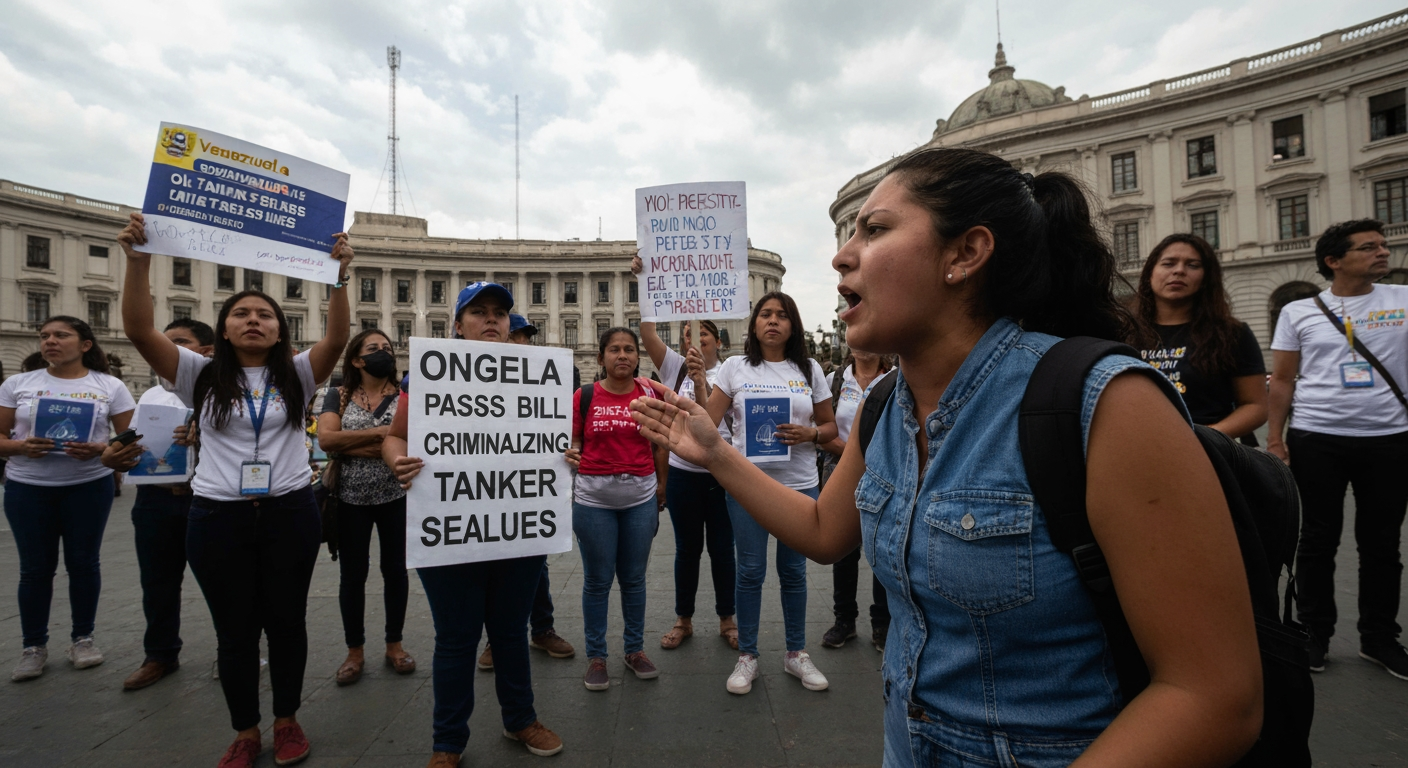
CARACAS, Venezuela – In a swift legislative maneuver, Venezuela’s National Assembly has approved a bill criminalizing the seizure of oil tankers and other activities that could disrupt its maritime trade, a direct response to recent U.S. actions targeting Venezuelan crude shipments. The measure, passed rapidly by the ruling-party-controlled assembly, signals an escalation in the protracted geopolitical struggle over the South American nation's vast oil reserves and its sovereignty. With provisions for severe fines and prison sentences of up to 20 years, the law positions Venezuela to legally challenge what it characterizes as acts of "piracy" and "blockades" on the international stage.
A Legislative Countermeasure to Maritime Interdictions
The "Law to Guarantee Freedom of Navigation and Commerce Against Piracy, Blockades, and Other International Illicit Acts" was introduced, debated, and approved by Venezuela's unicameral National Assembly within a mere two days. The bill now awaits President Nicolás Maduro's signature to officially become law. It stipulates harsh penalties, including fines and imprisonment for up to two decades, for any individual or entity found to be promoting, requesting, supporting, financing, or participating in what Venezuela defines as "acts of piracy, blockades or other international illegal acts" against commercial entities operating with the country. Beyond punitive measures, the legislation also mandates the executive branch to develop "incentives and mechanisms for economic, commercial and other protections" for national or foreign entities conducting business with Venezuela who might face such alleged unlawful acts. Venezuelan officials have framed the bill as a necessary legal defense against what they perceive as unlawful interference with their oil exports and national sovereignty.
The Backdrop of Escalating U.S. Sanctions and Seizures
The passage of this bill comes on the heels of intensified pressure from the United States, which recently carried out the seizure of two oil tankers, the Skipper and the Centuries, carrying Venezuelan crude in international waters. The first seizure involved the Panama-flagged vessel, Skipper, on December 10, followed by the Centuries on December 20, with reports indicating a third tanker, the Bella 1, was pursued but evaded capture. U.S. authorities contend that these vessels are part of a "shadow fleet" employed by Venezuela to circumvent U.S. economic sanctions aimed at limiting the Maduro government's revenue.
These maritime interdictions represent a significant escalation in President Donald Trump's four-month pressure campaign against the Maduro administration. Since 2019, the U.S. has imposed comprehensive sanctions on Venezuela's state-owned oil company, PDVSA, severely impacting the country's oil production, which plummeted from approximately 3.5 million barrels per day to 400,000 barrels per day by 2020. The stated goal of these sanctions is to cut off financial resources to the Venezuelan government and pressure President Maduro to resign. Adding to the tensions, President Trump announced a "total and complete blockade of all sanctioned oil tankers" traveling to and from Venezuela, a move that Caracas has vehemently denounced as a "grotesque threat" and an act of "international piracy."
International Reactions and Legal Contentions
The U.S. seizures and Venezuela's legislative response have ignited a fierce debate on the international stage concerning the legality of such actions and their implications for maritime law. China has publicly condemned the U.S. seizures, with Chinese Foreign Ministry Spokesperson Lin Jian asserting that such actions constitute a "serious violation of international law" and "unilateral bullying." Similarly, Russia, a key ally of Venezuela, has voiced strong support for Caracas, with Foreign Minister Sergey Lavrov reportedly denouncing the U.S. actions as "aggressions and flagrant violations of international law."
While the U.S. maintains that its interdictions are lawful enforcement actions under existing sanctions regimes, particularly when targeting vessels allegedly operating under false flags or without proper registration, some international legal experts question the broader legality. Critics argue that the aggressive tactics employed by the U.S. could be seen as stretching the boundaries of international law, potentially escalating into armed conflict. Venezuela's U.N. Ambassador, Samuel Moncada, accused the U.S. of acting "outside international law" and described the alleged naval blockade as "essentially a military act aimed at laying siege to the Venezuelan nation." The ongoing dispute highlights fundamental disagreements over sovereign rights, the reach of unilateral sanctions, and the principles governing international navigation and commerce.
Venezuela's Oil Lifeline and Strategic Defense
Venezuela, a founding member of OPEC, holds the world's largest proven crude oil reserves, estimated at 304 billion barrels. This vast resource historically served as the bedrock of its economy. However, years of political turmoil, mismanagement, and increasingly stringent U.S. sanctions have severely crippled its oil industry, leading to a dramatic decline in production and exports. The sanctions have also led to an oil storage crisis, pushing the country's facilities to their limits and potentially forcing a shutdown of oil wells if export routes remain constrained.
In an effort to circumvent these restrictions and sustain its vital oil revenues, Venezuela has reportedly utilized a "shadow fleet" of tankers and even adopted cryptocurrencies like USDT for oil payments. The newly passed bill is a direct manifestation of Venezuela's strategic efforts to defend this critical economic lifeline. It also taps into historical grievances, as President Trump has explicitly referenced "stolen" assets, alluding to past nationalizations and expropriations of foreign oil assets by the Venezuelan government, particularly during the era of former President Hugo Chávez. These historical claims, alongside the current sanctions regime, underscore the complex and high-stakes nature of the conflict over Venezuela's oil wealth.
Conclusion: A Deepening Standoff
The passage of Venezuela's bill criminalizing oil tanker seizures marks a significant formalization of its legal and political stance against what it views as external aggression. This legislative move, fueled by recent U.S. maritime interdictions and a broader pressure campaign, intensifies an already volatile geopolitical standoff. While Venezuela aims to protect its vital oil industry and assert its sovereignty through legal means, the U.S. continues to enforce sanctions, citing efforts to undermine the Maduro government and its alleged illicit activities.
The deepening confrontation carries far-reaching implications, not only for Venezuela's embattled economy and its ability to export oil but also for international maritime law and the stability of global energy markets. With major global powers like China and Russia siding with Venezuela in condemning the U.S. actions, the dispute highlights fundamental differences in interpreting international law and the legitimate exercise of national power. As President Maduro prepares to sign the bill into law, the world watches as this complex and high-stakes struggle continues to unfold.
Related Articles


Ratko Mladić, "Butcher of Bosnia" and Convicted War Criminal, Dies at 84
THE HAGUE, Netherlands – Ratko Mladić, the former Bosnian Serb military commander known as the "Butcher of Bosnia" and convicted of genocide, war crimes, and crimes against humanity, has died at the age of 84. Serbian...


Long-Awaited 9/11 Mastermind Trial Set for 2028, Decades After Attacks
GUANTANAMO BAY, Cuba – Nearly a quarter-century after the devastating terror attacks of September 11, 2001, a military judge has finally set a trial date for Khalid Sheikh Mohammed, the alleged mastermind behind the...