Venezuela Reverses Course, Opens Oil Sector to Private Investment in Landmark Shift
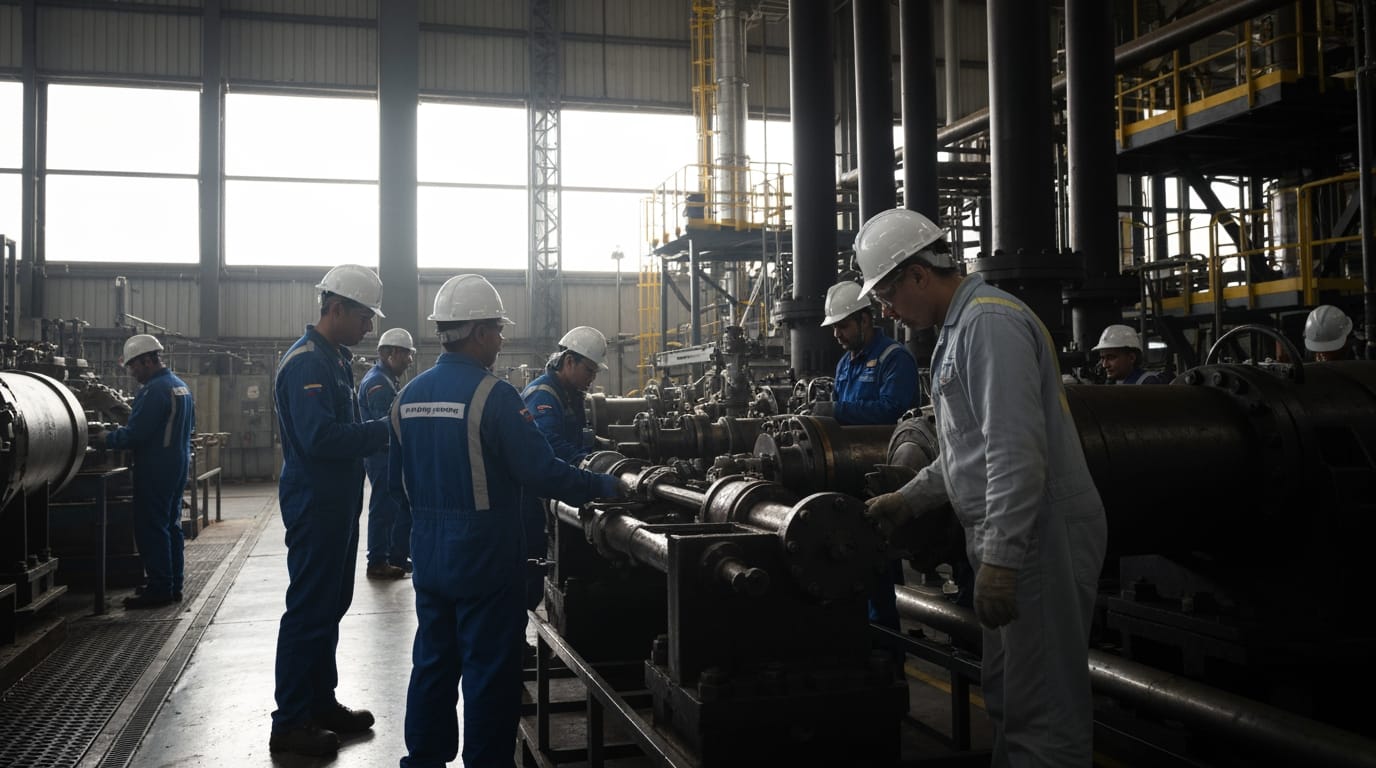
CARACAS, VENEZUELA – In a monumental policy reversal, Venezuela's National Assembly has approved sweeping reforms to its hydrocarbons law, officially opening the nation's vast oil sector to private and foreign investment after decades of stringent state control. The move, spearheaded by Acting President Delcy Rodríguez, marks a dramatic departure from the socialist-era nationalization policies that had long defined the oil-rich nation's economic landscape, and comes amidst a profound economic crisis and intensifying international pressure.
The legislative changes, signed into law by Rodríguez on January 29, 2026, are designed to attract much-needed capital and expertise to Venezuela's dilapidated petroleum industry, which possesses the world's largest proven oil reserves yet has seen its production plummet. This strategic pivot follows the recent capture of President Nicolás Maduro and the subsequent easing of U.S. sanctions, setting the stage for a potentially transformative, yet uncertain, era for the South American country and the global energy market.
The Policy Reversal: Unlocking Decades of State Control
The newly reformed Organic Law of Hydrocarbons fundamentally alters the operational framework for Venezuela's oil industry. Under the previous model, state-owned Petróleos de Venezuela S.A. (PDVSA) maintained majority control over all oil operations, often requiring foreign entities to operate through joint ventures where PDVSA held the dominant stake. The new legislation, however, grants private companies significantly more latitude, permitting them to manage extraction activities, explore new fields, and commercialize crude output once government obligations are met.
Key provisions within the reform aim to create a more attractive environment for international investors. These include allowing for independent arbitration of disputes, a critical concession given past expropriations, and establishing a more flexible royalties regime. While royalties are capped at 30%, the executive branch can reduce these to as low as 15% or 20% for specific projects or joint ventures deemed not economically viable at the standard rate. This flexibility is intended to incentivize investment in projects that might otherwise be considered too costly or risky. Furthermore, the reform aligns with mechanisms introduced by the 2020 Anti-Blockade Law, a special legal framework designed to circumvent sanctions and draw foreign capital.
The National Assembly approved the bill on January 29, with Acting President Delcy Rodríguez signing it shortly thereafter. National Assembly President Jorge Rodríguez, brother of the acting president, hailed the law's approval as a historic step for the country, following an extensive debate process that incorporated over 120 proposals from across the nation. The swiftness of this legislative action underscores the interim government's urgency to revitalize the beleaguered oil sector.
From Petrostate Powerhouse to Economic Peril: The Imperative for Change
Venezuela's dramatic policy shift is a direct consequence of a prolonged and devastating economic crisis that has gripped the nation for years. Once a regional economic powerhouse fueled by its immense oil wealth, Venezuela's gross domestic product (GDP) plummeted by roughly three-quarters between 2014 and 2021. This contraction has been accompanied by hyperinflation, widespread scarcity of basic goods, and a significant humanitarian crisis that has spurred millions to emigrate.
At the heart of this collapse lies the steep decline in oil production. Despite holding the world's largest proven oil reserves—estimated at between 300 and 304 billion barrels—Venezuela's output has fallen precipitously. In the early 2000s, the country produced over 3 million barrels per day (bpd), a figure that reached 3.5 million bpd in the 1970s. However, years of mismanagement, underinvestment, and technical problems, exacerbated by international sanctions, have crippled the industry. Current production hovers around 800,000 to 1 million bpd, representing less than 1% of global output.
The severe economic downturn and the dire state of PDVSA, which is described as financially bankrupt and operationally ineffective, provided an undeniable impetus for the interim government to seek external investment. Officials openly acknowledge that previous laws had fallen behind the actual needs of the industry, and that updating the legal framework is crucial to ensuring legal certainty for private investors. The hope is that renewed private sector involvement will provide the capital and technical expertise necessary to reverse the production decline and stabilize the national economy.
The Lingering Shadow of Nationalization and Investor Caution
Venezuela's history with foreign oil companies is fraught with tension and past expropriations, creating a significant hurdle for attracting new investment. The industry was officially nationalized in 1976, leading to the creation of PDVSA. Under President Hugo Chávez in the early 2000s, state control was further solidified, with foreign operators often compelled into minority positions within joint ventures or seeing their assets seized outright. Major U.S. firms like ExxonMobil and ConocoPhillips exited the country, pursuing international arbitration that resulted in billions of dollars in compensation awards that Venezuela has largely failed to satisfy.
This history casts a long shadow, leading to considerable caution among potential investors. While the new law addresses issues like dispute resolution through arbitration, concerns remain regarding regulatory stability and the potential for future policy reversals under different administrations. The physical infrastructure of Venezuela's oil fields and refineries is also in a state of severe decay due to years of neglect and lack of maintenance. Rebuilding this infrastructure to restore significant production levels could require tens to hundreds of billions of dollars over many years, a daunting prospect for any investor.
Despite these challenges, some existing operators, such as Chevron, Repsol, and Maurel & Prom, which have continued to maintain a presence and are owed debts by PDVSA, may be more inclined to increase their investment under upgraded U.S. Treasury Department licenses. These companies possess existing knowledge of the operational landscape, which could give them an advantage in navigating the complexities of the Venezuelan market.
A New Geopolitical Chessboard: U.S. Influence and the Path Forward
The timing and nature of Venezuela's oil sector opening are inextricably linked to shifts in geopolitical dynamics, particularly the assertive role played by the United States. President Donald Trump's administration has openly advocated for U.S. companies to engage with Venezuela's oil industry, with Trump himself stating that major oil companies were "scouting it out and picking their locations" in the country. Concurrent with Venezuela's legislative reforms, the U.S. Treasury Department eased sanctions on Venezuelan oil, specifically expanding the ability of U.S. energy companies to operate in the country. This coordination suggests a mutual interest in revitalizing Venezuela's oil output.
The U.S. interest appears to be multifaceted: seeking to restore Venezuela as a reliable global oil supplier, potentially influencing global energy markets, and fostering economic stability in a politically volatile region. However, analysts caution that large-scale investment hinges on establishing a truly sustainable and secure legal, fiscal, and institutional framework that minimizes political risk. The success of this new policy will depend on whether the interim government can consistently uphold the new legal provisions and build sufficient trust with foreign investors.
The shift also has implications for China, which has been a major partner for Venezuela through oil-for-loan agreements, especially after U.S. sanctions limited Venezuela's access to traditional markets. Redirecting oil exports to the more lucrative U.S. market could alter these established relationships. While Venezuelan oil service companies generally support the reform, anticipating increased activity and potential employment generation, the path to a full recovery remains long and complex. The nation's future hinges on its ability to overcome the deep-seated issues of infrastructure decay, political instability, and the lingering distrust from its past.
Conclusion: A Risky Bet for a Desperate Nation
Venezuela's decision to open its oil sector to private investors represents a desperate, yet calculated, gamble to escape its economic quagmire. This dramatic policy reversal, driven by the collapse of its state-dominated oil industry, a severe economic crisis, and direct pressure from the United States, marks the end of an era defined by aggressive nationalization. The interim government hopes that by offering more attractive terms and greater operational control, it can entice the vast foreign capital and technical expertise needed to resuscitate its dormant oil fields and revive its economy.
However, the road ahead is fraught with challenges. The legacy of past expropriations, coupled with persistent political instability, legal uncertainties, and the monumental task of rebuilding a crumbling infrastructure, will test the resolve of even the most optimistic investors. The success of this historic pivot is far from guaranteed, and its long-term impact on Venezuela's economy, society, and geopolitical standing will be closely watched. What is clear is that Venezuela has embarked on a new, high-stakes chapter in its oil-dependent history, where the pursuit of prosperity now openly relies on the very private capital it once vehemently resisted.


