Verdun: A Century of Unyielding Slaughter
Verdun, France – In the annals of warfare, few names evoke the sheer brutality and immense human cost as profoundly as Verdun. From February 21 to December 18, 1916, the hills north of this ancient French city became the stage for the longest and one of the bloodiest battles of the First World War. For 302 days, French and German forces engaged in an apocalyptic struggle that claimed an estimated 700,000 to nearly one million casualties, leaving an indelible mark on the landscape and the collective memory of both nations. This protracted conflict, fought primarily over a relatively small area, transformed Verdun into a potent symbol of national sacrifice and unwavering resilience.
Falkenhayn's Gamble: The Strategy of Attrition
The Battle of Verdun was conceived by German Chief of Staff Erich von Falkenhayn as a war of attrition, designed not primarily for territorial gain, but to "bleed France white." Falkenhayn believed that France, driven by national pride and strategic necessity, would commit every available soldier to defend the historically significant fortress city, thus exposing its army to devastating German artillery fire. The German objective was to inflict such unsustainable casualties upon the French that their military and political will to fight would collapse, weakening the Allied front.
Verdun presented an ideal target for this grim strategy. Situated in a salient, it offered the Germans the advantage of attacking from three sides and concentrating converging artillery fire. French intelligence had detected German preparations as early as January 1916, but their defenses had been largely neglected, with many of the city's surrounding forts partly disarmed under the erroneous assumption they could not withstand modern heavy artillery.
The German offensive began on February 21, 1916, at 7:15 AM, with an unprecedented artillery bombardment. More than 1,200 German guns pounded French positions along an eight-mile front north and east of the Meuse River, unleashing a storm of steel that shattered trenches and demoralized defenders. The initial infantry assault by the German 5th Army, under Crown Prince Wilhelm, saw rapid advances. Just four days into the battle, on February 25, the largest and highest of Verdun's forts, Fort Douaumont, fell to a small German raiding party without significant resistance, a staggering blow that underscored the French military's initial disarray.
French Resilience and the Lifeline of the "Sacred Way"
The swift fall of Fort Douaumont sent shockwaves through the French high command, leading to the appointment of General Philippe Pétain to command the beleaguered French Second Army at Verdun. Pétain, known for his expertise in defensive tactics, swiftly implemented crucial measures that would ultimately determine the battle's outcome. He focused on a defense-in-depth strategy, establishing a network of mutually supporting strongpoints rather than concentrating all forces in vulnerable front-line trenches. Crucially, Pétain also introduced a system of continuous troop rotation, dubbed the "noria" (water wheel) system, ensuring that exhausted units were regularly relieved by fresh troops, a measure vital for maintaining morale and combat effectiveness.
Central to the French defense was the critical supply route known as the "Voie Sacrée" (Sacred Way). This single, 56-kilometer road, connecting Bar-le-Duc to Verdun, became the sole artery for transporting men, ammunition, food, and medical supplies to the embattled front. Despite constant German shelling, an incessant convoy of trucks, often numbering thousands, moved day and night, ensuring that the French defenders were continuously resupplied. The ability to sustain the flow of resources along the "Voie Sacrée" was paramount to the French preventing a collapse, turning the road into a powerful symbol of national will and logistical triumph.
The French resistance was characterized by an unyielding tenacity, encapsulated by the rallying cry, "Ils ne passeront pas!" (They shall not pass!). This defiant spirit, combined with Pétain's organizational genius, solidified the French lines and thwarted the German objective of a swift breakthrough.
The Grinding Hell of Attrition
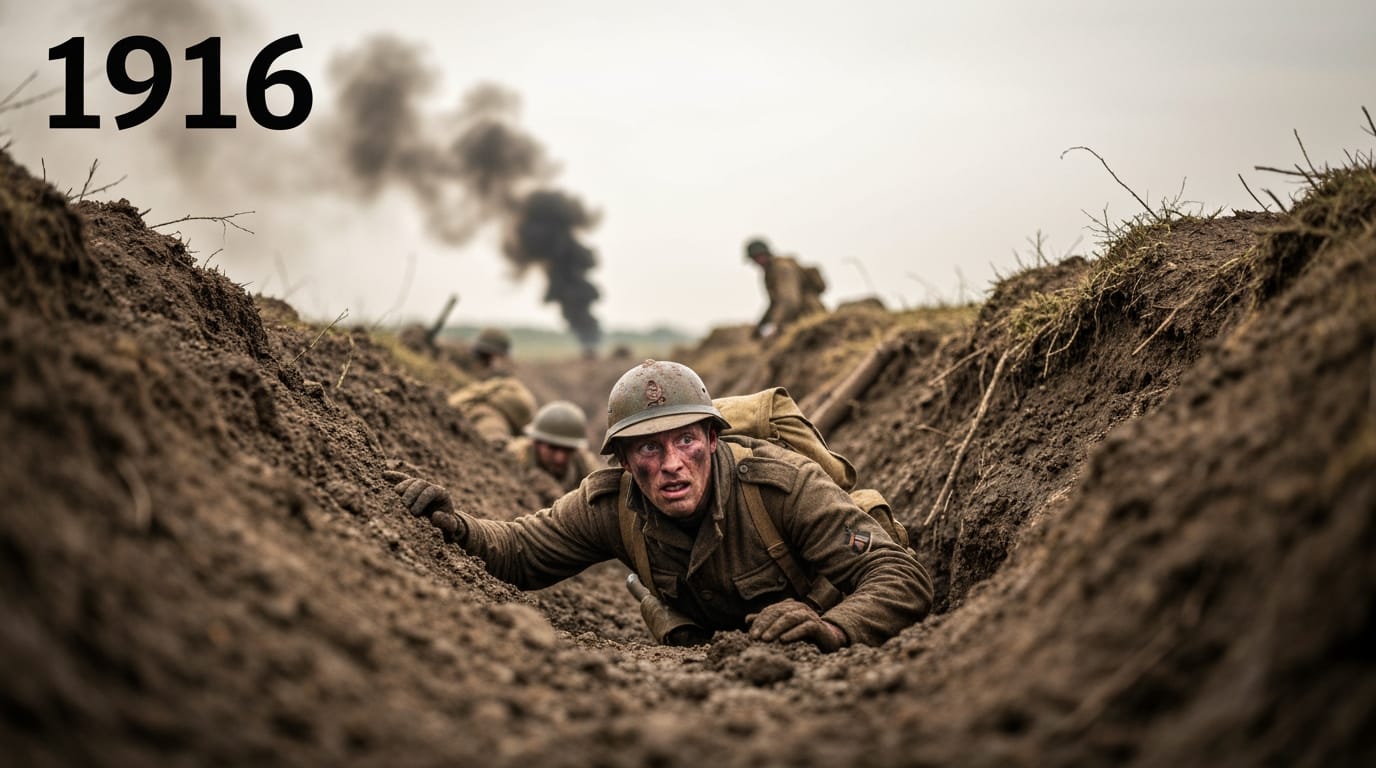
The battlefield of Verdun quickly devolved into an unimaginable landscape of devastation. Millions of artillery shells, fired by both sides, pulverized the terrain, transforming once-forested hills into a pockmarked moonscape of mud, craters, and pulverized earth. Soldiers endured horrific conditions in waterlogged trenches infested with rats, surrounded by the decay of the fallen. The psychological toll was immense, with many suffering from "obusite," or shell shock, a debilitating condition caused by prolonged exposure to the relentless bombardments.
The conflict saw the extensive use of new and devastating weaponry, including phosgene gas and flamethrowers, adding to the terror and lethality of the fighting. The struggle for strategic points was brutal; Fort Vaux, another key French fortification, was captured by German forces in June after tenacious resistance, highlighting the relentless pressure on the French defenders. Villages like Fleury-devant-Douaumont changed hands multiple times, becoming mere ruins in the ceaseless exchanges of fire.
Falkenhayn's strategy of attrition, while devastating for the French, proved equally catastrophic for the German forces. Both armies poured men into the inferno, leading to comparable casualty figures. Estimates vary, but generally suggest French losses between 377,231 and 400,000, and German losses between 337,000 and 350,000, encompassing killed, wounded, and missing. The sheer scale of casualties meant that the battle became a "meat-grinder" for both sides, "bleeding Germany white" as much as it did France.
The Tide Turns: French Counter-Offensives and the Battle's End
Despite the immense pressure, the French held their ground, slowly regaining the initiative in the latter half of 1916. A significant factor in relieving the strain on Verdun was the launching of the Allied Somme Offensive on July 1, 1916. This major Anglo-French operation to the west forced Germany to divert troops, artillery, and ammunition from Verdun to reinforce their lines on the Somme, thereby lessening the intensity of the German attacks.
In late April, General Robert Nivelle took over command from Pétain, who was promoted, and began planning methodical counter-offensives. Through carefully coordinated infantry advances and improved artillery fire, the French began to systematically reclaim lost territory. On October 24, 1916, Fort Douaumont, the symbolic prize of the initial German advance, was recaptured by French forces, a powerful morale boost and a significant strategic victory. Fort Vaux also fell back into French hands in December.
By mid-December, French counter-attacks had pushed the German lines back several kilometers, recapturing most of the ground lost earlier in the year. While the fighting never officially ceased with a formal armistice at Verdun itself, the worst of the battle had subsided, and the conflict effectively ended on December 18, 1916.
Verdun's Enduring Legacy
The Battle of Verdun stands as a defining event of the First World War, a testament to both the destructive power of modern warfare and the indomitable spirit of those who fought. While often characterized as a French victory for successfully repelling the German offensive, it was undeniably a pyrrhic one, fought at an astronomical cost for both belligerents. Falkenhayn's strategy to break the French army ultimately failed, and the heavy losses incurred at Verdun contributed to a severe manpower crisis within the German army that would hinder its capabilities for the remainder of the war.
For France, Verdun became more than just a battle; it solidified its place in the national conscience as a symbol of unwavering resistance, national identity, and supreme sacrifice. The "Lion of Verdun," General Pétain, emerged as a national hero for his crucial role in orchestrating the defense. The battle also profoundly influenced subsequent military doctrines, emphasizing the importance of defense-in-depth, robust logistics, and the psychological endurance of troops. Today, the scarred landscape around Verdun remains a powerful memorial, a poignant reminder of the staggering human cost of total war, with millions of unexploded shells still lying beneath the surface, a silent testament to the fury unleashed over a century ago.