Zelenskyy Unveils Revised 20-Point Peace Plan, Seeking Path to End War
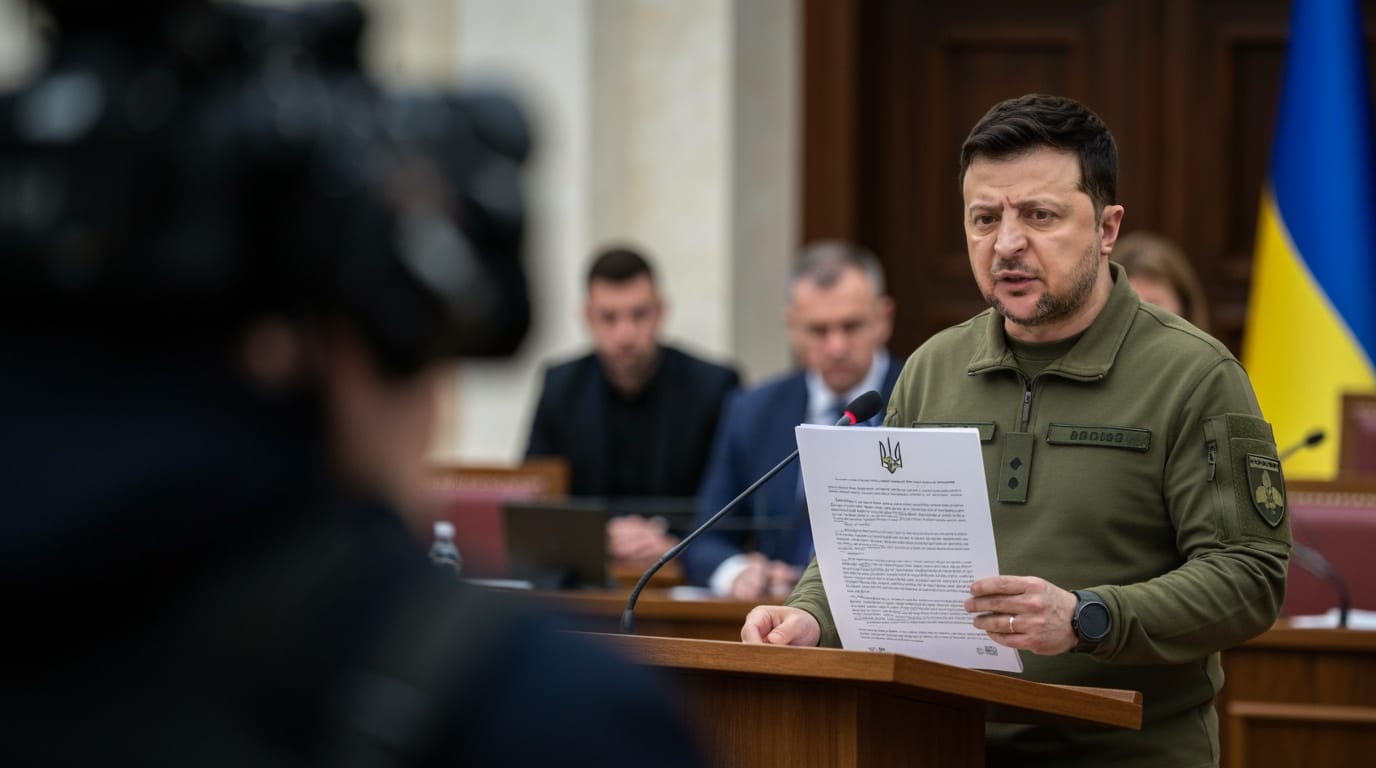
Kyiv, Ukraine – Ukrainian President Volodymyr Zelenskyy has presented a comprehensive 20-point peace plan, a revised and U.S.-backed framework aimed at resolving the ongoing conflict with Russia. Unveiled during a briefing with journalists in Kyiv, the proposal builds upon earlier diplomatic efforts and outlines a detailed pathway for security, territorial integrity, and future development for Ukraine, with significant international guarantees. The plan represents a critical diplomatic push as the war approaches its fourth anniversary, having been developed over recent weeks in discussions involving Ukrainian, American, and European negotiators.
The unveiling of this revised document signals a concerted effort to establish a concrete basis for future negotiations, though contentious issues, particularly concerning territorial control and the fate of the Zaporizhzhia nuclear power plant, remain at the forefront. While an earlier 28-point draft had been perceived as leaning heavily towards Russia's demands, this new iteration reflects significant modifications, bringing many positions closer to Ukraine's stance, according to President Zelenskyy. Moscow's response to the new proposal is highly anticipated, with American envoys expected to present the plan to the Kremlin.
Core Tenets of the Revised Proposal
The 20-point peace plan fundamentally reaffirms Ukraine's sovereignty and seeks to establish a full and unquestionable non-aggression agreement with Russia. A crucial component of the proposal involves robust security guarantees from the United States, NATO, and European signatory states, designed to mirror Article 5, the collective defense clause of NATO's founding treaty. These guarantees would entail a coordinated military response if Russia were to invade Ukraine again, alongside the reinstatement of global sanctions against Moscow. Importantly, these security provisions would be void if Ukraine were to initiate an unprovoked invasion or attack on Russian territory.
Furthermore, the plan stipulates that Ukraine would maintain its armed forces at a substantial strength of 800,000 personnel in peacetime, a significant detail given earlier drafts that reportedly called for a reduction in Ukrainian military size. On the issue of nuclear status, Ukraine reiterates its commitment to remaining a non-nuclear state, aligning with the Treaty on the Non-Proliferation of Nuclear Weapons. The document also envisions Ukraine's eventual membership in the European Union within a clearly defined timeframe and the accelerated conclusion of a free trade agreement with the United States.
Beyond security, the plan addresses post-conflict recovery and economic stability. It outlines a strong global development package and the establishment of various funds aimed at economic recovery, the reconstruction of damaged areas, and humanitarian issues. The ambitious objective is to mobilize an estimated $800 billion to help Ukraine realize its full potential. Provisions for the exchange of prisoners of war and the return of deported persons, including children, are also integral to the humanitarian dimension of the plan.
Navigating the Territorial Maze and Nuclear Security
One of the most complex and sensitive aspects of any peace settlement revolves around territorial control, particularly in Ukraine's eastern Donbas region and the issue of the Zaporizhzhia Nuclear Power Plant. President Zelenskyy acknowledged the difficulty of these points, indicating that while Ukraine opposes withdrawal, the plan introduces concepts such as a "free economic zone" or a demilitarized zone in the Donbas. Specifically, he stated that the plan de facto recognizes the current troop deployment lines in Donetsk, Luhansk, Zaporizhzhia, and Kherson as the line of contact at the time the agreement would be signed.
A potential proposal suggests that if Ukrainian heavy forces were to pull back by a specified distance (five, 10, or 40 km) in the approximately 25% of the Donetsk region it still controls to create a demilitarized "free economic zone," Russia would be expected to reciprocate accordingly. Crucially, the revised plan has removed earlier demands that would have compelled Ukraine to withdraw from the Donetsk region immediately or formally recognize Russian-occupied territory as Russian. Demands for Ukraine to renounce its NATO aspirations have also been removed from the document, a significant concession for Kyiv.
The Zaporizhzhia Nuclear Power Plant (ZNPP), currently under Russian control, presents another critical challenge. While an initial U.S. proposal suggested joint operation by Ukraine, the U.S., and Russia with American chief managers, Ukraine opposes Russian control. Kyiv's updated position proposes a joint venture with the U.S., where 50% of the generated electricity would go to Ukrainian-controlled territories. The plan emphasizes the necessity of demilitarizing the ZNPP, the city of Enerhodar, and the Kakhovka Hydroelectric Power Plant to ensure safety and security.
The American Hand and the Road Ahead
The "US-backed" nature of this peace plan highlights the significant diplomatic involvement of the United States. Negotiators from Washington, Kyiv, and European capitals engaged in weeks of discussions, including recent talks in Berlin and Miami, to refine the proposal. The U.S. is envisioned to play a leading role in the ceasefire monitoring and verification mechanism once an agreement is reached. Notably, former U.S. President Donald Trump's team also engaged in separate discussions with Russian and Ukrainian envoys in Miami, underscoring the multifaceted diplomatic efforts underway.
The unveiling of the 20-point plan was followed by its immediate transmission to Moscow, with Russia's official response expected soon. Initial indications from the Kremlin, through spokesperson Dmitry Peskov, suggested a "non-response" to media inquiries, with Moscow stating it would formulate its position through existing channels and emphasizing its desire for a comprehensive peace deal rather than a temporary truce. This stance underscores the deep skepticism and complex dynamics that continue to define the search for a resolution.
For the agreement to take effect, Zelenskyy has suggested a national referendum on the entire 20-point document. This would necessitate a sustained ceasefire of at least 60 days to allow for its proper conduct. The ultimate goal remains a legally binding international treaty, to be confirmed at a peace conference with broad international participation. However, European diplomats have expressed frustration over the "endlessly frustrating" peace push, with concerns that earlier drafts were one-sided and that some demands were "impossible for Ukraine to accept," leading them to "pretend to play along." These sentiments highlight the delicate balance required to garner universal support for any peace initiative. President Zelenskyy has also warned that if diplomatic efforts fail, Ukraine anticipates increased Western pressure on Moscow, including tougher sanctions and enhanced military support.
Conclusion
President Zelenskyy's unveiling of the revised, U.S.-backed 20-point peace plan marks a significant development in the ongoing efforts to bring an end to the protracted conflict in Ukraine. The comprehensive proposal addresses critical areas from security guarantees and territorial integrity to economic recovery and international cooperation. While it represents a distillation of complex negotiations and a departure from earlier drafts seen as less favorable to Kyiv, formidable challenges remain, particularly concerning Russia's willingness to accept its terms and the resolution of deeply entrenched territorial disputes. The coming days will be crucial as the international community awaits Moscow's formal response, underscoring that while a detailed roadmap for peace has been presented, the journey towards a lasting resolution is far from over.


