Deadly Explosion Rocks Moscow, Claiming Lives of Police Officers
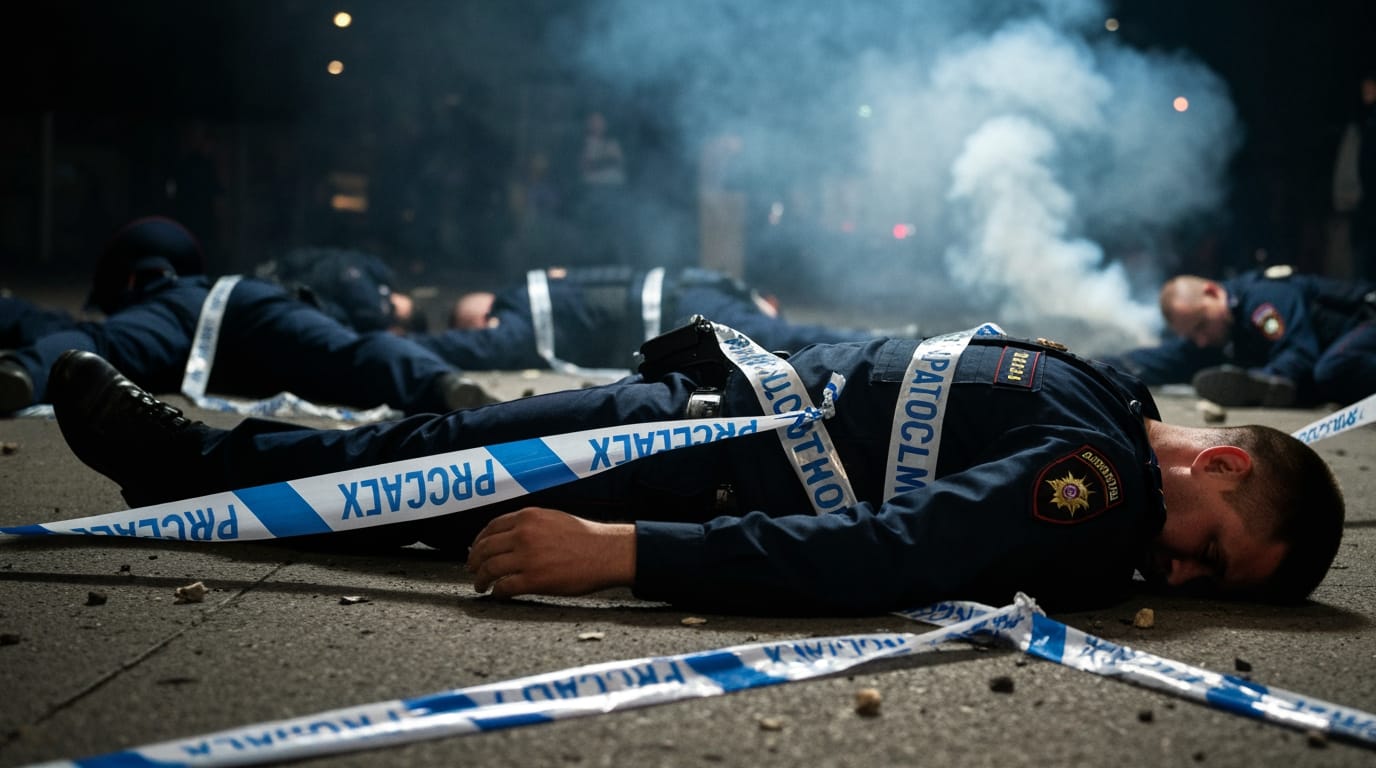
MOSCOW – Two traffic police officers and a third individual died in an explosion that ripped through southern Moscow early Wednesday morning, marking another violent incident in the Russian capital. The blast, occurring on Yeletskaya Street, has prompted a full-scale investigation by Russia's Investigative Committee, focusing on the attempted murder of law enforcement officers and explosives trafficking. This latest event adds to a troubling series of attacks that have challenged Moscow's security in the past year, raising significant concerns across the nation.
The Deadly Encounter on Yeletskaya Street
The fatal incident unfolded in the pre-dawn hours, around 1:30 AM local time, when two traffic police officers approached a suspicious person near their service vehicle. As they engaged the individual, an explosive device was triggered, resulting in an immediate and devastating blast. Both officers succumbed to their injuries, along with the suspect. Russian television broadcasts displayed images of the cordoned-off area, teeming with a large police presence, as investigators began sifting through the wreckage. The victims have been identified as Lieutenant Ilya Klimanov, 24, who joined the Moscow police force in October 2023, and Lieutenant Maxim Gorbunov, 25, a member of the force since February 2023.
Intensive Investigation Underway
Following the explosion, Russia's Investigative Committee swiftly launched a criminal case. Officials have confirmed that an investigation into the "attempted murder of law enforcement officers" and "explosives trafficking" is actively underway. Forensic experts and investigators have converged on Yeletskaya Street to meticulously examine the crime scene and gather evidence, including reviewing CCTV footage from the vicinity. The immediate goal is to determine the precise mechanism of the detonation and to identify any accomplices or broader networks involved in the attack. The gravity of the incident, particularly the targeting of police officers, underscores the heightened security challenges facing Moscow.
Echoes of Recent Violence Across the Capital
This latest explosion on Yeletskaya Street is not an isolated event but rather another grim chapter in a series of violent incidents that have rocked Moscow in recent months. Notably, it occurred just two days after Lieutenant General Fanil Sarvarov, head of the operational training directorate of the Russian military's general staff, was killed in a car bombing in southern Moscow on Monday, December 22. Russian investigators are exploring the possibility that Ukrainian intelligence services orchestrated Sarvarov's assassination, describing it as a likely targeted attack.
The death of Lt. Gen. Sarvarov marked the third such bombing in Moscow within the past year to claim the life of a senior Russian officer linked to the ongoing conflict in Ukraine. Earlier incidents include the killing of Lt. Gen. Igor Kirillov in December 2024 and Lt. Gen. Yaroslav Moskalik in April 2025, both victims of explosive devices. Beyond military targets, the capital has also endured other major security breaches, such as the deadly Crocus City Hall attack in March 2024, which killed over 140 people, and a series of religiously motivated attacks in Dagestan in June 2024 that claimed the lives of at least 15 police officers.
Heightened Security and Calls for Retribution
The recurring nature of these attacks has intensified scrutiny on Moscow's security apparatus and raised public anxiety. Russian officials and prominent pro-war figures have vociferously called for swift retribution in response to the perceived targeting of key personnel and law enforcement. The government faces increasing pressure to not only apprehend those responsible for these acts of violence but also to implement more robust preventive measures to safeguard both state officials and the general populace.
The ongoing investigations into potential foreign involvement, particularly from Ukrainian intelligence services, add a complex geopolitical dimension to the domestic security challenges. As authorities continue their painstaking work on Yeletskaya Street, the immediate focus remains on understanding the full scope of this latest tragedy and preventing further acts of violence in a city increasingly on edge. The events underscore a difficult period for Russia, grappling with internal security threats while engaged in a protracted international conflict.