Albanian PM Alleges Anti-Trump Forces Orchestrating Widespread Protests
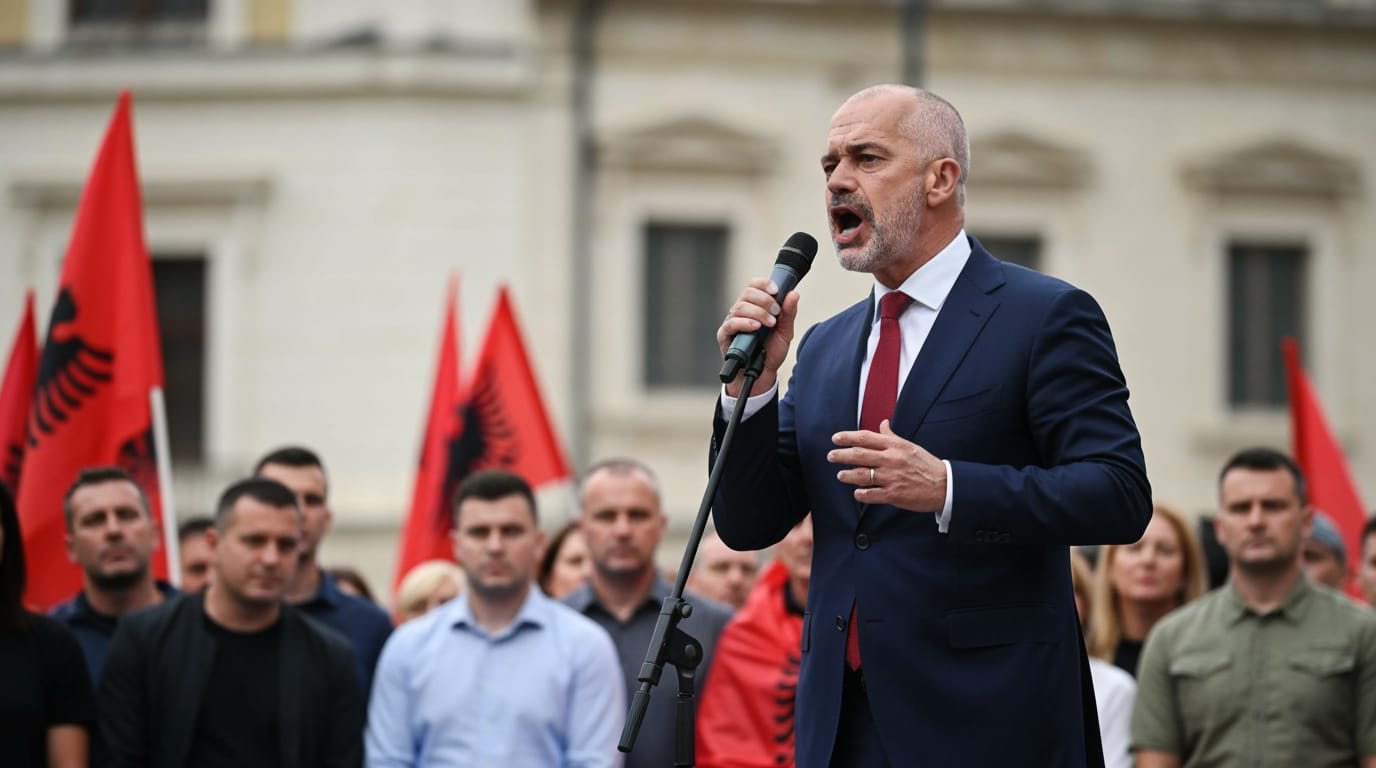
TIRANA, Albania – Albanian Prime Minister Edi Rama has ignited a fierce political debate, accusing ongoing mass protests against a controversial luxury resort project of being fueled by "anti-Trump hostility" and characterizing some demonstrators as possessing a "fascist mentality." His recent remarks come as tens of thousands have taken to the streets in what has been dubbed the "Flamingo Revolution," initially sparked by environmental concerns over a development backed by former U.S. President Donald Trump's son-in-law, Jared Kushner.
Prime Minister Rama, in a recent series of statements and a podcast, has fiercely defended the proposed multi-billion dollar resort on protected coastal lands, asserting that criticism leveled against Albania is rooted in broader political agendas. Speaking to the German Press Agency (dpa) in Berlin, Rama claimed that "Albania has become a platform for anti-Trump anger around the world." He further suggested that negative media reports were motivated by "anti-Trump hostility spilling across borders." This perspective contrasts sharply with his earlier stance in 2016, when he openly declared that a Trump presidency would pose a "threat to America, and undoubtedly, a threat to Albania-US relations." The shift in rhetoric underscores a complex and evolving dynamic between Albania's leadership, internal dissent, and high-profile international business interests.
The "Flamingo Revolution," as it has become known, originated in late May 2026, driven by intense opposition to the planned construction of luxury resorts in ecologically sensitive areas, specifically the Vjosa-Narta delta and on Sazan Island and Zvernec. The projects, linked to Jared Kushner and Ivanka Trump, have stirred a potent mix of environmental activism and anti-corruption sentiment across the Balkan nation. Protesters, many carrying banners reading "Albania is not for sale," cite grave environmental risks to vital wildlife habitats, including a critical lagoon for migratory birds, such as flamingos, which gave the movement its popular name. Beyond ecological concerns, the demonstrations highlight deep-seated public frustration over a perceived lack of transparency surrounding the deals, the prioritization of politically connected investors, and allegations of corruption within the government.
What began as localized environmental protests in Zvërnec quickly escalated into a widespread anti-government movement, with daily demonstrations drawing tens of thousands to the capital, Tirana. These rallies represent some of the largest civic protests seen in Albania since the fall of communism. The movement's demands have broadened significantly to include calls for Prime Minister Rama's resignation, investigations into alleged corruption by the Special Structure against Corruption and Organized Crime (SPAK), and a halt to policies seen as eroding democratic governance. The intensity of the protests has led to clashes with police, involving the use of tear gas, pepper spray, and water cannons, resulting in injuries to both demonstrators and law enforcement officers. An Albanian rights group, the Albanian Helsinki Committee, has expressed concern over the "disproportionate use of force" by police during these confrontations, urging an independent investigation.
Prime Minister Rama has consistently dismissed the environmental criticisms as "misinformation," asserting that the development plan, still undergoing finalization, would transform Albania into a magnet for international investment and attract "big capital." He argues that the government is handling negotiations with "dignity and professionalism" and that the projects are not "selling out" Albania, as protesters claim. Kushner's investment firm has been granted "Strategic Investor Status" by the Albanian government, a designation that facilitates such large-scale developments. Despite the escalating tensions, Rama has remained steadfast in his support for the project, suggesting that preliminary work, though temporarily paused due to pressure, has not been formally suspended and that environmental assessments will be conducted in full compliance with EU criteria.
Analysts suggest that the protests, while directly challenging the Trump-linked development, tap into a broader reservoir of discontent concerning issues of autocracy, state capture, and the rule of law. Some observers interpret the situation as Albania finding itself caught in a larger geopolitical dynamic, where the protests might be seen as a challenge not only to local governance but also to the perceived influence of the Trump family on the international stage. Despite Albania's consistent pro-Western and Euro-Atlantic foreign policy orientation, maintaining strong ties with the United States across various administrations, the current controversy tests the limits of this strategic partnership against the backdrop of domestic political unrest. The "Flamingo Revolution" thus embodies a critical juncture for Albania, reflecting a population increasingly assertive in demanding transparency, accountability, and environmental protection, even as its leaders navigate complex international alliances and business interests.


