Argentina's Universities Erupt: Mass Protests Challenge Milei's Austerity Measures
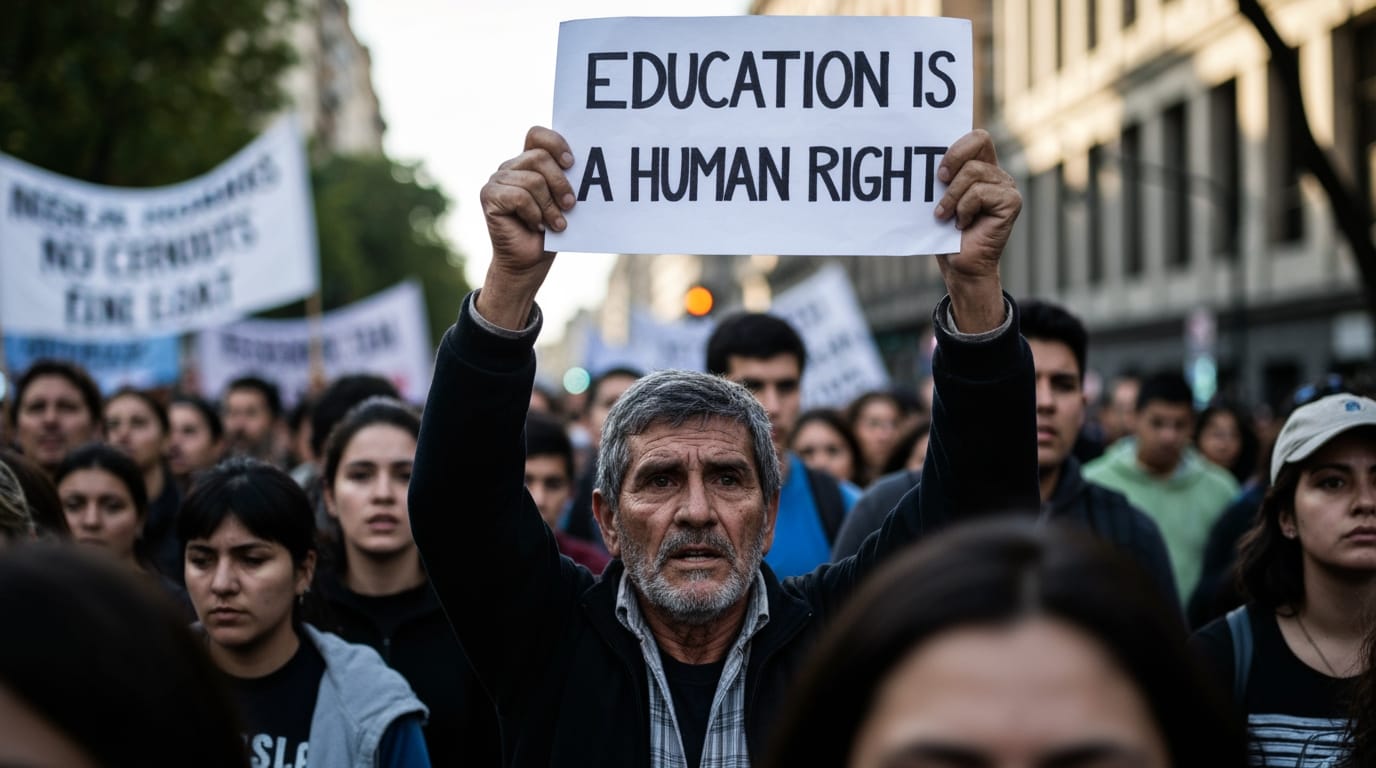
BUENOS AIRES, Argentina – Hundreds of thousands of Argentines have poured into the streets across the nation, forming a powerful wave of dissent against President Javier Milei's drastic budget cuts to public universities. The protests, marked by impassioned students, faculty, alumni, and labor unions, underscore a profound national commitment to free public education and represent one of the most significant challenges yet to the libertarian president's sweeping austerity agenda. As universities declare financial emergencies and struggle to maintain basic operations, the future of Argentina's esteemed higher education system hangs in the balance, igniting a fierce debate over fiscal responsibility versus the preservation of a cherished social pillar.
A Sea of Books and Banners: The Scale of Public Outcry
The demonstrations, which peaked with a massive march on April 23, 2024, saw estimates of participants ranging from hundreds of thousands to over a million people across Argentina. Major cities like Buenos Aires, Cordoba, and Rosario became focal points for the movement, as protesters carried books, signs demanding "Defend the public universities," and chanted slogans asserting that "Studying is a right." The sheer breadth of participation is notable, drawing not only the academic community but also labor unions, opposition parties, and even some individuals who had voted for President Milei in the previous election, all united in their alarm over the proposed cuts. The public university system, which has been tuition-free since 1949 and has produced five Nobel laureates, holds a deep-seated place of pride and significance within Argentine society, serving as a critical pathway for social mobility for generations. This deeply ingrained value explains the widespread and fervent response to the government's policies.
The protests intensified following President Milei's veto of a law passed by Congress that aimed to increase funding for public universities and raise teacher salaries to keep pace with soaring inflation. University rectors and student leaders have warned that without adequate funding, many institutions face the risk of closure, a prospect that galvanizes broad sections of the population. Public classes held in the streets and occupations of university buildings underscore the creative and determined resistance from students and faculty alike, demonstrating their refusal to allow the education system to collapse.
Milei's "Chainsaw" and the Rationale for Austerity
President Javier Milei, who took office in December, campaigned on a promise to use a "chainsaw" to drastically cut public spending and reduce Argentina's budget deficit to zero, aiming to curb hyperinflation that reached nearly 290% annually. His administration views the university budget cuts as an essential component of this broader austerity drive, necessary to stabilize the national economy and achieve fiscal surplus targets, some of which are aligned with agreements with the International Monetary Fund.
From the government's perspective, the measures are a painful but unavoidable step to rectify decades of what it describes as reckless spending and corruption under previous left-leaning administrations. Presidential spokesperson Manuel Adorni has defended the government's stance, arguing that public education has been in decline for years and that the administration has no desire to close universities but rather seeks to monitor their budgets. Milei himself has expressed skepticism about public universities, attacking them as "bastions of 'woke' indoctrination" and suggesting they are used for "shady business." While his government has provided some marginal increases for operational costs, these have been widely rejected as insufficient by university officials and unions, representing only about 3% of the total budget needed for 2024.
The Crippling Impact on Higher Education
The budget cuts have had an immediate and severe impact on Argentina's 57 state-run universities. Funding for public universities fell by approximately 30% in real terms in 2024, with projections indicating a further decline, potentially reaching 35-36% lower than 2023 levels by 2025. One report suggested a staggering 68% reduction in university incomes in 2024. These drastic reductions have triggered a financial emergency across the university system.
The consequences are far-reaching:
- Operational Strain: Universities have been forced to implement extreme cost-saving measures, including turning off lights, air conditioning, and even hot water to manage energy bills that have surged by nearly 500% monthly. The prestigious University of Buenos Aires (UBA) was compelled to suspend some medical procedures at its Hospital de Clínicas, directly impacting public health services.
- Faculty and Staff Distress: University professors and staff have seen their purchasing power plummet, with salaries declining by roughly 30-40% in real terms since December 2023. An associate professor now earns an average of $320 per month, while a teaching assistant earns as little as $120. This has led to a growing number of resignations, with many experienced educators and researchers leaving the public system for private institutions or seeking opportunities abroad, raising concerns about a potential "brain drain."
- Research in Peril: Funding for scientific research has been "choked off almost entirely," with grants frozen and projects left in limbo. Researchers describe 2024 as a "lost year" for science, with a significant drop in the public science and technology budget. This threatens Argentina's scientific output and its capacity for innovation.
- Student Hardship: Budget shortfalls have exacerbated challenges for students, with reports of increased academic dropout rates because some can no longer afford transportation to classes. Scholarships for low-income students have also decreased by about 40%, further limiting access to higher education for the most vulnerable.
- Academic Compromises: Universities are operating in "survival mode," freezing salaries, delaying infrastructure repairs, cutting research, shortening semesters, and reducing course offerings. Some institutions have even merged departments or cut non-essential services to stay afloat.
A Battle on Multiple Fronts: Political and Legal Challenges
The confrontation over university funding is playing out not only in the streets but also within the halls of power and the judicial system. Congress passed a law designed to fund universities' operational costs and raise teacher salaries in line with inflation, reflecting a widespread political consensus on the importance of public education. However, President Milei promptly vetoed this legislation, arguing that it disproportionately increased public spending without specifying how such increases would be covered during a period of harsh fiscal austerity.
Despite Milei's veto, both chambers of Congress rejected his decision, effectively making the bill law. Yet, the government has resisted implementing it, suspending its execution and appealing to the Supreme Court, asserting that the law cannot take effect until the funding source is established. In response, university rectors and associations have filed legal challenges. Federal courts have begun to rule against the government, ordering immediate compliance with the law regarding salaries and scholarships, citing "irreparable damage" if implementation is further delayed. This legal battle highlights the deep institutional and ideological divide within Argentina over the future of its public services.
Conclusion: A Nation at a Crossroads
The widespread protests against President Milei's university cuts reveal a nation grappling with the profound implications of radical economic reform. While the government maintains that fiscal austerity is paramount for long-term stability, a significant portion of Argentine society views free, high-quality public education as a non-negotiable right and a cornerstone of national identity and progress. The crisis threatens not only the operational viability of universities but also the nation's scientific capabilities, its capacity for social mobility, and the global standing of its academic institutions.
The ongoing demonstrations, legal battles, and political maneuvering indicate that the debate over university funding is far from over. It is a critical test of President Milei's reform agenda and a powerful assertion by Argentines of their commitment to an educational legacy that they believe is essential for the country's future. The resolution of this conflict will undoubtedly shape Argentina's social and intellectual landscape for years to come.