Bipartisan U.S. Delegation Reaffirms Sovereignty in Copenhagen Amidst Greenland Tensions
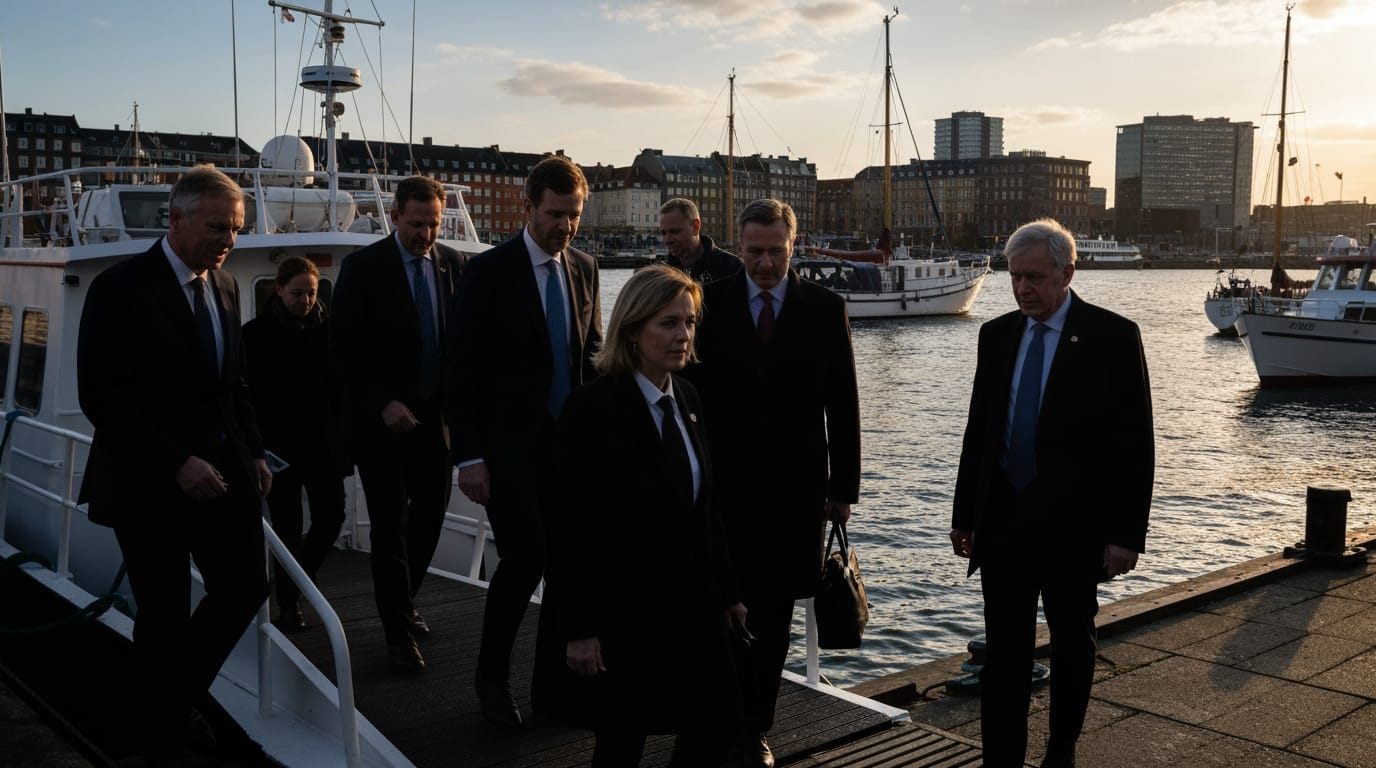
COPENHAGEN – A bipartisan delegation of U.S. lawmakers arrived in the Danish capital this week, embarking on a critical diplomatic mission to reaffirm congressional support for Denmark and Greenland's sovereignty. The visit comes at a fraught moment in transatlantic relations, marked by renewed pressure from U.S. President Donald Trump to acquire the strategically vital Arctic island, prompting concerns over the integrity of long-standing alliances and regional stability. Led by Senator Chris Coons (D-Del.), the 11-member group is scheduled to meet with top Danish and Greenlandic officials, aiming to underscore a message of partnership and respect, a stark contrast to recent rhetoric emanating from the White House.
The congressional visit follows a series of escalating remarks from President Trump, who has not ruled out the use of force to obtain Greenland, citing its national security importance and rich mineral deposits. Such declarations have triggered profound unease in Copenhagen and Nuuk, Greenland's capital, where leaders have consistently maintained that the autonomous territory is "not for sale" and its future is a matter of self-determination. This diplomatic overture from Capitol Hill seeks to mitigate the damage caused by executive-level provocations, emphasizing that a significant segment of U.S. leadership remains committed to respectful engagement and alliance-building in the rapidly evolving Arctic landscape.
A Divergence in Washington: Congress Signals Steadfast Alliance
The U.S. delegation, which includes prominent Republican and Democratic senators such as Thom Tillis (R-N.C.), Lisa Murkowski (R-Alaska), Jeanne Shaheen (D-N.H.), and Dick Durbin (D-Ill.), alongside several House representatives, met Friday with Danish Prime Minister Mette Frederiksen and Greenlandic Prime Minister Jens-Frederik Nielsen. Senator Coons articulated the delegation's purpose: "At a time of increasing international instability, we need to draw closer to our allies, not drive them away." This sentiment directly addresses the alarm raised by President Trump's persistent pursuit of Greenland, which has been widely criticized for undermining the NATO alliance and playing into the hands of adversaries like Russia and China.
The congressional push for reassurance follows high-level talks earlier in the week in Washington, where Danish Foreign Minister Lars Lokke Rasmussen and Greenlandic Foreign Minister Vivian Motzfeldt engaged with U.S. Vice President J.D. Vance and Secretary of State Marco Rubio. Danish officials confirmed that those meetings ended with a "fundamental disagreement" over Greenland's future, as the U.S. administration's position on acquisition remained unchanged. The bipartisan congressional delegation's presence in Copenhagen thus serves as a critical counter-narrative, aiming to demonstrate that the executive branch's stance does not universally reflect U.S. foreign policy principles or congressional will.
Greenland: A Recurring American Ambition Meets Resolute Rejection
U.S. interest in Greenland is not a novel concept, dating back to 1867 when the U.S. State Department assessed its strategic value. President Harry Truman famously offered to purchase the island for $100 million in 1946, an offer Denmark rejected. However, the current iteration of this ambition, primarily driven by President Trump, has introduced an unprecedented level of diplomatic strain. His administration has repeatedly framed the acquisition as vital for U.S. national security, particularly in monitoring Russian and Chinese activities in the Arctic and securing access to Greenland's vast reserves of rare earth minerals and other critical resources. In early January 2026, President Trump reiterated his stance, suggesting the U.S. would pursue ownership "the easy or the hard way," while a Republican congressman, Representative Randy Fine, even introduced a "Greenland Annexation and Statehood Act."
However, the response from Nuuk and Copenhagen has been unwavering. Greenlandic authorities, exercising their right to self-determination as an autonomous territory within the Kingdom of Denmark, have unequivocally stated that the island is not for sale and will not be governed or owned by the U.S. Danish Prime Minister Frederiksen warned that an American takeover would "mark the end of NATO." This firm stance highlights a core principle of international law and underscores the deep-seated cultural and political ties that bind Greenland to Denmark.
The Arctic's Geopolitical Chessboard: Minerals, Military, and Melting Ice
Greenland's immense strategic value is undeniable and multifaceted. Positioned between North America and the Arctic, it hosts the Pituffik Space Base (formerly Thule Air Base), a crucial U.S. military installation that has served as a cornerstone of missile warning, space surveillance, and NATO's deterrence strategy for decades. This military presence, established through a 1951 defense agreement, grants the U.S. significant access, though it explicitly respects Danish sovereignty.
Beyond its military significance, the accelerating melt of the Arctic ice sheet, a direct consequence of climate change, is unveiling new shipping routes and exposing rich deposits of critical minerals. Greenland boasts the world's eighth-largest reserves of rare earth elements, with estimated deposits of 1.5 million tons, including significant sites like Kvanefjeld and Tanbreez. These minerals are essential for modern technologies, from electronics to defense systems, making Greenland a coveted prize in an era of heightened resource security concerns and supply chain vulnerabilities. The escalating competition for Arctic resources and strategic positioning has seen Russia modernize its Arctic bases and China expand its scientific and commercial footprint, further intensifying the geopolitical stakes.
Strengthening Resilience: Denmark and Greenland's Response
In response to the heightened U.S. interest and the broader geopolitical shifts in the Arctic, Denmark and Greenland have taken concrete steps to bolster their own capabilities and underscore their commitment to regional security within the framework of NATO. Denmark announced plans to increase its military presence in Greenland, including more personnel, patrol ships, long-range drones, and upgrades to an airport to accommodate Danish F-35 fighter aircraft. This move followed American demands for increased Danish defense spending, particularly concerning Greenland's defense. Furthermore, European nations have sent military personnel to the island at Denmark's request, demonstrating collective support for Danish and Greenlandic sovereignty.
Greenlandic leaders have also expressed a willingness to deepen cooperation with the United States on security matters, provided it respects their territorial integrity and international law. They have also indicated that an independent Greenland would seek to join NATO, further solidifying the island's alignment with Western alliances. These actions collectively signal a determination to protect their autonomy and contribute to Arctic stability on their own terms.
Conclusion: Navigating a Complex Arctic Future
The bipartisan U.S. congressional delegation's visit to Copenhagen underscores the complex and often contradictory dynamics shaping contemporary U.S. foreign policy and the future of the Arctic. While President Trump's persistent calls for acquiring Greenland have created significant diplomatic friction, the congressional mission serves as a vital reminder of the enduring strength of the U.S.-Danish alliance and a commitment to respecting the sovereignty of partners.
Greenland remains a crucial geopolitical flashpoint, its strategic location, vast mineral wealth, and the opening of new maritime routes due to climate change ensuring its continued prominence on the international stage. The ongoing dialogue, even amid "fundamental disagreement," highlights the intricate balance required to navigate these challenges. As the Arctic continues to transform, maintaining robust alliances, respecting sovereignty, and fostering collaborative security efforts will be paramount for ensuring regional stability and prosperity. The message from Capitol Hill in Copenhagen is clear: despite executive-level differences, the U.S. Congress views Denmark and Greenland as invaluable partners whose sovereignty is to be honored, not threatened.


