Bolsonaro Backs Son Flávio for 2026 Presidential Bid, Setting Stage for High-Stakes Election
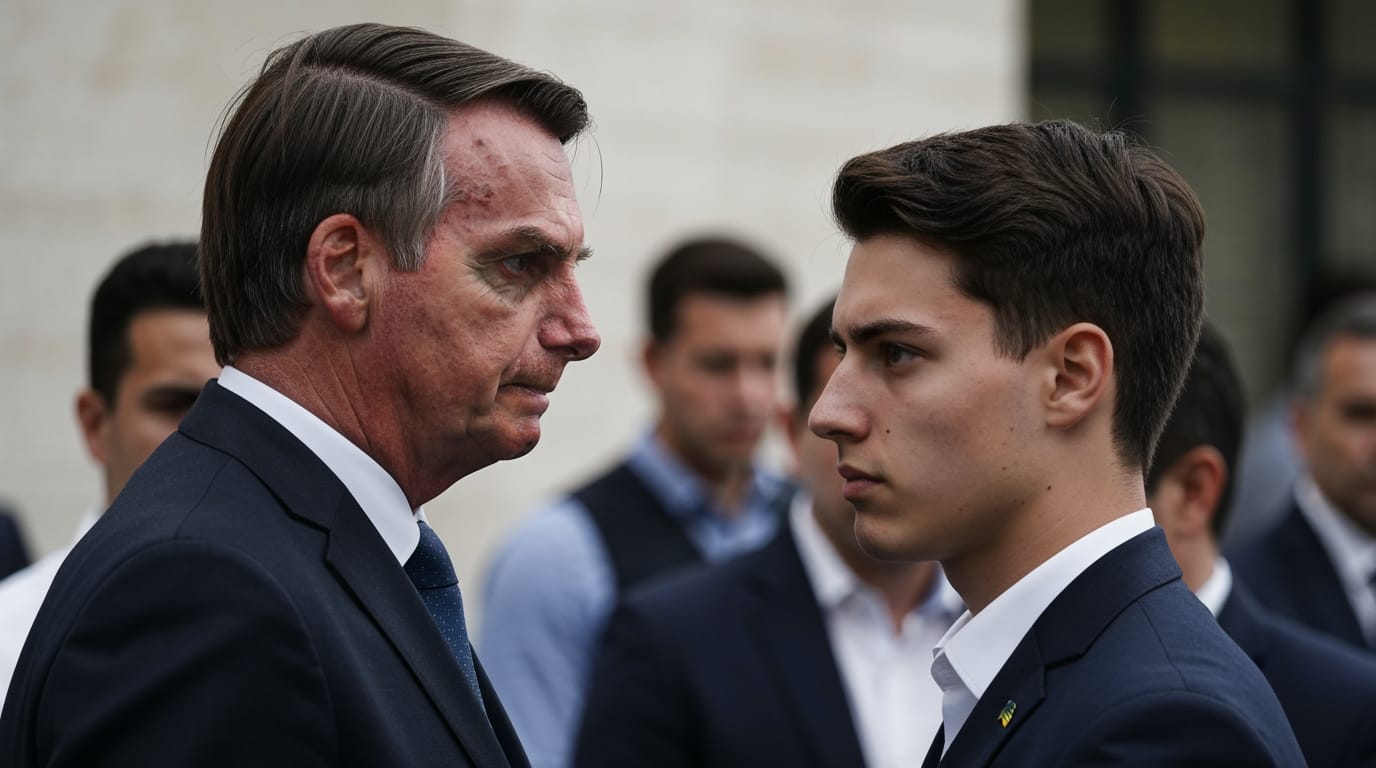
BRASÍLIA – Former Brazilian President Jair Bolsonaro has officially endorsed his eldest son, Senator Flávio Bolsonaro, as the Liberal Party's (PL) candidate for the 2026 presidential election, a move that signals a determined effort by the Bolsonaro family to maintain its political dynasty despite the patriarch's ongoing imprisonment. The announcement, confirmed by Jair Bolsonaro himself and the PL leadership, sets the stage for what is anticipated to be a highly polarized electoral contest against incumbent President Luiz Inácio Lula da Silva.
The endorsement was publicly declared in early December 2025 by Flávio Bolsonaro and later reinforced by a letter from the former president on December 25, coinciding with Jair Bolsonaro's hospitalization for hernia surgery. This decisive backing puts an end to speculation about other potential right-wing candidates, including former First Lady Michelle Bolsonaro or São Paulo Governor Tarcísio de Freitas, who some investors had hoped would be a more market-friendly choice. The nomination underscores Jair Bolsonaro's enduring influence over the far-right political landscape, even as he serves a 27-year prison sentence for his involvement in plotting a coup following the 2022 election.
The Endorsement and Its Immediate Repercussions
Senator Flávio Bolsonaro, 44, formally announced his intention to run for president on December 5, 2025, via social media, articulating a mission to continue his family's political legacy and counter the current left-leaning administration. The Liberal Party's president, Valdemar Costa Neto, swiftly confirmed the endorsement, stating, "As president of the PL, I inform you that Senator Flavio Bolsonaro is the name selected by Jair Bolsonaro to represent the party in the presidential race." Costa Neto added that if Bolsonaro spoke, "it's settled!"
The news reverberated through Brazilian financial markets, leading to an immediate negative reaction. The currency fell by as much as 3% against the U.S. dollar, and the benchmark Bovespa stock index dropped around 4%. Investors had largely favored a candidate with executive experience, such as Governor de Freitas, believing he could foster broader alliances between the right-wing movement and more centrist parties. Andre Perfeito, an economist at Garantia Capital, warned that the decision could "implode" ties between Bolsonaro's right-wing base and centrist factions.
The endorsement also sparked some internal divisions within the far-right. Reports indicate that some prominent supporters expressed surprise and even anger at the unilateral decision, with some questioning the timing and Flávio's "political muscle." Criticism emerged regarding the former president making such a pivotal decision from prison, with some observers suggesting it might alienate centrists within conservative circles.
Flávio Bolsonaro: A "More Centered" Vision
Flávio Bolsonaro has positioned himself as a pragmatic continuation of his father's political project, seeking to moderate the family's often-combative image. In interviews, he described himself as "a more centered Bolsonaro," emphasizing a profile that is "more moderate, more measured." He aims to build a platform focused on smaller government, tax cuts, and privatizations, aligning with traditional conservative economic principles. Notably, he has attempted to distance himself from the "culture wars" that often characterized his father's presidency, even mentioning that he received AstraZeneca COVID-19 vaccines, unlike his father who publicly eschewed them.
Flávio's political career includes serving as a state lawmaker in Rio de Janeiro before being elected to the Senate in 2018, the same year his father won the presidency. He now pledges to uphold market-friendly reforms and modernize the state, stressing predictability and competence in his economic program. His strategy appears to be an attempt to unify the right-wing vote and appeal to a broader electorate, although this approach faces skepticism from political analysts and some within the right-wing base.
The Enduring Influence of the Bolsonaro Dynasty
The endorsement highlights the continued, albeit modified, political influence of Jair Bolsonaro, even from behind bars. The former president is considered the honorary leader of the Liberal Party and continues to rally a significant conservative base. His incarceration, following a conviction for a coup plot in the aftermath of the 2022 elections, has prevented him from seeking office until 2030, necessitating a successor to carry the family's banner.
The Bolsonaro family has long been deeply entrenched in Brazilian politics, often blurring the lines between family and governance. Jair Bolsonaro's three eldest sons—Flávio, Eduardo, and Carlos—have all held elected positions and have been vocal proponents of their father's agenda. Eduardo Bolsonaro, a federal lawmaker, gained prominence for his outspoken support of his father and his efforts to lobby international figures like former U.S. President Donald Trump regarding his father's legal challenges. However, these interventions have not been without controversy, with Eduardo himself facing legal scrutiny for alleged obstruction of justice. Carlos Bolsonaro, a Rio de Janeiro city councilman, has been instrumental in shaping the family's digital communications strategy and maintaining a strong social media presence.
The family has also faced numerous accusations of corruption and questionable financial dealings over the years, which have complicated their anti-corruption rhetoric. Despite these challenges, Jair Bolsonaro's sustained grip on his loyal base underscores the power of personal endorsements in Brazilian politics.
The 2026 Presidential Landscape
Flávio Bolsonaro's entry into the presidential race sets the stage for a rematch of sorts between the Bolsonaro family and the Workers' Party (PT) led by President Lula da Silva. Lula, now 80, has announced his intention to seek a fourth non-consecutive term, reassuring supporters of his vigor. Early polls suggest Lula currently holds a lead, though the election is still over nine months away.
The upcoming election is expected to be a fiercely contested battle, further solidifying Brazil's deep political divisions. While Flávio Bolsonaro aims to unite the right and present a more moderate image, the path to victory remains complex. Polls currently show Flávio trailing Lula by double digits, while other potential right-wing candidates, like Tarcísio de Freitas, were polling closer to the incumbent. This fragmentation within the right could pose a significant challenge for Flávio Bolsonaro in building the broad coalition needed to unseat an incumbent president. Political analysts warn that without a unified front, the right risks losing the election to Lula.
In conclusion, Jair Bolsonaro's endorsement of his son Flávio marks a critical juncture in Brazilian politics. It signifies the Bolsonaro family's determination to extend its political influence and continue its "project for the nation" amidst the former president's imprisonment. As Flávio Bolsonaro embarks on a campaign to moderate his family's legacy while upholding conservative tenets, the 2026 presidential election promises to be a pivotal contest, shaping the future direction of Brazil's governance and ideology.


