Cambodia Relies on Colonial Era Maps to Bolster Stance in Enduring Border Dispute with Thailand
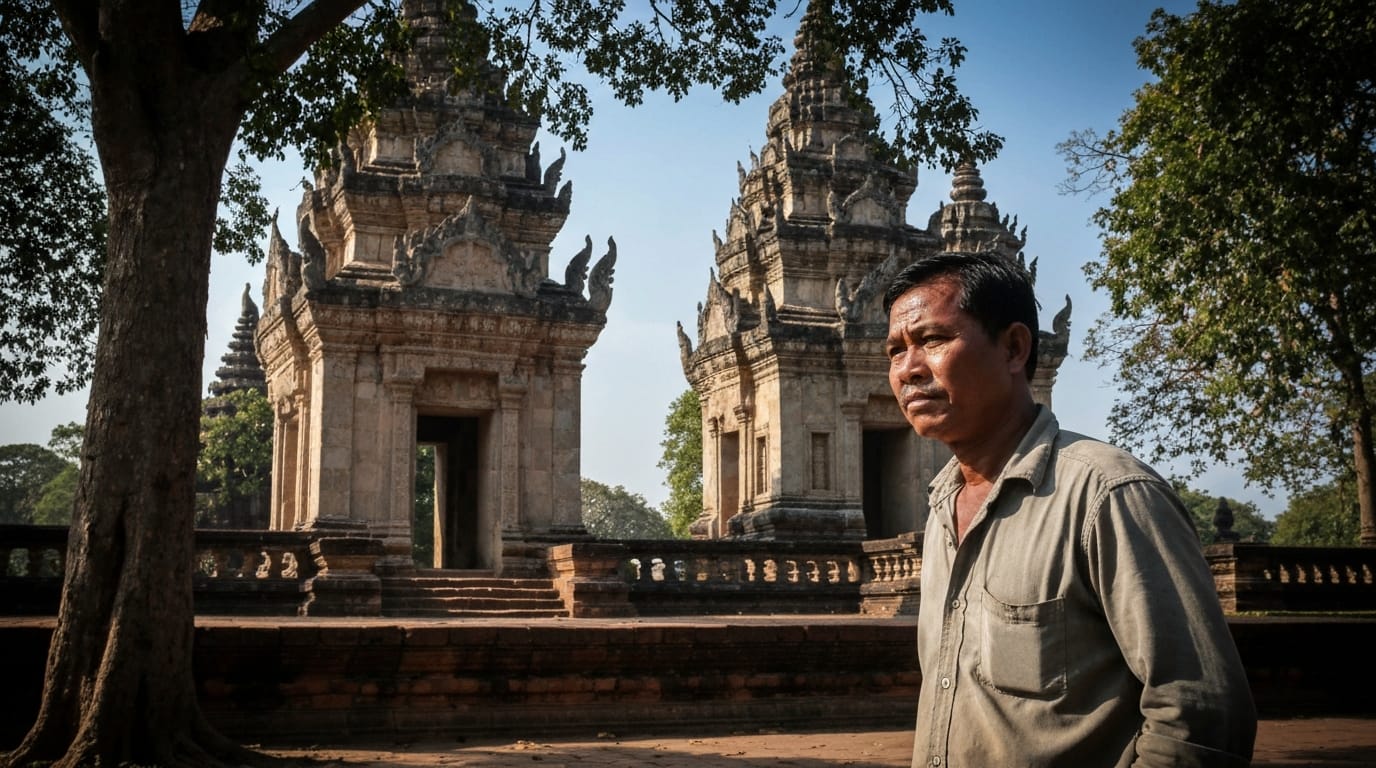
For decades, the ancient Hindu temple of Preah Vihear, perched atop a cliff overlooking Cambodia’s northern plains, has been a flashpoint of contention between Cambodia and Thailand. Now, as both nations continue to navigate the intricate and often fraught relationship surrounding their shared border, Cambodia is intensifying its reliance on historical French colonial maps, particularly a key 1907 document, hoping these cartographic artifacts will definitively vindicate its territorial claims in the long-running dispute. The diplomatic stakes are high, with national pride, sovereignty, and regional stability hanging in the balance, as two Southeast Asian neighbors grapple with a legacy of colonial cartography.
The heart of the dispute lies not just with the 11th-century Preah Vihear temple itself, a UNESCO World Heritage site revered for its exquisite Khmer architecture, but with the surrounding 4.6-square-kilometer territory. While the International Court of Justice (ICJ) definitively ruled in 1962 that the temple belonged to Cambodia, that judgment did not explicitly delineate the precise border in the adjacent contested area. This ambiguity has fueled intermittent clashes, diplomatic stalemates, and a persistent source of friction, transforming a shared historical and cultural heritage into a symbol of unresolved territorial claims. The temple’s strategic location, offering panoramic views, further underscores its perceived importance beyond its cultural value, representing a significant marker of national identity for both peoples.
Central to Cambodia’s argument is the "Annex I map," a meticulously drawn document produced by a Franco-Siamese Border Commission in 1907. During that period, Cambodia was a French protectorate, while Thailand was then known as Siam. The map, a product of negotiations and surveys between French colonial authorities and Siamese representatives, depicts the border line placing Preah Vihear and the contested territory firmly within Cambodian jurisdiction. Cambodia asserts that this map, which was officially communicated to Siam and subsequently used in international legal proceedings, represents the mutually recognized and binding demarcation. From Phnom Penh’s perspective, the map is not merely a historical relic but a foundational legal document, reflective of an era when borders were being formally established across Southeast Asia by colonial powers and regional kingdoms. The continued rejection of this map, Cambodia contends, undermines established international agreements and the very principle of uti possidetis juris, which respects colonial-era boundaries as the basis for new independent states.
Thailand, however, maintains a different interpretation of these historical documents and the broader context. While acknowledging the 1962 ICJ ruling regarding the temple’s sovereignty, Bangkok disputes the precise line drawn on the Annex I map, especially concerning the 4.6-square-kilometer area. Thai authorities contend that the 1907 map was never officially ratified by the Siamese parliament, nor was it always consistent with other demarcation principles of the era, such as the natural watershed boundary that often dictated divisions in mountainous regions. Thailand argues that parts of the map contradict these natural geographical features and therefore should not be the sole determinant of the modern international boundary. Furthermore, Thailand emphasizes the practical implications of such a demarcation, asserting that it would result in the loss of territory historically and culturally tied to the Thai people, often highlighting the need for a practical and mutually acceptable solution rather than a strict adherence to a single colonial map. This stance underscores a deeply rooted sense of national sovereignty and a reluctance to concede territory based on what it perceives as an incomplete or unilaterally imposed historical document.
The dispute has not been confined to legal arguments and diplomatic exchanges; it has frequently escalated into armed confrontations along the border, particularly in the immediate vicinity of Preah Vihear. Following the temple's inscription as a UNESCO World Heritage site in 2008, tensions flared, leading to a series of deadly clashes in 2008, 2009, and most notably in 2011, which displaced thousands of civilians on both sides and resulted in numerous casualties. These military skirmishes drew international condemnation and calls for restraint from the United Nations and regional bodies like the Association of Southeast Asian Nations (ASEAN). In 2013, the ICJ issued a clarification of its 1962 ruling, affirming Cambodia's sovereignty over the entire promontory on which the temple stands and ordering Thai troops to withdraw from the area. While this ruling provided some clarity on the temple grounds, the broader territorial demarcation remained a point of contention, leaving local communities in a state of perpetual uncertainty and threatening the fragile peace along the border. The human cost of this unresolved dispute is profound, impacting livelihoods, disrupting cross-border trade, and sowing fear among residents who live daily with the specter of renewed hostilities.
Looking ahead, the path to a definitive resolution remains complex and politically charged for both nations. For Cambodia, the French maps represent a clear, historical, and legally defensible basis for its claims, offering a framework that it believes international law should uphold. For Thailand, the issue is not merely about an old map but about national sovereignty, historical continuity, and the protection of its territorial integrity. Resolving this deep-seated dispute would undoubtedly foster greater regional stability, unlock economic potential through enhanced cross-border trade and tourism, and allow both nations to focus on shared challenges such as sustainable development and cultural preservation. However, given the strong nationalist sentiments on both sides and the differing interpretations of historical agreements and cartography, a lasting solution will likely require sustained diplomatic engagement, a willingness to compromise, and potentially further international mediation. Until then, the ancient stones of Preah Vihear continue to stand as a silent witness to a modern territorial puzzle, awaiting a resolution that honors history while securing a peaceful future.