China Intensifies Military Drills Around Taiwan, Fires Rockets in Simulated Blockade
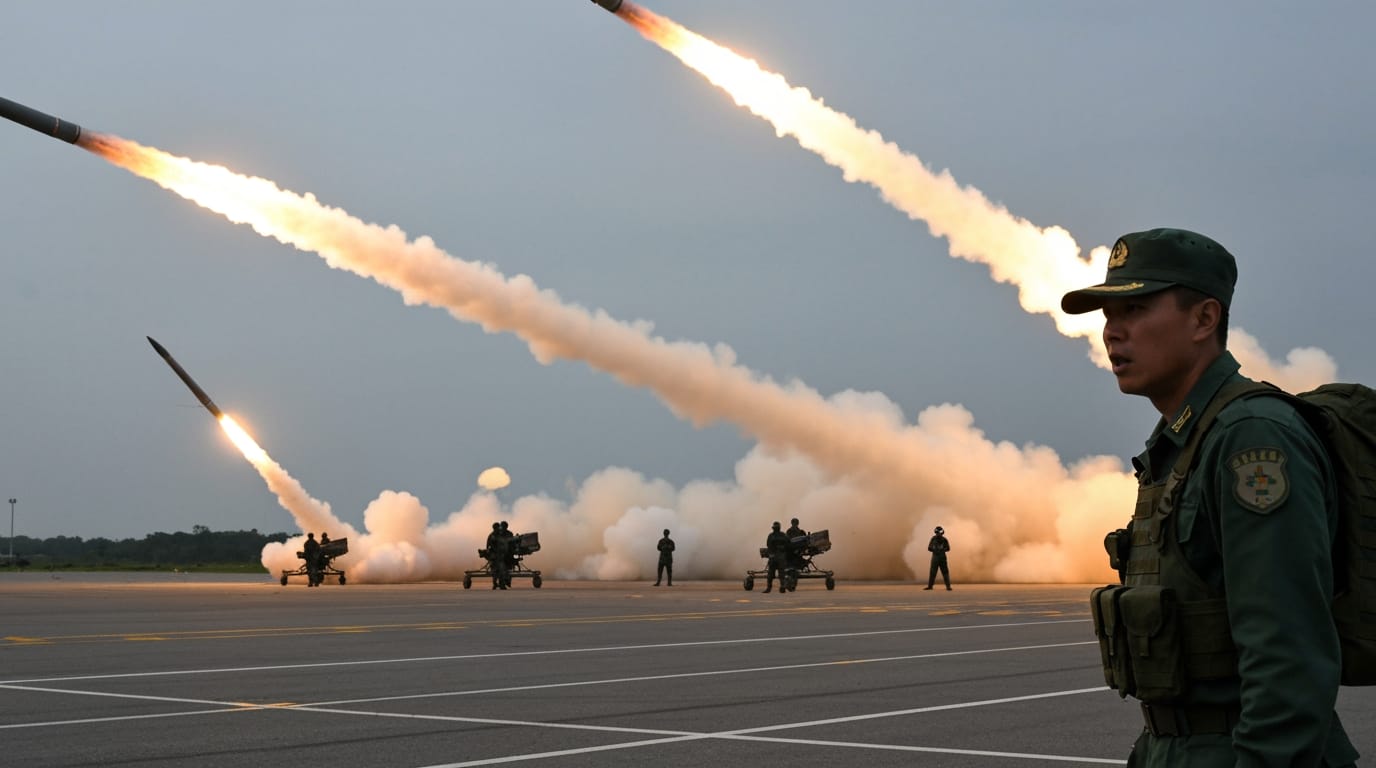
Taipei, Taiwan – China's military on Tuesday unleashed a barrage of rockets and deployed a formidable array of naval and air assets on the second day of extensive live-fire drills around Taiwan, escalating tensions in the critical Indo-Pacific region. The exercises, code-named "Justice Mission 2025," are widely seen as a potent warning against what Beijing perceives as "Taiwan Independence" separatist forces and external interference, simulating a full blockade of the self-governed island. Taiwan, in response, condemned the actions as "highly provocative and reckless" and moved its forces to high alert, underscoring the delicate balance of power in one of the world's most significant geopolitical flashpoints.
Live-Fire Escalation and Comprehensive Drills
The People's Liberation Army (PLA) Eastern Theater Command confirmed that its ground forces conducted long-range live-fire drills to the north of Taiwan, achieving "desired effects." Reports from AFP journalists on Pingtan, a Chinese island closest to Taiwan, observed at least 10 rockets launched in quick succession on Tuesday morning, leaving trails of white smoke across the sky. These rocket firings were part of broader military exercises that involved destroyers, frigates, fighter jets, bombers, and China's massive Type 075 amphibious assault ship, marking its first appearance in drills around the island.
The "Justice Mission 2025" drills, which commenced on Monday and were expected to conclude by 6 p.m. local time on Tuesday, encompassed simulated strikes, assaults on maritime targets, and anti-air and anti-submarine operations in waters north and south of Taiwan. Beijing's state broadcaster CCTV reported that a core theme of the exercises was to practice blockading key Taiwanese ports, including Keelung in the north and Kaohsiung in the south. Taiwan's Defense Ministry detected 130 Chinese military aircraft and 22 vessels near the island within a 24-hour period, with 90 warplanes reportedly crossing the median line of the Taiwan Strait and entering Taiwan's air defense identification zone—the second-highest number on record for a single day.
Geopolitical Undercurrents and Beijing's Stance
China views Taiwan, a democratically governed island, as an inseparable part of its territory, a stance reiterated by Beijing's Foreign Ministry spokesperson Lin Jian, who stated that any attempt to obstruct China's unification with the island "will inevitably end in failure." The spokesperson for the PLA Eastern Theater Command, Senior Colonel Shi Yi, declared the drills a "stern warning against 'Taiwan Independence' separatist forces" and a "legitimate and necessary action to safeguard China's sovereignty and national unity."
These latest exercises follow recent developments that have drawn Beijing's ire. Specifically, they come 11 days after the United States announced a record $11.1 billion arms package to Taiwan, a move strongly condemned by China. Additionally, remarks by Japan's Prime Minister Sanae Takaichi last month, suggesting Japan could intervene militarily in a crisis over Taiwan, also contributed to the heightened Chinese rhetoric. China's top diplomat Wang Yi emphasized that China would "forcefully counter" large-scale U.S. weapons sales to Taiwan.
Taiwan's Response and International Concerns
Taiwanese President Lai Ching-te condemned China's actions, stating that Beijing's conduct was "far from what would be expected of a responsible major power." However, he also struck a calming note, assuring that Taiwan would "act with responsibility—neither escalating tensions nor provoking conflict." Taiwan's Defense Ministry accused China of being the "biggest destroyer of peace" and confirmed that rapid-response exercises were underway, with forces placed on high alert. The island's coast guard also deployed vessels to monitor Chinese naval activity, shadowing the ships in a "one-on-one" approach.
The drills significantly impacted regional commerce and travel. Taiwan's Civil Aviation Authority reported that 11 of Taipei's 14 flight routes were affected, impacting more than 100,000 passengers and disrupting 941 flights. Exclusion zones declared by China, some within 12 nautical miles of Taiwan's coast, forced commercial airlines to reroute and created significant disruptions to international shipping, affecting global supply chains. The Taiwan Strait is one of the world's busiest shipping lanes, with nearly half of the world's container shipping fleet transiting it annually.
Broader Implications and Future Outlook
These military exercises represent the sixth major round of war games conducted by China around Taiwan since former U.S. House Speaker Nancy Pelosi's visit in August 2022, which also triggered unprecedented drills and missile launches, some landing in Japan's exclusive economic zone. Analysts note a pattern of increasing intensity and frequency in these drills, blurring the lines between routine training and potential preparations for a full-scale assault. Beijing's consistent demonstration of its ability to blockade Taiwan highlights a strategic intent to deter international intervention and assert its claims over the island.
While China prefers peaceful reunification, it has consistently refused to rule out the use of force. The ongoing drills serve as a powerful signal of Beijing's resolve, raising concerns about regional stability and the potential for miscalculation. The international community continues to watch closely as China's military posturing around Taiwan intensifies, with significant implications for global trade, security, and the future of self-governed democracies in the region.


