China Launches Large-Scale Military Drills Around Taiwan, Escalating Tensions
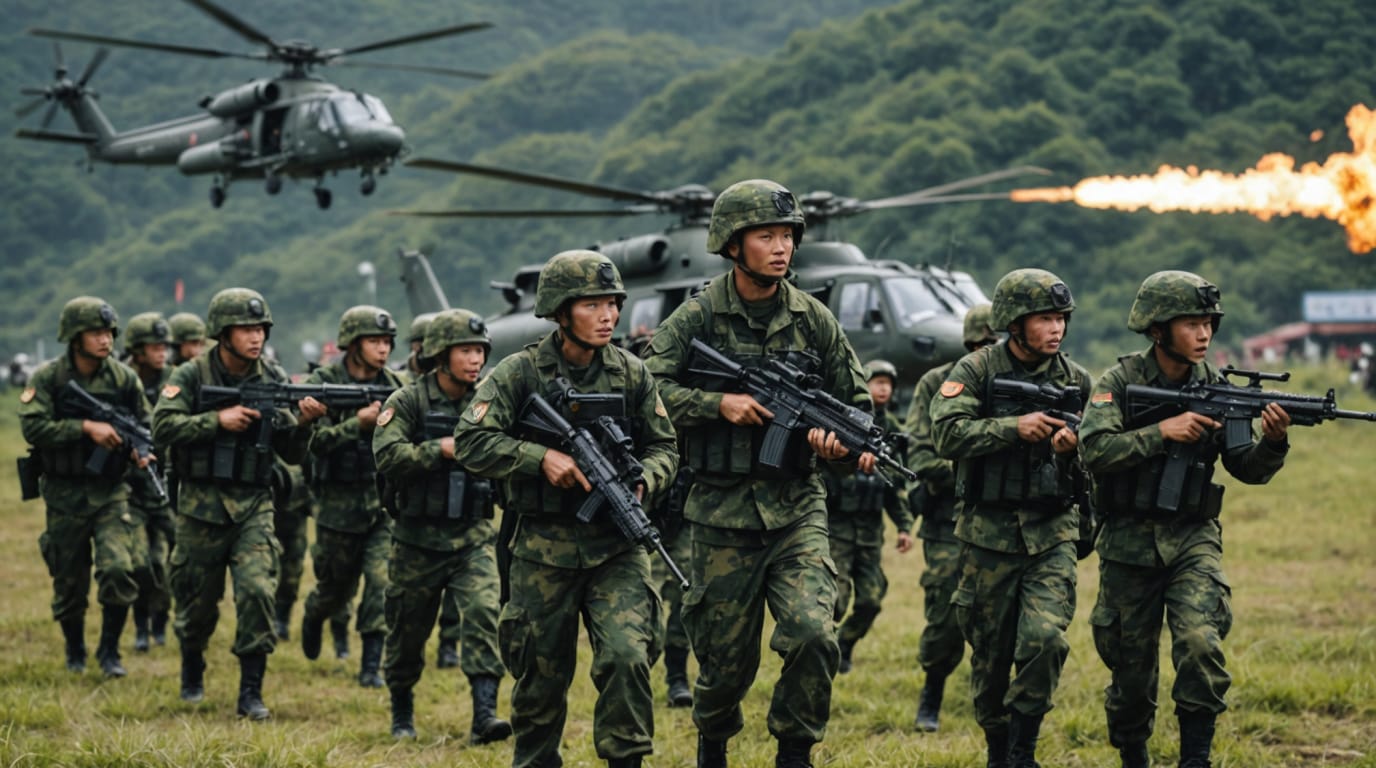
China has commenced extensive military exercises in the waters and airspace surrounding Taiwan, accompanied by strong warnings against what it perceives as separatist activities. The drills, which began Tuesday, involve the People's Liberation Army (PLA) navy, air force, army, and rocket forces, simulating a comprehensive assault on the island. These actions have been condemned by Taiwan, which views them as a threat to regional stability and a form of intimidation.
Drills as a "Stern Warning"
The PLA's Eastern Theater Command announced that the exercises are intended as a "stern warning and forceful deterrence" against Taiwan independence, focusing on sea-air combat readiness patrols, seizing comprehensive control, strikes on maritime and land targets, and blockade operations. Col. Shi Yi, a spokesperson for the Eastern Theater Command, stated that the drills are a "legitimate and necessary action to safeguard China's sovereignty and national unity." The Chinese military released a poster titled "Closing In," depicting Chinese ships and fighter jets encircling Taiwan, with the message "sinister moves of Taiwan separatists courting disaster upon themselves."
These drills follow a pattern of increased military activity by China around Taiwan in recent years, often interpreted as rehearsals for a potential blockade or invasion. Similar exercises were conducted in 2022 after a visit to Taiwan by then-U.S. House Speaker Nancy Pelosi.
Taiwan's Response
Taiwan's Ministry of National Defense (MND) has strongly condemned the drills, asserting that they undermine regional peace and stability. The MND reported tracking 19 Chinese navy vessels, including the Shandong aircraft carrier group, operating in the waters surrounding Taiwan. In response, Taiwan has deployed its own military aircraft and ships and activated land-based missile systems to monitor the situation.
Presidential Office spokesperson Karen Kuo stated that Taiwan has the confidence and ability to defend its national sovereignty and protect its people. The Taiwanese government maintains that only the island's 23 million people have the right to decide its future.
China's "Parasite" Rhetoric
Adding to the heightened tensions, China has employed inflammatory rhetoric, labeling Taiwan's President Lai Ching-te a "parasite." An animated video released by the Eastern Theater Command depicted Lai as a cartoon bug held by chopsticks above a burning Taiwan, accompanied by the words "Parasite poisoning Taiwan island. Parasite hollowing Island out. Parasite courting ultimate destruction."
This rhetoric reflects Beijing's deep distrust of Lai, who they view as a proponent of Taiwan independence. Lai, who took office last month, has called on Beijing to cease its political and military intimidation.
International Implications
The military drills and escalating rhetoric have raised concerns internationally, particularly in the United States, Taiwan's most important backer and arms supplier. While the U.S. maintains a policy of "strategic ambiguity" regarding whether it would militarily defend Taiwan from a Chinese attack, it is legally obligated to provide Taiwan with the means to defend itself.
The situation in the Taiwan Strait is considered a potential flashpoint for a war between China and the United States. The U.S. has consistently opposed any unilateral attempt by China to alter the status quo.
Historical Context
The tensions between China and Taiwan date back to 1949 when Chiang Kai-shek's Kuomintang nationalist forces fled to Taiwan after losing the Chinese civil war to Mao Zedong's communist forces. China has never ruled Taiwan and considers the island a renegade province that must be reunified with the mainland, by force if necessary.
Taiwan, officially known as the Republic of China (ROC), has its own democratically elected government and maintains unofficial relations with numerous countries. However, only a handful of nations maintain formal diplomatic ties with Taiwan, as most recognize the People's Republic of China (PRC) as the sole legitimate government of China.
Underlying Issues
Several factors contribute to the ongoing tensions:
- Sovereignty: China insists that Taiwan is part of its territory, while Taiwan maintains its de facto independence.
- Political Systems: China is governed by the Chinese Communist Party, while Taiwan is a multi-party democracy.
- U.S. Involvement: The U.S.'s support for Taiwan, including arms sales and security commitments, is a major point of contention with China.
- Taiwanese Identity: A growing sense of Taiwanese identity has fueled support for maintaining the island's autonomy.
Future Outlook
The situation in the Taiwan Strait remains volatile. China's military exercises and aggressive rhetoric are likely to continue, placing sustained pressure on Taiwan. The response from Taiwan, the United States, and other international actors will be crucial in shaping the future of cross-strait relations and maintaining regional stability. The international community is closely watching to see if China's actions are merely coercive or a prelude to more aggressive actions.


