China's Tianwen-2 Probe Reaches Asteroid, Begins Historic Sampling Mission
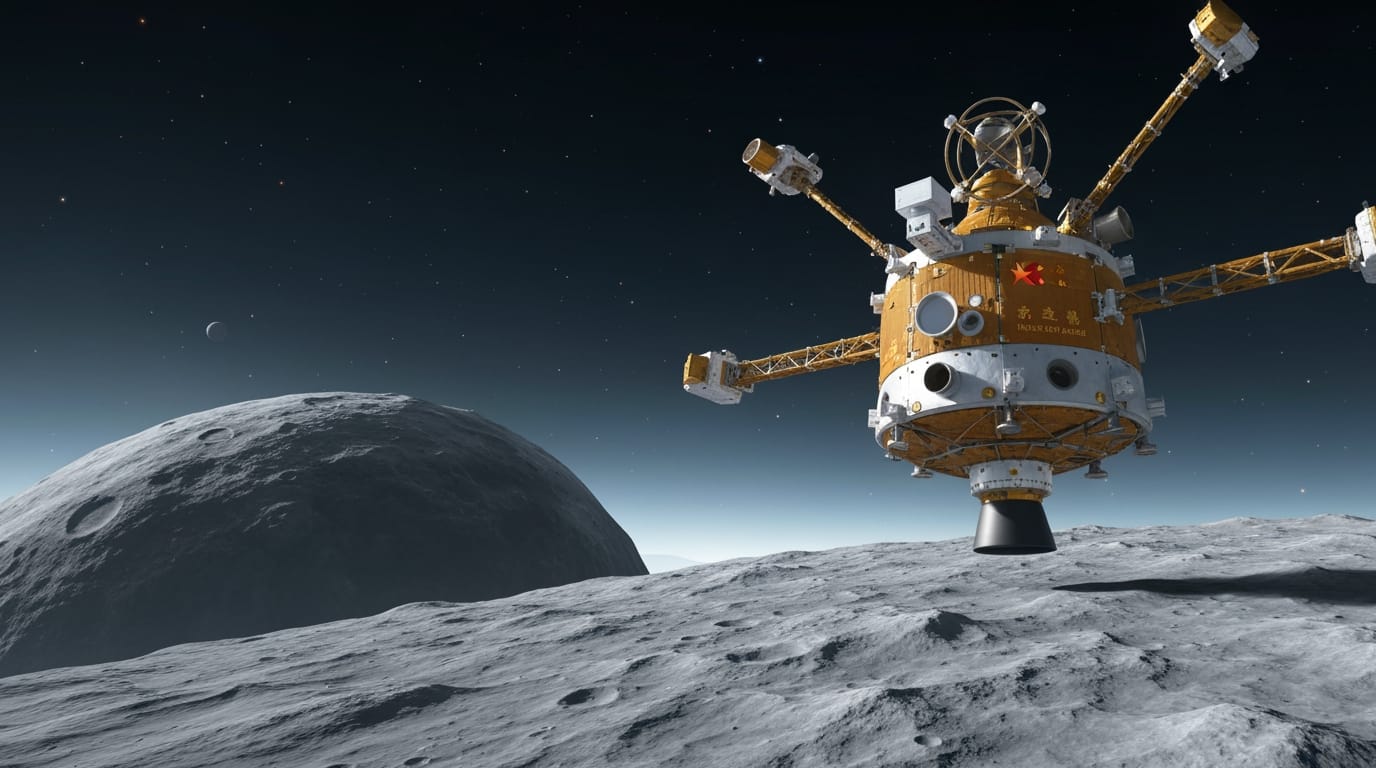
BEIJING, July 6, 2026 – China's Tianwen-2 space probe has successfully arrived at the near-Earth asteroid 2016 HO3, also known as Kamoʻoalewa, initiating a groundbreaking mission to collect samples from the celestial body and return them to Earth. This significant milestone, announced today by the China National Space Administration (CNSA), marks a crucial step in China's ambitious deep-space exploration program and holds immense scientific potential for understanding the early solar system and the enigmatic origins of Kamoʻoalewa itself.
After an approximately 400-day journey spanning roughly one billion kilometers, the robotic spacecraft reached a distance of 20 kilometers from the asteroid on Monday, July 6, 2026, and officially commenced scientific exploration. The mission aims to gather at least 100 grams of material from the asteroid, which will be the first asteroid samples collected by China, before a scheduled return to Earth in November 2027. This endeavor places China among a select few nations capable of such complex interplanetary sample return operations, signaling its growing prowess in space science and engineering.
Precision Rendezvous After a Year-Long Trek
The Tianwen-2 probe embarked on its journey from the Xichang Satellite Launch Center on May 29, 2025, carried by a Long March 3B rocket. Its voyage included a series of intricate deep-space maneuvers and trajectory corrections, ensuring its precise approach to the target asteroid. The spacecraft first detected asteroid 2016 HO3 on June 6, 2026. By June 7, at a range of 30,000 kilometers, Tianwen-2 executed a critical capture control maneuver, aligning itself into a coplanar trajectory with the asteroid. The probe then progressively narrowed the distance, approaching within 2,000 kilometers by June 19, before settling into its current 20-kilometer scientific exploration orbit. During the approach phase, the mission team utilized optical navigation data from acquired imagery to significantly refine the asteroid's ephemeris, reducing positional uncertainty from hundreds of kilometers to the kilometer scale. This meticulous approach underscores the advanced navigational capabilities demonstrated by the CNSA.
Unlocking Solar System Secrets with Kamoʻoalewa
The primary target, 2016 HO3 or Kamoʻoalewa, is a fascinating near-Earth asteroid that acts as a quasi-satellite of Earth. Its name, meaning "oscillating celestial object" in Hawaiian, aptly describes its unique orbital dance around the Sun while remaining gravitationally linked to Earth. Discovered in 2016, Kamoʻoalewa is estimated to be between 40 to 100 meters across, making it potentially the smallest asteroid ever visited by a spacecraft.
Scientists are particularly keen on Kamoʻoalewa due to compelling spectroscopic evidence suggesting it might be an ejecta fragment from an ancient impact on Earth's Moon. If confirmed, the samples returned by Tianwen-2 could provide unprecedented insights into the Moon's formation and the dynamics of early solar system impacts. Beyond its potential lunar origin, studying samples from Kamoʻoalewa promises to offer clues about the origins and evolution of the solar system itself, as such asteroids are considered "living fossils" preserving primordial material.
Innovative Sampling Techniques and Long-Term Exploration
The Tianwen-2 mission is designed for comprehensive data collection and advanced sampling. Over the next several weeks, the probe will conduct detailed scientific observations, mapping the asteroid's surface morphology, material composition, and internal structure. This preliminary work will be crucial for selecting optimal sample collection sites.
For sample acquisition, Tianwen-2 is equipped with two innovative methods: a "touch-and-go" approach and a more ambitious "anchor-and-attach" system with drills. While "touch-and-go" has been successfully used by previous missions like NASA's OSIRIS-REx and Japan's Hayabusa2, the "anchor-and-attach" method, which involves physically drilling into the asteroid, would be a pioneering achievement, allowing for potentially deeper and more controlled sampling. Explosives may also be deployed to expose potential subsurface volatiles for detection, adding another layer of scientific investigation. The goal is to collect at least 100 grams of regolith, which will then be transferred to a return capsule.
After successfully collecting samples, the probe will depart Kamoʻoalewa in April 2027. The return capsule will then separate and re-enter Earth's atmosphere, aiming for a landing in November 2027. Following the sample delivery, Tianwen-2 will not conclude its mission. It will perform a gravity assist maneuver around Earth, redirecting itself towards a second target: the main-belt comet 311P/PanSTARRS. The probe is expected to arrive at this comet in January 2035, where it will conduct remote sensing and in-situ measurements for at least a year, equipped with 11 onboard instruments to explore this distant celestial body.
China's Expanding Cosmic Horizons
The Tianwen-2 mission is the second in China's "Tianwen" (Heavenly Questions) series, named after an ancient Chinese poem, reflecting the nation's soaring aspirations in deep space exploration. This mission follows the success of Tianwen-1, which successfully orbited, landed, and deployed a rover on Mars in 2021, establishing China as a major player in interplanetary exploration.
The successful rendezvous with Kamoʻoalewa and the planned sample return represent a significant leap for China, demonstrating advanced capabilities in precision navigation, robotic sampling, and long-duration interplanetary travel. Experts view Tianwen-2 as a critical milestone, solidifying China's position alongside the United States and Europe in the field of deep-space exploration beyond the Moon. The knowledge gained from these ancient asteroid samples could revolutionize humanity's understanding of the solar system's genesis and provide crucial data for future resource utilization and planetary defense strategies. This multi-faceted mission underscores China's long-term commitment to scientific discovery and its expanding influence in the global space arena.


