Deadly Tunnel Collapse in Uttarakhand Claims Seven, Intensifies Scrutiny on Himalayan Infrastructure Safety

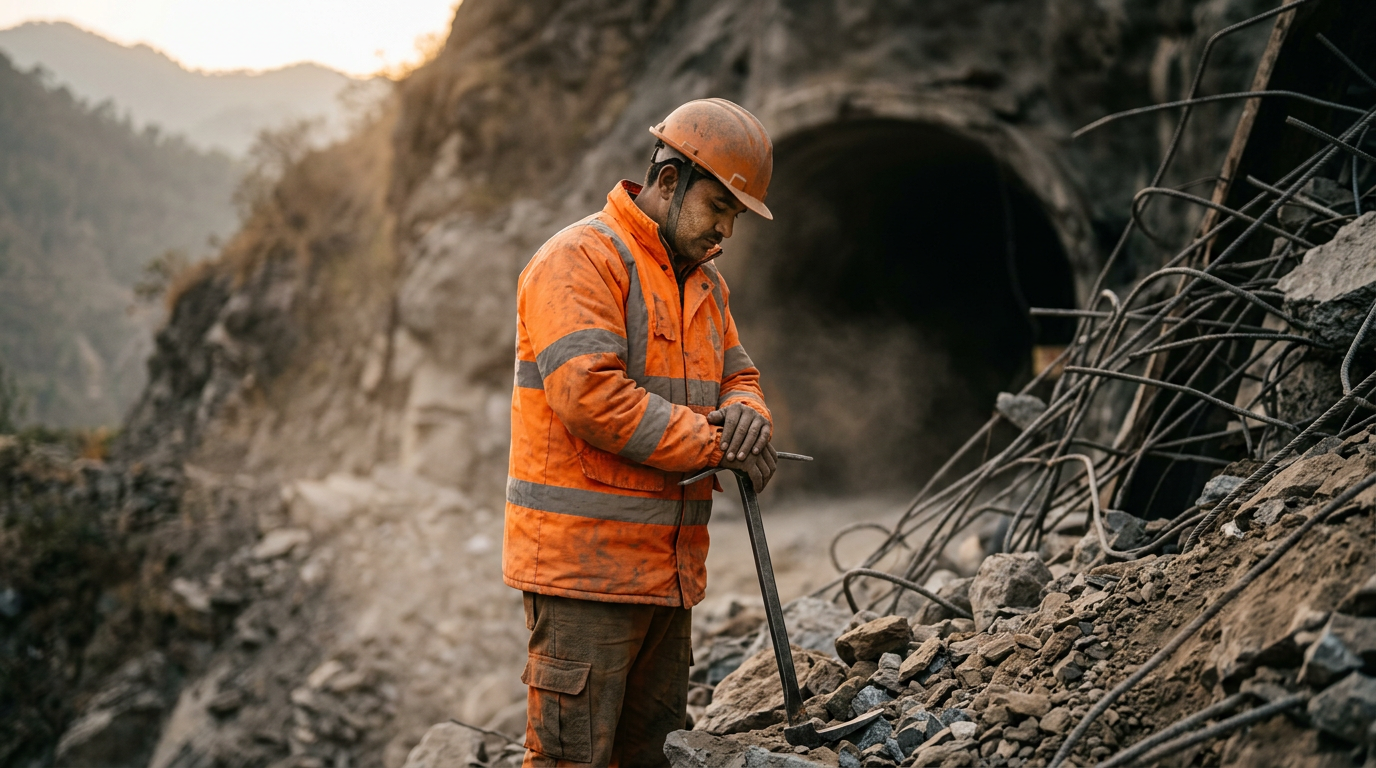
CHAMOLI, INDIA – Seven workers are confirmed dead and three remain missing following a devastating tunnel collapse at an under-construction hydroelectric project in India's Chamoli district, Uttarakhand, late Thursday evening. The incident, attributed to a sudden surge of water and debris, has triggered a massive, round-the-clock rescue operation amidst challenging conditions, casting a somber shadow over critical infrastructure development in the geologically fragile Himalayan region.
The Catastrophe Unfolds in Pipalkoti
The tragedy struck around 6:30 PM on Thursday at the Mayapur (Pipalkoti) site of the Vishnugad-Pipalkoti Hydroelectric Project, managed by the Tehri Hydro Development Corporation Limited (THDC). Landslides and subsidence caused a torrent of debris and water to fill the Tail Race Tunnel (TRT), where workers were engaged in welding reinforcement bars. Officials reported that anywhere from 22 to 28 individuals were inside the tunnel at the time of the collapse. The sudden ingress of water and material swept several workers towards the exit, while others were trapped deep within the structure.
Initial rescue efforts overnight successfully brought 19 workers to safety. However, the joyous relief was quickly tempered by grim discoveries. Seven workers were declared dead after being brought out, and authorities continue an urgent search for three others who remain unaccounted for. The deceased have been identified as Pradeep Singh Pawar of Tehri, Mukesh of Chamoli, Durlabh Sharma of Bihar, Vijay and Jitendra Kumar of Jharkhand, and Lokeshwar and Bhuneshwar, whose native places are yet to be ascertained. Several injured workers are receiving medical attention at Gopeshwar District Hospital, with some requiring transfer to higher medical facilities.
The Grueling Battle for Survival: Rescue Operations Intensify
The immediate aftermath saw a swift deployment of multiple agencies to the disaster site. Teams from the National Disaster Response Force (NDRF), State Disaster Response Force (SDRF), Indo-Tibetan Border Police (ITBP), and local police and fire services are coordinating the complex rescue mission. The operation is fraught with significant challenges, primarily due to the sheer volume of water and debris that has inundated the tunnel. Rescuers face continuous water seepage and rising levels, making every step inside the collapsed passage perilous.
Uttarakhand Chief Minister Pushkar Singh Dhami rapidly responded to the crisis, flying to Pipalkoti to personally oversee the rescue efforts and monitor the situation in real-time. District Magistrate Gaurav Kumar is also on site, marshalling all available resources to locate the missing individuals. Rescue personnel have reportedly entered the water-filled tunnel, battling the treacherous conditions in a desperate bid to reach those still trapped. The determination of these teams remains unwavering as they navigate the unstable environment, underscoring the immense human effort involved in such emergencies.
A Region Under Strain: The Perils of Himalayan Development
The Vishnugad-Pipalkoti Hydroelectric Project is one of many ambitious infrastructure undertakings in the mountainous state of Uttarakhand, a region critical for both energy production and connectivity. However, such development often contends with extremely challenging geological conditions. Construction accidents are a recurring concern across India, where rapid infrastructure growth sometimes outpaces stringent safety standards, particularly when coupled with fragile geology and extreme weather events.
The Himalayan region, characterized by its young and fragile mountains, seismic activity, and unpredictable underground conditions, presents a heightened risk for large-scale construction projects like tunnels. Heavy rains, which had battered the Chamoli district for days prior to the collapse, are believed to have contributed to the ground instability that triggered the incident. This latest tragedy is not an isolated event; it echoes past incidents that highlight the inherent dangers. In 2023, a tunnel section in northern Uttarakhand collapsed, trapping 41 workers for 17 days before their dramatic rescue. Similarly, an explosion inside a coal mine in Meghalaya in February claimed the lives of at least 18 workers. These incidents collectively underscore the precarious balance between developmental imperatives and the imperative of worker safety in such high-risk environments.
The Human Cost and Future Implications
The collapse at Pipalkoti represents a tragic loss of life and a stark reminder of the sacrifices made in the pursuit of national development. Beyond the immediate fatalities, the incident leaves behind grieving families and a community grappling with the aftermath of a preventable disaster. The injured workers face recovery, while the search for the three missing individuals continues, holding a community in anxious suspense.
The incident is expected to intensify scrutiny on safety protocols, geological assessments, and construction practices employed in major infrastructure projects within the Himalayan belt. While the government has pledged full support for rescue and relief operations, the long-term implications will likely involve renewed calls for comprehensive reviews of worker safety, environmental impact, and engineering resilience in a region prone to natural calamities. The ongoing efforts to find the remaining workers serve as a poignant symbol of hope amidst profound tragedy, even as the larger questions of sustainable and safe development in India's mountainous terrains loom large.
Related Articles


Ratko Mladić, "Butcher of Bosnia" and Convicted War Criminal, Dies at 84
THE HAGUE, Netherlands – Ratko Mladić, the former Bosnian Serb military commander known as the "Butcher of Bosnia" and convicted of genocide, war crimes, and crimes against humanity, has died at the age of 84. Serbian...


Long-Awaited 9/11 Mastermind Trial Set for 2028, Decades After Attacks
GUANTANAMO BAY, Cuba – Nearly a quarter-century after the devastating terror attacks of September 11, 2001, a military judge has finally set a trial date for Khalid Sheikh Mohammed, the alleged mastermind behind the...