escalating maritime tensions as Chinese Coast Guard damages Philippine fishing vessels
MANILA, Philippines – The fragile peace in the South China Sea has been further shattered by recent confrontations, with Philippine authorities reporting injuries to Filipino fishermen and significant damage to their vessels by the China Coast Guard (CCG). These incidents, occurring in areas internationally recognized as falling within the Philippines' exclusive economic zone, mark a dangerous escalation in the long-running maritime dispute and underscore the growing risks to human life and regional stability.
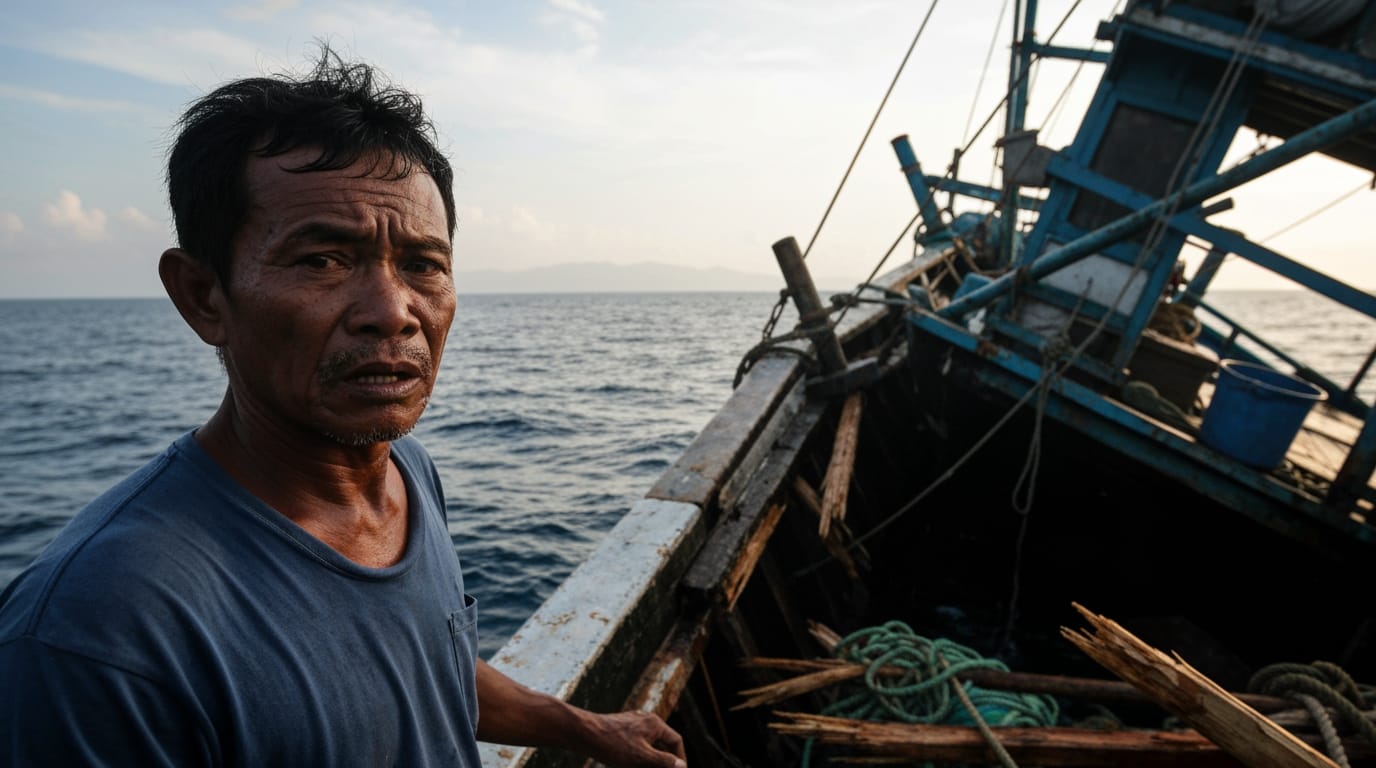
The latest reported aggression unfolded near Sabina Shoal, also known as Escoda Shoal or Xianbin Reef, approximately 150 kilometers (93 miles) from the Philippine island of Palawan. On Friday, December 12, 2025, Philippine authorities confirmed that three Filipino fishermen sustained injuries, including bruises and open wounds, after CCG vessels allegedly targeted their boats with high-pressure water cannons and executed dangerous blocking maneuvers. Two Philippine fishing boats suffered substantial damage from the water cannon blasts, which were powerful enough to destroy wooden structures on the vessels. Further complicating the situation, small Chinese rigid hull inflatable vessels (RHIBs) reportedly cut the anchor lines of several Filipino boats, endangering their crews amidst strong currents and high waves. The Philippine Coast Guard (PCG) deployed multi-role response vessels to assist the fishermen, only to face harassment and dangerous close-quarter maneuvers from Chinese vessels, including one that approached within 35 yards during nighttime navigation. Despite these interferences, the PCG managed to reach the fishermen, providing immediate medical attention and essential supplies.
A Pattern of Aggression: Documented Damages and Injuries
The December 2025 incident at Sabina Shoal is not an isolated event but rather the latest in a series of increasingly assertive actions by the China Coast Guard in contested waters. These confrontations frequently involve the use of water cannons, dangerous blocking maneuvers, and physical damage to Philippine vessels, both government and civilian.
Earlier in 2025, the Philippines accused a Chinese ship of deliberately ramming one of its government vessels in the Spratly Islands in October. A month prior, in September, a water cannon attack by a CCG vessel near Scarborough Shoal, known as Bajo de Masinloc in the Philippines, shattered a window on the bridge of another Philippine fisheries bureau vessel, injuring one crew member. Scarborough Shoal, a traditional fishing ground, has been a flashpoint since China effectively took control of it in 2012, consistently preventing Filipino fishermen from accessing its rich waters.
Perhaps one of the most severe incidents occurred on June 17, 2024, near Second Thomas Shoal (Ayungin Shoal), during a routine Philippine resupply mission to the BRP Sierra Madre, a grounded naval vessel serving as a Philippine outpost. During this confrontation, CCG personnel reportedly interfered with the mission, ramming and boarding a Philippine Navy inflatable boat. They allegedly used knives and axes to damage the vessel and its equipment. The incident resulted in eight Filipino personnel sustaining injuries, with one reportedly losing a finger. China also allegedly seized high-powered firearms and personal effects from the Philippine crew. This event prompted the Philippines to demand compensation for damages totaling PHP 60 million. Another incident in August 2025 saw a China Coast Guard vessel damaged after colliding with a Chinese Navy ship while attempting to expel a Philippine Coast Guard vessel from Scarborough Shoal, highlighting the volatile nature of these encounters.
Manila's Steadfast Stance and Diplomatic Outcry
In response to what it describes as continuous "illegal and aggressive actions," the Philippine government has consistently condemned China's behavior and lodged numerous diplomatic protests. Since President Ferdinand Marcos Jr. took office in July 2022, the Philippines has filed a total of 241 diplomatic protests against China, with 60 filed in 2025 alone.
The Philippine Department of Foreign Affairs (DFA) has repeatedly emphasized that these incidents occur within the Philippines' Exclusive Economic Zone (EEZ), asserting the nation's sovereign rights and jurisdiction. Manila firmly relies on the 2016 ruling by the Permanent Court of Arbitration in The Hague, which invalidated China's expansive claims in the South China Sea, including its "nine-dash line," and affirmed the Philippines' rights under the United Nations Convention on the Law of the Sea (UNCLOS). The tribunal explicitly ruled that China violated UNCLOS by interfering with Philippine fishing activities, harming the marine environment, and dangerously operating law enforcement vessels around Scarborough Shoal. The Philippines views China's actions as a direct affront to international law and maritime order.
Beijing's Assertion of Sovereignty and Justification of Actions
China, for its part, maintains sweeping claims over nearly the entire South China Sea, asserting historical rights that it argues are indisputable. Beijing has consistently rejected the 2016 arbitral ruling, dismissing it as illegal and null, and refuses to recognize its authority.
In official statements, the China Coast Guard often characterizes its actions as "necessary control measures" against Philippine vessels that it claims are "illegally entering" its territorial waters or conducting "provocative" and "infringement activities." China states its actions are aimed at defending its national sovereignty and maritime rights. Furthermore, in June 2024, China introduced new guidelines that authorize its Coast Guard officers to use lethal force on foreign vessels and detain non-Chinese individuals in areas it claims for up to 60 days without formal charge, a move that has significantly heightened tensions.
The Human Cost and Geopolitical Ramifications
Beyond the diplomatic exchanges, these maritime encounters have a profound human cost, particularly for the Filipino fishing communities whose livelihoods depend on access to these rich fishing grounds. Local fishermen report a significant decline in their catch, with some experiencing a 30% drop in livelihood and reduced weekly hauls from 7 tons to merely 1.5 tons. They are often driven away from their traditional fishing areas, their boats damaged, and their catch sometimes confiscated. Analysts warn that China's aggressive posture in these waters not only impacts individual fishermen but also poses a threat to the Philippines' national food security.
The escalating tensions in the South China Sea have attracted significant international attention. Allies of the Philippines, including the United States and the European Union, have condemned China's aggressive actions, calling them destabilizing and contrary to international law. The United States has repeatedly reaffirmed its mutual defense treaty commitments to Manila, raising concerns about the potential for broader conflict in the region. Experts describe the aggressive enforcement of exclusion zones around shoals and the shadowing of aid missions as a "new normal," indicating a persistent and intensified assertion of Chinese claims. The risk of miscalculation or accidental clashes escalating into a wider confrontation remains a critical concern for regional and global security.
The ongoing maritime standoff between the Philippines and China in the South China Sea represents a complex and deeply entrenched geopolitical challenge. While the Philippines continues to assert its sovereign rights and call for adherence to international law, China remains steadfast in its expansive territorial claims, often employing coercive tactics. The frequent incidents involving damage to vessels and injuries to personnel not only endanger the lives and livelihoods of ordinary Filipino citizens but also fuel regional instability. With no immediate resolution in sight, the international community watches closely as the two nations navigate this contentious waterway, the future of peace and maritime rights hanging in the balance.


