Escalating Tensions: South Korea Scrambles Jets Amid Joint Chinese and Russian Air Drills
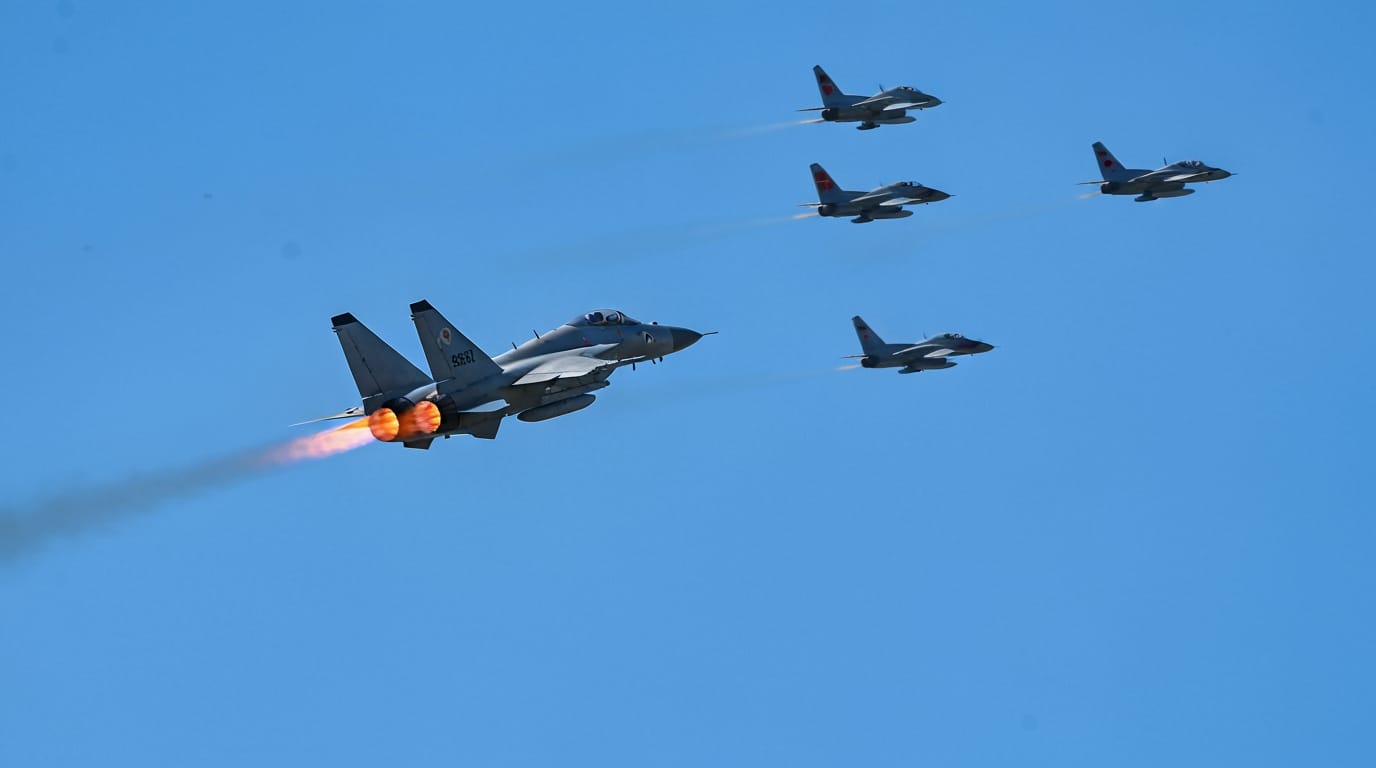
Seoul, South Korea – South Korea's military scrambled fighter jets today in response to nine Chinese and Russian military aircraft entering its Air Defense Identification Zone (KADIZ), marking the latest instance of heightened aerial activity in an increasingly volatile Northeast Asian security landscape. The incident underscores a persistent pattern of joint military exercises by Beijing and Moscow near the Korean Peninsula, prompting vigilance and concerns over regional stability.
This morning's episode saw seven Russian and two Chinese military aircraft, including bombers and fighter jets, penetrate the KADIZ over the East and South Seas. The South Korean Joint Chiefs of Staff (JCS) reported that the foreign aircraft entered the zone around 10 a.m. local time before exiting approximately an hour later. Crucially, South Korean authorities confirmed that the aircraft did not violate the nation's sovereign territorial airspace, which extends 12 nautical miles from its coastline. In response to the detected presence, the Republic of Korea Air Force promptly dispatched fighter jets, deploying tactical measures to monitor the situation and prevent any potential contingencies.
The Contested Air Defense Identification Zones
The frequent activation of South Korean air defenses stems from entries into its Air Defense Identification Zone (ADIZ), a concept often misunderstood in its distinction from sovereign airspace. An ADIZ is a designated area, typically extending beyond a nation's territorial airspace, within which countries request foreign aircraft to identify themselves and provide flight plans for security reasons. This mechanism allows for early identification and response to potentially hostile aircraft approaching national airspace. While an ADIZ is established for national security, it is not governed by international law in the same way as sovereign airspace, and adherence to its protocols by foreign military aircraft is generally considered international practice rather than a legally binding obligation.
The legal ambiguity surrounding ADIZs forms the crux of the recurring friction. International practice suggests that military aircraft should provide prior notification and share flight plans when entering another nation's ADIZ. However, both Moscow and Beijing have consistently dismissed the legitimacy of South Korea's ADIZ, asserting that such zones over international waters do not constitute territorial airspace and that all nations retain the freedom of movement therein. This differing interpretation creates a persistent challenge for Seoul, which views unannounced entries as a security concern, particularly in a region where multiple nations, including China, South Korea, and Japan, maintain overlapping ADIZs, further complicating air traffic management and increasing the risk of miscalculation.
A Pattern of Joint Strategic Patrols
Today's incident represents the 10th joint strategic air patrol conducted by Chinese and Russian forces, according to statements from China's Ministry of National Defense. These exercises have become a regular feature of the Northeast Asian security landscape, occurring without prior notification to South Korea typically once or twice a year since 2019. The frequency and scope of these joint maneuvers have steadily increased, reflecting a deepening military cooperation between China and Russia.
Past incidents highlight the ongoing nature of these aerial activities. In November 2024, South Korea similarly scrambled jets after five Chinese and six Russian military aircraft entered its KADIZ, which China referred to as its ninth joint strategic patrol. Another notable event occurred in December 2023, involving two Chinese and four Russian planes, prompting not only South Korea but also Japan to scramble fighter jets in response. Earlier incidents include a large-scale incursion in December 2020 involving four Chinese and 15 Russian aircraft, and a particularly tense encounter in July 2019, where South Korean warplanes fired hundreds of warning shots at Russian military aircraft that briefly violated South Korean airspace during a joint patrol with China. Data from South Korea indicates that Chinese military aircraft have entered KADIZ approximately 430 times without prior notice between 2020 and 2024, with Russian entries totaling around 60 over the same period.
Broadening Geopolitical Implications
The recurring joint air drills by China and Russia carry significant geopolitical weight, signaling an increasingly coordinated military partnership that extends beyond mere routine exercises. This growing alignment is a crucial factor reshaping the security environment in Northeast Asia, particularly in light of Russia's war in Ukraine and the expanding military and defense ties between Moscow and Beijing. Both China and Russia are traditional allies of North Korea, a dynamic that further complicates the regional security calculus for South Korea, Japan, and their allies, including the United States.
The exercises are widely interpreted as a demonstration of strength and interoperability between the Chinese and Russian militaries, aimed at projecting power and potentially testing the response capabilities of regional actors. They also serve as a signal to Washington and its allies, occurring at a time when the United States is working to strengthen its trilateral security cooperation with South Korea and Japan. The overlapping ADIZs, particularly around disputed territories like Ieo Island (claimed by South Korea and China) and the Dokdo/Takeshima islets (claimed by South Korea and Japan), add another layer of complexity, raising concerns about potential miscalculations or unintended escalations in already tense maritime and aerial boundaries. The integration of North Korea into this nascent security bloc remains a significant concern, with experts suggesting the potential for trilateral military exercises involving Pyongyang, Beijing, and Moscow in the near future.
An Ongoing Regional Challenge
Today's scramble of South Korean fighter jets is not an isolated event but rather a symptom of a deepening strategic partnership between China and Russia, challenging existing regional norms and defense postures. While the immediate threat of territorial airspace violation was averted, the persistent nature of these unannounced incursions into the KADIZ necessitates continuous vigilance and strategic adaptation from South Korea and its allies. The exercises serve as a stark reminder of the evolving power dynamics in Northeast Asia and the intricate web of security concerns that define the region. As geopolitical realignments continue, the delicate balance of power in the East Sea remains under close observation, with every aerial maneuver carrying broader implications for peace and stability.


