Europe at a Crossroads: Macron Sounds Alarm on Looming Political and Economic Crisis
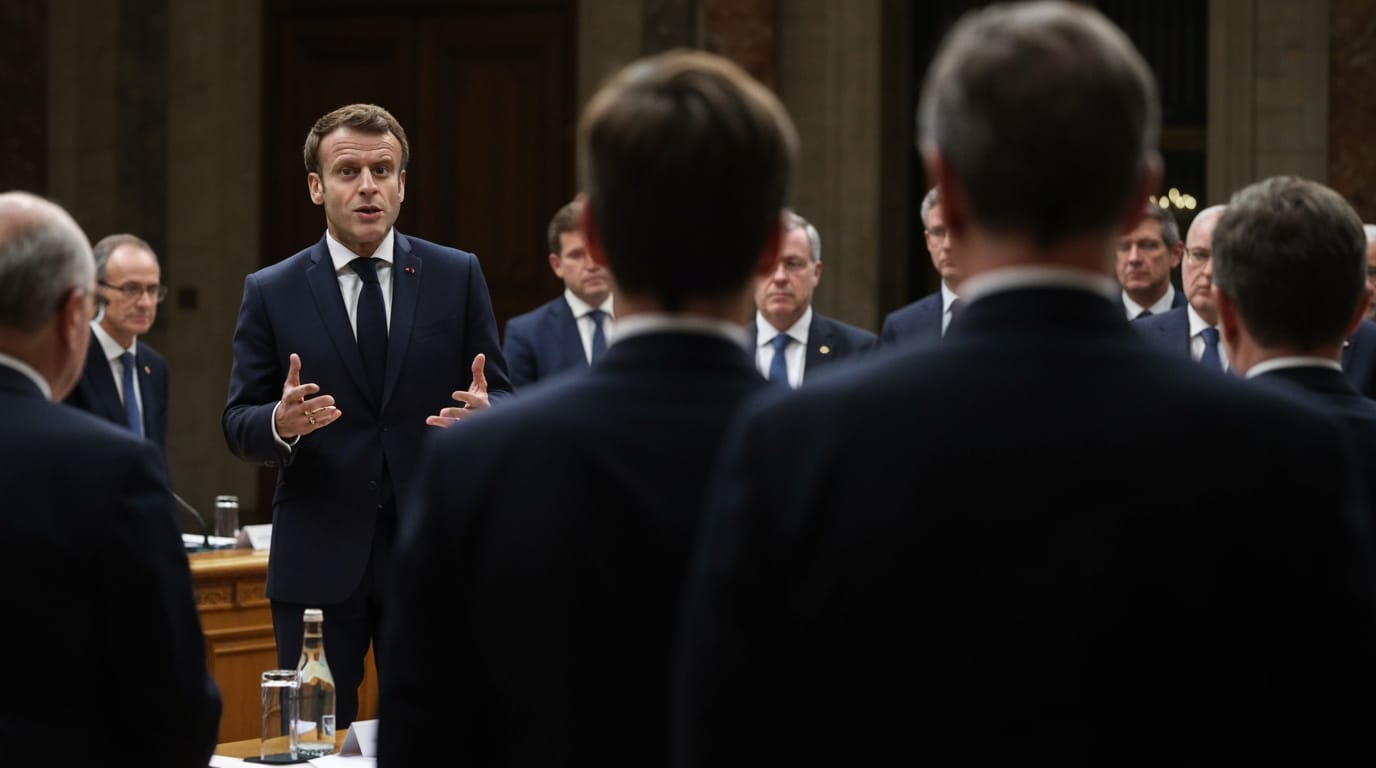
DAVOS, Switzerland — Europe finds itself at a pivotal juncture, facing a convergence of profound political and economic challenges that threaten its stability and global standing. French President Emmanuel Macron has issued a stark warning, asserting that the continent must abandon its "naivety" and proactively safeguard its economic and strategic interests or risk being marginalized in a rapidly shifting international landscape. His recent statements underscore a growing urgency among European leaders to address systemic vulnerabilities amid escalating global competition and geopolitical instability.
Macron's pronouncements, delivered at the World Economic Forum in Davos and reiterated in interviews with several European newspapers in January and February 2026, paint a picture of a continent under siege from both external pressures and internal fragilities. He has consistently argued that Europe must cultivate greater sovereignty and autonomy to navigate a "world without rules" where traditional multilateralism is increasingly challenged. The French leader's remarks highlight concerns that Europe's economic model, built on open trade and international cooperation, is ill-equipped to withstand aggressive protectionist measures and state-backed competition from global powers.
The Economic Gauntlet: US and Chinese Competition
At the core of Macron's economic warning is the intensifying competition from the United States and China, which he argues are actively disrupting global trade norms. He has characterized the situation with China as a "trade tsunami," driven by "massive excess capacities" and "distorted practices" that threaten to overwhelm European industries. The US, meanwhile, presents a challenge of "constant unpredictability" through what he describes as "threats" and "intimidation" related to trade and technology. Macron pointed to American "overconsumption" and Chinese "underconsumption and overinvestment" as key global economic imbalances that disadvantage Europe.
The French President emphasized that both the US and China have moved away from respecting established global trade rules, instead employing protectionist measures and subsidies to bolster their domestic industries. This approach leaves Europe, with its comparatively open markets and adherence to regulatory frameworks, at a significant disadvantage. Macron cautioned that Europe's competitiveness "still lags behind that of the US" and that current EU regulations and fragmented markets hinder its ability to respond effectively. He specifically cited the threat of American tariffs, particularly if the EU proceeds with enforcing its Digital Services Act against major US tech firms, as an example of potential economic friction with allies. Macron suggested that maintaining tariffs between the US and Europe, especially in the context of global instability, "doesn't make sense" when both are allies confronting challenges like the conflict in Ukraine.
Geopolitical Pressures and the Call for Strategic Autonomy
Beyond economic concerns, Macron has underscored a profound shift in the global geopolitical landscape, marked by rising instability, a move towards autocracy, and increased conflict. He asserts that Europe must develop its "strategic autonomy" to avoid becoming a "vassal of the United States" and to maintain its ability to engage with all regions of the world. This vision of autonomy involves less reliance on external powers, particularly in defense and key strategic industries. The concept has gained increased relevance, especially given discussions around potential changes in US foreign policy and a possible return of former President Donald Trump to the White House, who has previously accused European nations of underfunding their defense.
Macron's concerns extend to internal European cohesion, advocating for reforms to bolster the continent's collective strength. He has drawn parallels to a "Greenland moment," referring to instances of US pressure over territory, trade, and technology, viewing them as a wake-up call for Europe to strengthen its position. The President highlights the need for the EU to speak with a more unified voice and act decisively on the world stage, especially as traditional multilateral institutions are weakened.
Charting a Course for European Resilience
In response to these multifaceted challenges, President Macron has outlined a comprehensive strategy for European resilience. Central to his proposals is a call for significant investment in strategic sectors such as artificial intelligence and green energy, arguing that Europe risks being "swept aside" if it fails to do so. He advocates for a "Made in Europe" strategy that prioritizes European manufacturing and innovation, clarifying that this approach is about protection rather than protectionism.
Macron has urged European leaders to revive stalled economic reforms aimed at boosting competitiveness and global influence. Specific measures include simplifying and deepening the EU's single market, diversifying trade partnerships, and implementing common EU borrowing to finance large-scale investments. He has also suggested reforms to the European Central Bank's mandate, proposing it should target growth and climate objectives in addition to inflation. Furthermore, Macron has called for exemptions to the EU's own competition rules to enable support for European firms in critical sectors and for less fragmented markets in areas like energy, telecoms, and financial services, alongside a reduction in bureaucratic hurdles. He also stressed the importance of fostering greater cooperation with emerging economies, including the BRICS nations and the G20, to address global economic imbalances.
Conclusion: An Urgent Call to Action
President Macron's repeated warnings serve as an urgent call to action for Europe. His message is clear: the continent can no longer afford to be complacent or "naive" in the face of aggressive global competition and a volatile geopolitical environment. The path forward, as articulated by the French leader, requires a robust commitment to strategic autonomy, significant economic reforms, and a unified approach to trade and industrial policy. The implications of inaction, he suggests, could be profound, potentially leading to a diminished European role in global affairs and an erosion of its economic prosperity. The continent's ability to coalesce around these proposed solutions will determine its capacity to not only weather the approaching storms but also to emerge as a stronger, more self-reliant power on the world stage.


