Frank Gehry, Visionary Architect Who Redefined Form, Dies at 96
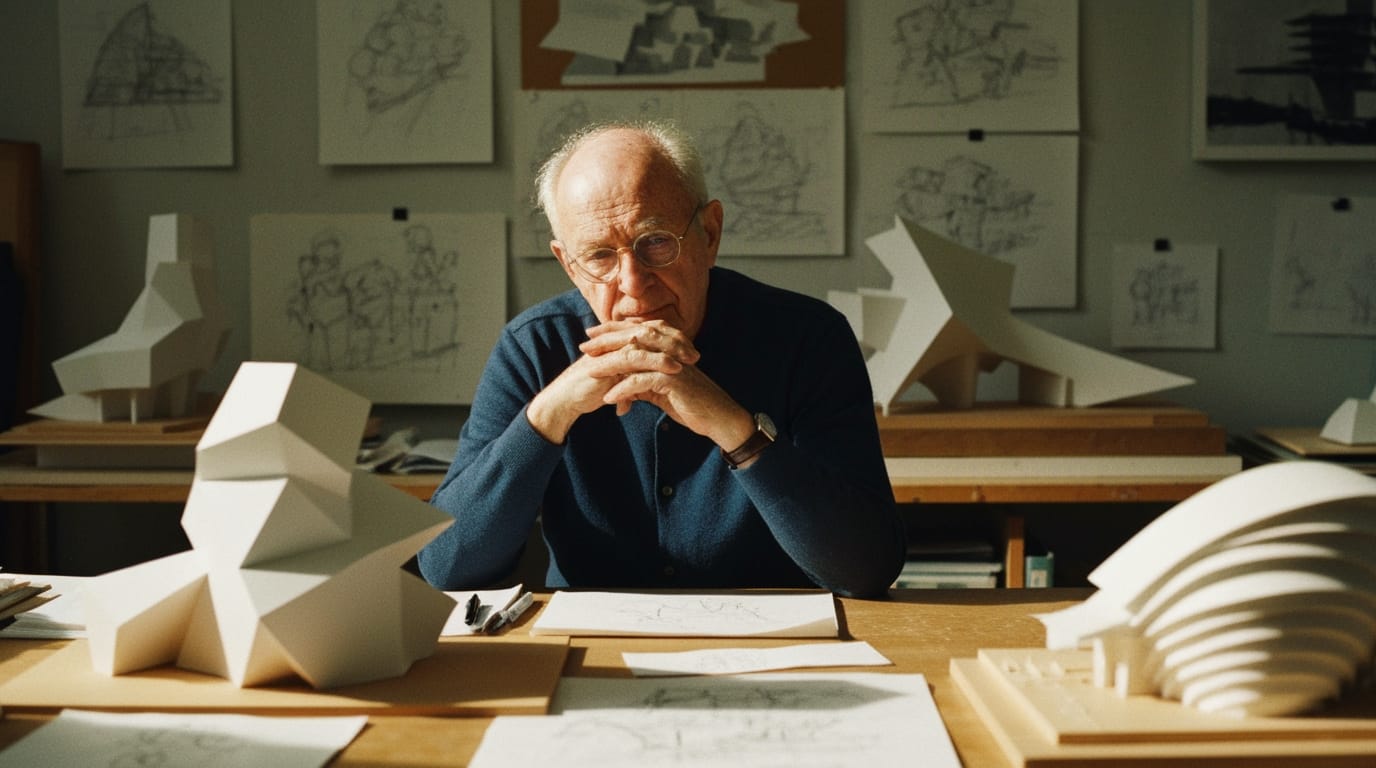
LOS ANGELES – Frank Gehry, the Canadian-American architect whose audacious, sculptural designs transformed cityscapes and challenged conventional notions of form, died Friday at his home in Santa Monica, California. He was 96. Meaghan Lloyd, chief of staff at Gehry Partners, confirmed his passing following a brief respiratory illness.
Gehry, often hailed as one of the most influential architects of his generation, leaves behind a monumental legacy of buildings that are as much works of art as they are functional spaces. From the shimmering, titanium-clad curves of the Guggenheim Museum Bilbao to the boisterous, stainless-steel sails of the Walt Disney Concert Hall in Los Angeles, his structures became global icons, drawing millions and redefining the role of architecture in public imagination. His death marks the end of an era for a figure who continuously pushed the boundaries of design, earning both fervent admiration and occasional critique for his distinctive, deconstructivist style.
Early Life and the Road to Architectural Innovation
Born Frank Owen Goldberg on February 28, 1929, in Toronto, Ontario, Gehry's early life offered glimpses of the creative spirit that would later define his career. Encouraged by his grandmother, Leah Caplan, he spent hours building imaginary cities and houses from scraps of wood from his grandfather's hardware store. This early exposure to unconventional materials and free-form construction foreshadowed his later architectural experiments.
His family moved to Los Angeles in 1947, a pivotal shift that would shape his professional trajectory. Gehry attended Los Angeles City College before earning his Bachelor of Architecture from the University of Southern California in 1954. A brief stint at the Harvard Graduate School of Design for city planning followed, though he ultimately left without completing the program, finding its curriculum at odds with his developing views on architecture. After serving in the U.S. Army and gaining experience at various architectural firms, he established his own practice, Frank O. Gehry & Associates, in 1962, later renamed Gehry Partners in 2002. His early ventures included the "Easy Edges" line of cardboard furniture, which saw commercial success and allowed him to remodel his own Santa Monica home, an early architectural canvas that showcased his experimental approach to everyday materials.
The Deconstructivist Master: Iconic Structures Take Shape
Gehry's ascent to global prominence solidified in the late 20th century with projects that introduced a radically new aesthetic to the architectural landscape. While he often resisted the label, his work became synonymous with deconstructivism, characterized by its fragmentation, non-linear forms, and dynamic, often unsettling, compositions. His buildings frequently employed unconventional materials like corrugated metal, chain-link fencing, and, famously, titanium, manipulated into fluid, undulating surfaces that defied traditional geometry.
The turning point came with the 1997 completion of the Guggenheim Museum Bilbao in Spain. This ambitious project, a fantastical assemblage of titanium curves and glass, garnered international acclaim for its breathtaking profile and its transformative effect on the industrial city of Bilbao. The museum became a global phenomenon, demonstrating architecture's power to revitalize urban economies and capture public imagination, an effect often dubbed the "Bilbao Effect." Following Bilbao, Gehry delivered a succession of equally groundbreaking works. The Walt Disney Concert Hall in downtown Los Angeles (2003), with its majestic, stainless-steel facade, quickly became a beloved civic landmark and a testament to his ability to blend artistic vision with functional design. Other notable projects include the Louis Vuitton Foundation in Paris (2014), the Jay Pritzker Pavilion in Chicago (2004), and the Ray and Maria Stata Center at MIT (2004), each bearing his unmistakable signature.
A Legacy of Emotion and Innovation
Throughout his prolific career, Gehry received numerous accolades, cementing his status as one of architecture's titans. He was awarded the prestigious Pritzker Architecture Prize in 1989, considered the field's highest honor, long before his most famous works like Bilbao were realized. Further recognition included the National Medal of Arts (1998) and the Presidential Medal of Freedom (2016), underscoring his profound cultural impact.
His unique approach made architecture more engaging and accessible to the public, sparking conversations and broadening perceptions of what buildings could be. Despite some critical division over the practicality or contextual integration of his radical structures, Gehry maintained that architecture, much like music, aims to evoke emotions through forms crafted from inert materials. He continued to work well into his nineties, with recent projects including the Eisenhower Memorial in Washington, D.C. (2020) and a renovation of the Philadelphia Museum of Art (2021), demonstrating an enduring creative drive.
Frank Gehry's designs were more than just buildings; they were statements, challenging norms and inviting viewers to experience space in new and unexpected ways. He was considered the most recognizable American architect since Frank Lloyd Wright, pioneering the use of computer-aided design to bring his complex visions to life.
A Lasting Imprint on the World Stage
The passing of Frank Gehry marks the end of a remarkable life dedicated to pushing architectural boundaries. His work fundamentally altered the landscape of modern cities and the perception of architecture itself. By consistently daring to build the improbable, he instilled a sense of wonder and dynamism into structures that might otherwise have been mundane. His buildings will continue to stand as testaments to a singular vision – a powerful reminder that architecture, in the hands of a master, can be both profoundly artistic and deeply human. His legacy will undoubtedly inspire generations of architects and designers to explore new frontiers, ensuring that the spirit of his innovative, emotionally resonant designs endures for centuries to come.


