French Police Clear Protesting Farmers as Mass Cattle Culling Intensifies Amid Disease Outbreak
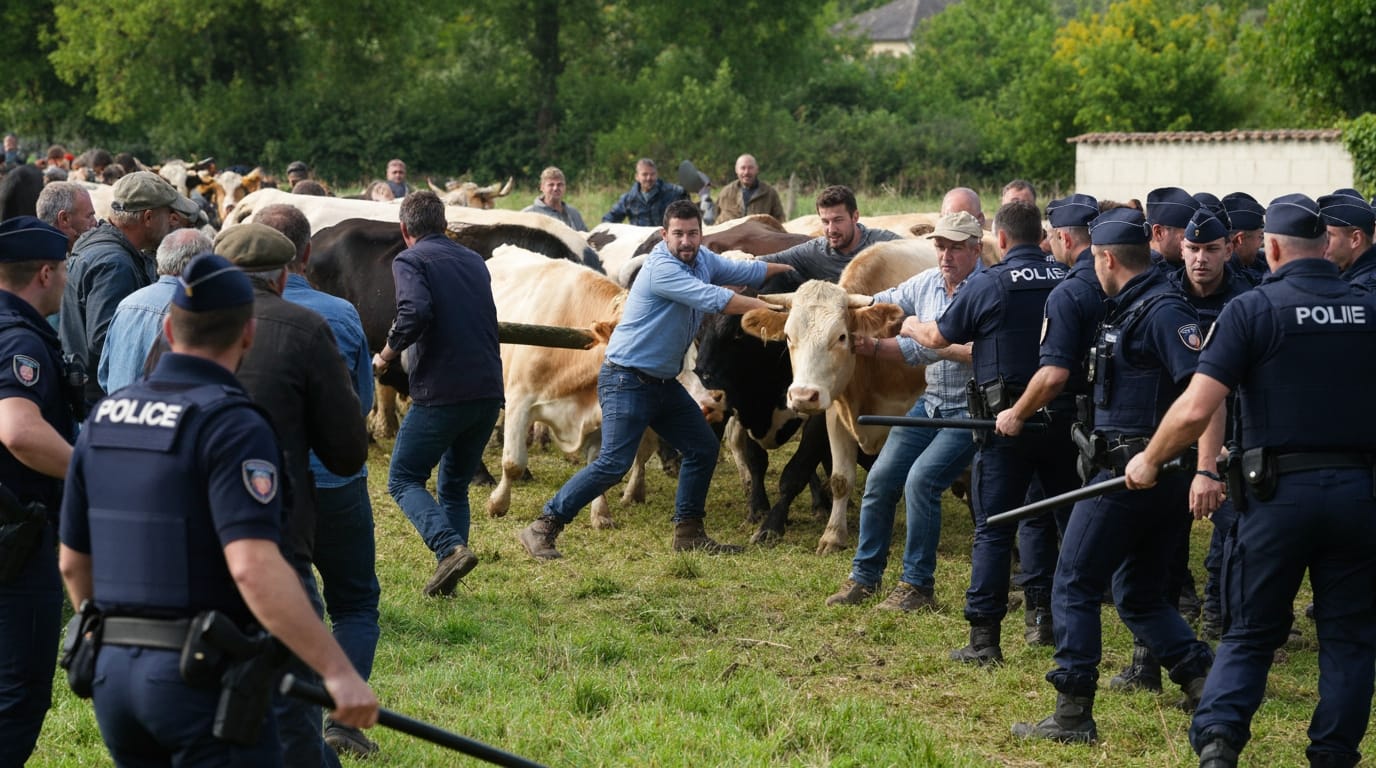
BORDEAUX, France – French law enforcement has recently moved to dismantle farmer-erected barricades, clashing with agricultural workers attempting to prevent the culling of cattle infected with Lumpy Skin Disease (LSD). The confrontations, particularly acute in the Occitanie region, mark an escalating dispute between authorities implementing disease containment measures and farmers desperate to save their herds and livelihoods. This contentious policy, aimed at halting the spread of the highly contagious viral disease, has ignited widespread protests across the nation, pushing long-simmering agricultural grievances to the forefront.
In recent days, the southwest of France has become a focal point of this deepening conflict. In the Ariège department, specifically around Bordes-sur-Arize, farmers mobilized to block access to farms where culling orders had been issued, including one for approximately 200 cows following an LSD outbreak. Farmers utilized tractors and even felled trees to construct roadblocks, disrupting transport and setting up a defiant stand against veterinary services and police. These actions led to violent clashes with riot police, who deployed tear gas to disperse demonstrators. Several arrests were reported, and some protesters allegedly threw projectiles and Molotov cocktails at law enforcement officers. By Thursday, December 11, and Friday, December 12, police had successfully cleared several blockades, allowing culling operations to commence.
The core of this escalating tension lies in the French Ministry of Agriculture's stringent policy for containing Lumpy Skin Disease, a viral illness that recently arrived in France. First detected in Savoie in June 2025, LSD, also known as contagious nodular dermatitis, is a highly contagious disease affecting cattle and buffalo. While harmless to humans and not transmissible through the consumption of animal products, the virus causes fever, skin nodules, reduced milk yield, potential sterility in bulls, and can lead to death. To prevent its wider spread and safeguard France's critical disease-free status for agricultural exports, the government has mandated the total culling of all animals in affected herds. This strategy, which also includes movement bans and compulsory vaccination in some areas, is supported by veterinary authorities and scientists who emphasize the need for rapid depopulation of hotspots to control the virus. By August 2025, the virus had affected 77 herds across three departments, and by late October, there were 94 reported outbreaks, resulting in the culling of approximately 2,600 animals.
Despite the government's scientific justifications, French farmers and their unions view the mass culling policy as an "inhumane" and economically devastating measure. Unions such as Confédération Paysanne and Coordination Rurale argue that the policy is primarily an economic decision to protect export markets rather than a purely health-driven one, and they have called for less drastic alternatives like partial culling of only infected animals or widespread vaccination. Farmers highlight the emotional distress of losing entire herds, often built up over generations, stating that financial compensation alone cannot replace the deep bonds with their animals. Concerns have also been raised that some culled animals had already been vaccinated, further fueling doubts about the necessity and effectiveness of the total culling approach. Protests have not been confined to rural areas; in early December, farmers from Confédération Paysanne stormed and vandalized the Agriculture Ministry in Paris, spraying red paint and chanting slogans to denounce the policy.
The legal challenges brought by farmers to halt the culling orders have largely been unsuccessful. For instance, a farmer from Savoie, backed by Coordination Rurale, filed a request with the Grenoble Administrative Court to overturn an order to slaughter his livestock. However, the court upheld the government's decision, affirming the "legality, necessity and proportionality" of the culling measures. Farmers emphasize the severe economic strain imposed by these forced culls, arguing that current support is insufficient to offset their losses. This immediate crisis surrounding Lumpy Skin Disease has also become a lightning rod for broader farmer discontent, including concerns over rising operating costs, perceived bureaucratic burdens, and the financial viability of farming in France. Road blockades, including one involving around 100 tractors on the A75 motorway near Buisson in Lozère, and disruptions on the A9 and roads around Toulouse, illustrate the depth of this widespread frustration. Farmers' unions have indicated that these protests, which are receiving support from across the southwest region, could continue for several days, threatening to spread further as a general strike on agricultural issues.
The ongoing clashes in France underscore a profound tension between public health imperatives and the deeply personal and economic realities of agricultural life. While authorities insist on the necessity of mass culling to prevent a wider epidemic and protect the national herd, farmers grapple with the immediate and long-term devastation of losing their livestock. As police continue to enforce the culling orders and farmers vow to maintain their resistance, the situation remains volatile, highlighting the urgent need for solutions that address both disease control and the sustainability of France's vital agricultural sector.


