Germany Eases Trucking Rules as Critical Water Levels Threaten Economic Stability

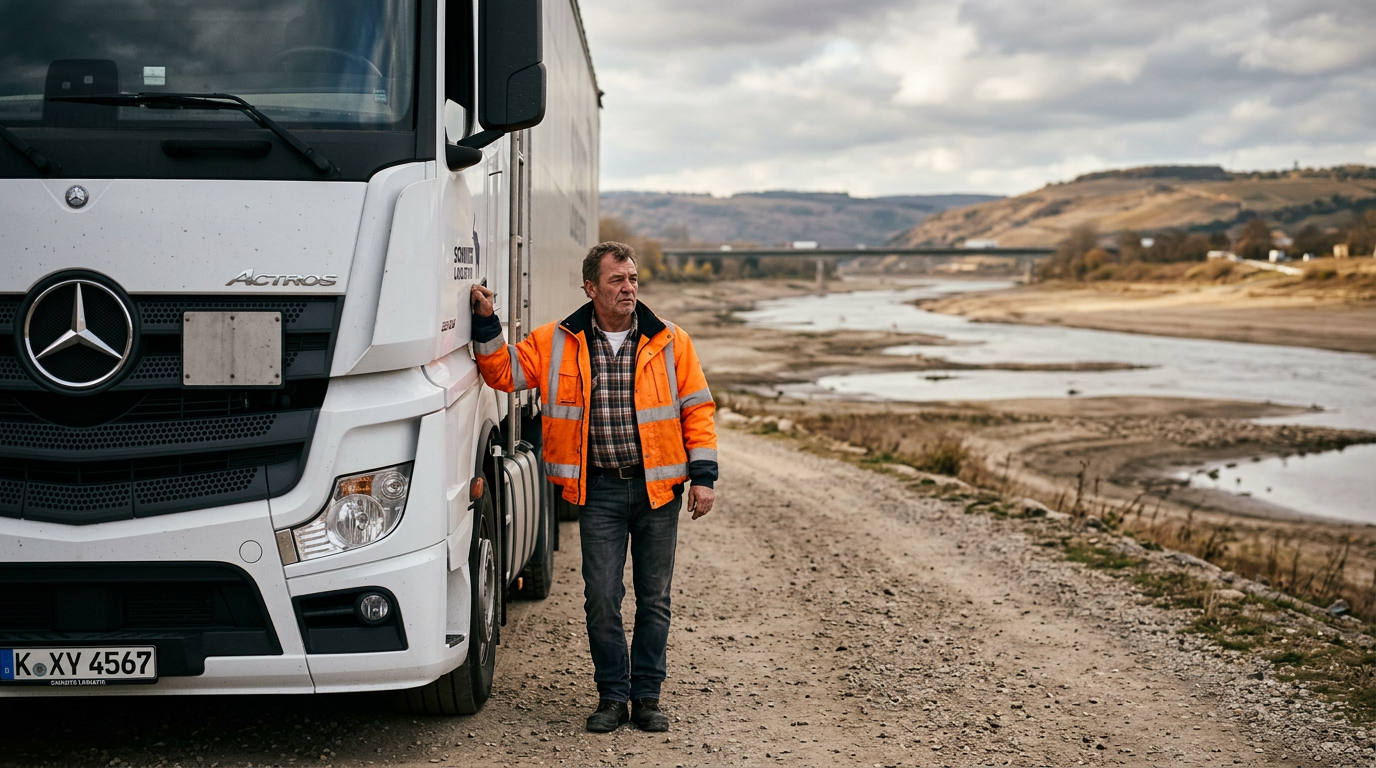
Germany has moved to temporarily relax trucking regulations, including Sunday driving bans, as record-low water levels on its crucial rivers, particularly the Rhine, severely hamper inland shipping and pose a growing threat to the nation's industrial heartland and overall economic stability. The unprecedented drought and heatwave across Europe have pushed key waterways to navigability limits, forcing industries to scramble for alternative transport methods and raising fears of significant economic repercussions.
The crisis intensified as water levels at Kaub, a critical chokepoint on the Rhine, plunged to historic lows, with forecasts indicating depths as shallow as 18 centimeters, surpassing the previous record of 25 centimeters set during the 2018 drought. This drastic reduction means that barges, which typically transport vast quantities of raw materials and finished goods, can only operate at a fraction of their capacity, some as low as 20% to 30%, necessitating more vessels or alternative logistics routes at substantially higher costs.
Rhine's Critical Role Under Threat
The Rhine River stands as Germany's most vital artery for inland shipping, annually moving approximately 285 million tonnes of freight, accounting for about 80% of all goods transported on the country's waterways. This crucial corridor connects Germany's major industrial clusters, including the Rhine-Ruhr steel region, Rhine-Main, and the Ludwigshafen chemical complex, with international ports like Rotterdam. Its diminished capacity directly impacts the flow of essential commodities such as grains, minerals, ores, coal, oil products, chemicals, and automotive components, disrupting supply chains for major players like steelmaker Thyssenkrupp and chemical giants Covestro and Lanxess.
The Port of Duisburg, situated in Germany's industrial Ruhr region, has reported a significant drop in vessel loading capacities, sometimes reduced to a mere third of usual levels. This has led to a 50% to 60% increase in port calls and a forced shift of cargo to smaller barges, rail, and road transport. Refining companies, such as Shell, are maximizing storage capacities and exploring pipelines as well as rail and road to divert shipments.
Emergency Measures and Policy Adjustments
In response to the escalating crisis, Federal Transport Minister Steffen Bilger convened an emergency meeting on August 6 with industrial executives, shipping companies, and port bosses to discuss practical solutions. A key outcome has been the temporary easing of restrictions on truck traffic. Several German states, notably Rhineland-Palatinate, have lifted the Sunday and public holiday driving bans for trucks involved in transport operations directly linked to low water levels on the Rhine or those replacing restricted inland waterway freight. These exemptions, effective from August 7 and slated to remain until at least September 30, 2026, also cover empty runs connected to such transport.
The federal government is also engaging with rail operators, including state-owned DB Cargo, to provide additional capacity and shift more freight from rivers to the rail network. Earlier in July, Germany launched a nationwide Low Water Information System (NIWIS) to provide real-time data on river levels, groundwater, and soil moisture, aiming to improve management of water resources amidst increasing climate pressures.
Economic Fallout and Supply Chain Strain
The economic ramifications of the prolonged low water levels are substantial. The cost of freight has surged, with tanker barge transport from Rotterdam to Karlsruhe seeing a threefold increase, jumping from €45 to €150 per tonne since June. This rise in logistics costs and shipping disruptions are pressuring Germany's supply chains and production. Economists from ING and the Kiel Institute for the World Economy warn that the current situation could shave between 0.1 and 0.3 percentage points off Germany's Gross Domestic Product (GDP) this year. This potential impact could be even more significant than the 0.3% GDP reduction experienced during the 2018 drought, as record lows are occurring earlier in the year.
While rail and road are being utilized as alternatives, they face their own limitations. Germany already contends with a chronic shortage of truck drivers and an overloaded rail network, making it difficult to fully compensate for the reduced capacity on waterways. The Port of Hamburg has actively promoted increased rail links to cities like Cologne and Duisburg for container transport, acknowledging rail's ability to operate independently of water levels.
Long-Term Adaptation to Climate Realities
The recurring nature and increasing severity of these low-water events are firmly linking them to the broader challenges of climate change. Environment Minister Carsten Schneider has highlighted that water scarcity could cost Germany an estimated €625 billion by 2050, underscoring the urgent need for long-term adaptation measures. Discussions are underway regarding more enduring solutions, including proposals to deepen critical stretches of the Rhine to ensure year-round navigability. There is also a push to strengthen rail transport infrastructure and support the development of vessels capable of navigating shallower waters.
Environmental organizations, however, have criticized the focus primarily on engineering solutions, advocating for a more holistic approach that prioritizes preserving climate-resilient rivers, reinforcing rail freight, and significantly reducing greenhouse gas emissions. They argue that solely adjusting navigation channels overlooks the crucial link between degraded rivers and persistently low water levels.
The current crisis serves as a stark reminder of Germany's vulnerability to climate-induced disruptions to its vital economic infrastructure. While immediate trucking rule relaxations offer some short-term relief, the ongoing situation on the Rhine and other major rivers underscores the pressing need for comprehensive, sustainable strategies to safeguard Germany's economy and adapt its logistics framework to the evolving realities of a changing climate. The coming weeks will be critical as industries and policymakers navigate this complex challenge, balancing immediate needs with long-term environmental and economic imperatives.
Related Articles

Ratko Mladić, "Butcher of Bosnia" and Convicted War Criminal, Dies at 84
THE HAGUE, Netherlands – Ratko Mladić, the former Bosnian Serb military commander known as the "Butcher of Bosnia" and convicted of genocide, war crimes, and crimes against humanity, has died at the age of 84. Serbian...


Long-Awaited 9/11 Mastermind Trial Set for 2028, Decades After Attacks
GUANTANAMO BAY, Cuba – Nearly a quarter-century after the devastating terror attacks of September 11, 2001, a military judge has finally set a trial date for Khalid Sheikh Mohammed, the alleged mastermind behind the...