Germany's Civic Space Downgraded Amid Mounting Concerns Over Freedoms
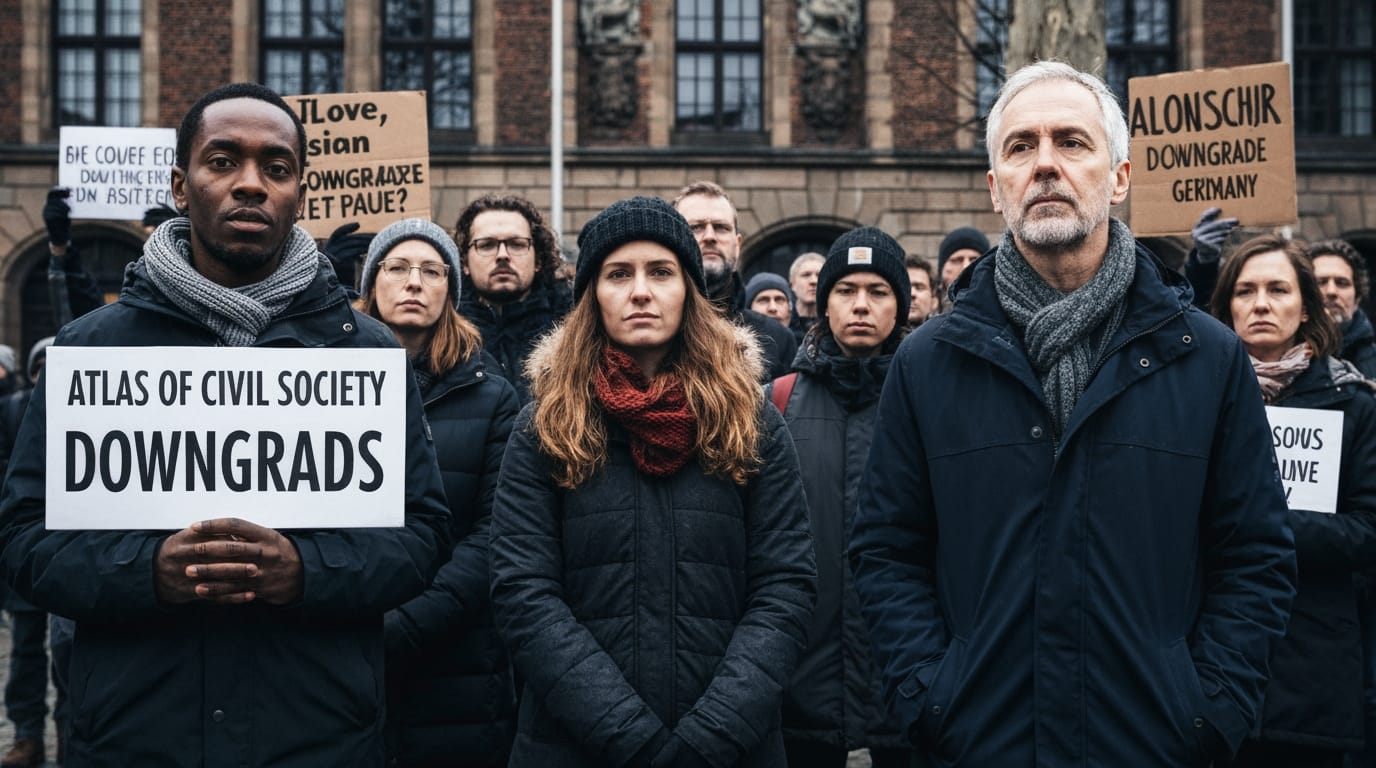
Berlin — Germany, long considered a robust democracy and a champion of civil liberties, has seen its civic space rating significantly downgraded, signaling a troubling trajectory for the nation's democratic health. A recent report by the CIVICUS Monitor, a global civil society watchdog, has lowered Germany's status from "Narrowed" to "Obstructed" in its "People Power Under Attack 2025" assessment, placing it in a category shared by countries like Hungary and Brazil. This marks a concerning trend, following an initial downgrade in 2023, and underscores growing anxieties about the government's approach to protest, dissent, and the operational freedom of non-governmental organizations.
The findings, which contribute to broader analyses like the "Atlas of Civil Society" published by the German relief organization Brot für die Welt, paint a picture of increasing restrictions on fundamental freedoms within the heart of Europe. Brot für die Welt, which draws on data collected by the CIVICUS network, highlighted in its 2025 Atlas that democracy and human rights are under attack globally, with a staggering 85% of the world's population living in countries where civil society is restricted, suppressed, or closed. Germany's inclusion in a more restrictive category reflects a pattern of actions by authorities that critics argue are stifling public debate and curtailing the essential watchdog role of civil society.
From "Narrowed" to "Obstructed": A Deteriorating Landscape
The latest downgrade to "Obstructed" by the CIVICUS Monitor, announced in December 2025, reflects a sharpened deterioration of civic freedoms. This change follows a previous downgrade in December 2023, when Germany's civic space was reclassified from "Open" to "Narrowed" in the "People Under Attack 2023" report. The "Obstructed" rating signifies that the space for civil society is heavily contested, with authorities implementing legal and practical constraints that hinder the full enjoyment of fundamental rights.
The primary drivers behind this most recent demotion are a sustained and comprehensive crackdown on Palestine solidarity activism and the targeting of non-governmental organizations (NGOs) critical of government policies regarding the Israeli-Palestinian conflict. Berlin police reportedly filed nearly 9,000 criminal charges related to pro-Palestinian demonstrations since October 2023, with protesters, journalists, and parliamentary observers allegedly facing severe police brutality, including kettling, pepper-spraying, and physical force. In one notable incident, a Palestine solidarity protest was reportedly dispersed for using Arabic, a rule introduced in 2024 that human rights groups, including Amnesty International, have condemned as discriminatory. Additionally, NGOs critical of Israel have reportedly faced funding cuts, raids, and surveillance, further exacerbating concerns about freedom of association and expression.
A Troubling Precedent: The 2023 Downgrade
The seeds of Germany's current civic space challenges were sown earlier, leading to the 2023 downgrade from "Open" to "Narrowed." This initial reclassification was largely attributed to the government's repressive measures against climate activists and early restrictions on pro-Palestine demonstrations.
The CIVICUS Monitor's 2023 report specifically cited the detention of climate activists for non-violent civil disobedience actions and the use of excessive force by police to remove protestors, with over 700 individuals removed from Lützerath in January of that year. Disturbingly, a journalist accredited with the police was reportedly beaten and pepper-sprayed while covering environmental protests. The report also highlighted the German government's imposition of restrictions on mass protests supporting Palestine during the assault on Gaza and an announced intention to "deport all non-citizens perceived to be expressing support for Hamas." These actions, observers noted, began to erode the previously "Open" environment, setting a worrying precedent for the state's interaction with public dissent.
The Essence of Civil Society and the Perils of its Shrinkage
Civil society encompasses the arena of voluntary, non-governmental organizations and institutions operating independently from the state and the market. It includes charities, advocacy groups, community organizations, and human rights campaigns, all working to promote shared interests, values, and community engagement. This "third sector" is considered a vital component of a functioning democracy, acting as a watchdog, advocating for social justice, and holding governments accountable.
The concept of "shrinking civic space" describes a global phenomenon where governments, through various tactics, limit the ability of civil society organizations to operate freely. This can manifest as restrictions on public assembly, freedom of expression, and association. When civil space shrinks, it diminishes channels for civic engagement, suppresses dissent, and limits citizens' ability to participate effectively in political processes. This environment can foster fear, leading to self-censorship and a decline in democratic engagement. Beyond direct repression, civil society organizations in Germany have also faced challenges through funding cuts and legal scrutiny, particularly those whose work is deemed politically sensitive or critical of government policy.
Global Implications and a Call for Re-evaluation
Germany's declining civic space rating carries significant implications for its international standing as a democratic leader. The nation now finds itself grouped with others where civic freedoms are under considerable strain, raising questions about its commitment to the very values it often advocates for on the global stage. The CIVICUS Monitor explicitly warns that civic space across Europe is in rapid decline, with 12 European countries downgraded since 2018.
International bodies and civil society forums have expressed deep concern over the developments, emphasizing that transparent and evidence-based funding decisions, independent of political alignment, are crucial for a resilient democracy. The ability of civil society to operate without fear of debilitating shutdowns is paramount for fostering a vibrant, pluralistic society capable of countering extremism and promoting democratic participation.
The continuous downgrades serve as a stark reminder that even established democracies are not immune to the pressures that can erode fundamental freedoms. For Germany, a nation with a profound historical commitment to human rights in its post-war constitution, the current trajectory necessitates a critical re-evaluation of policies and practices impacting civil society. Reversing this trend will require a renewed commitment to protecting freedom of expression, assembly, and association, ensuring that the voices of civil society can continue to contribute to a healthy democratic discourse without impediment.


