U.S. Launches Retaliatory Strikes on Iran Following Drone Attack in Strait of Hormuz
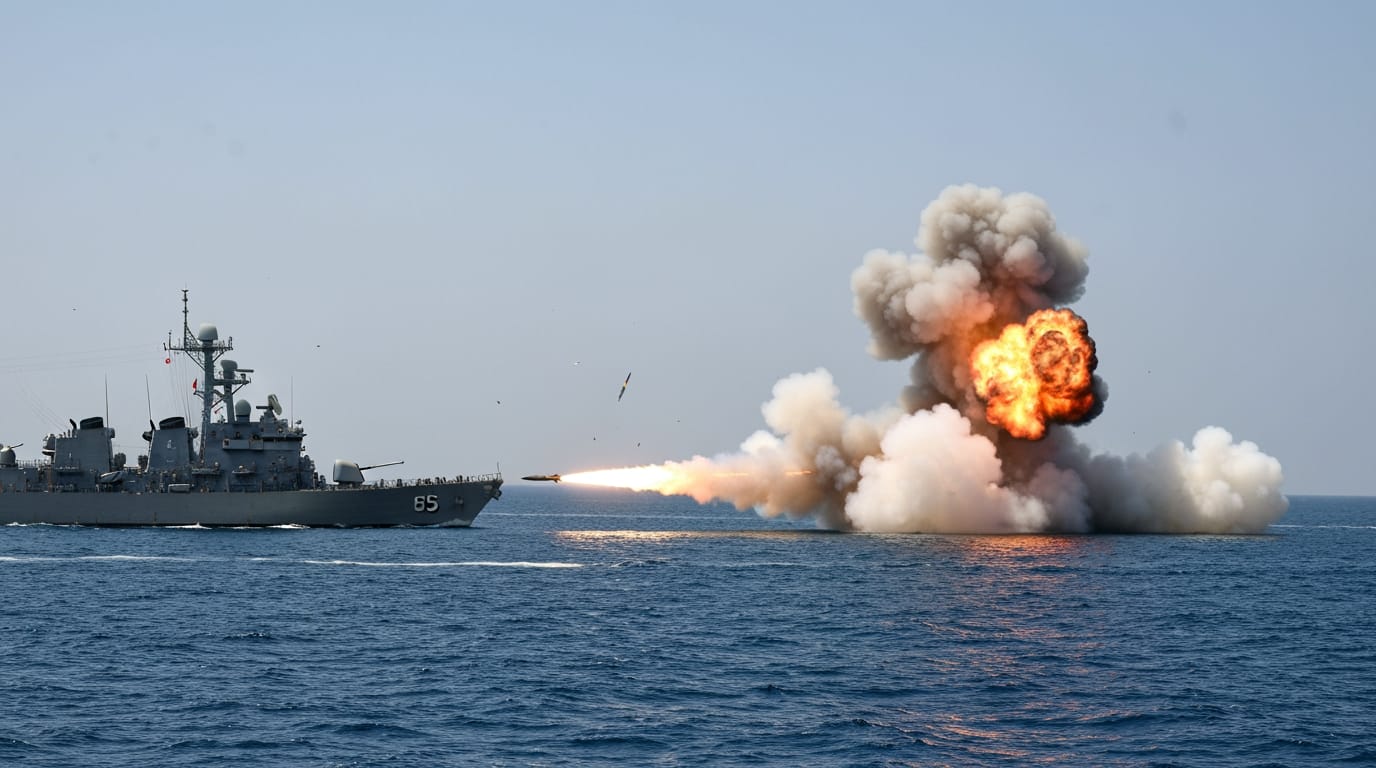
WASHINGTON D.C. – The United States military today conducted retaliatory strikes against Iranian targets after an Iranian drone attack on a commercial vessel in the strategic Strait of Hormuz, escalating tensions in a region already navigating a fragile ceasefire. President Donald Trump denounced the drone strike as a "foolish violation" of the recent diplomatic understanding between Washington and Tehran, underscoring the precarious nature of ongoing peace negotiations.
The U.S. Central Command (CENTCOM) confirmed that its forces targeted Iranian missile and drone storage facilities, as well as coastal radar sites, on Friday. This swift response follows Thursday's incident where a Singapore-flagged cargo ship, the M/V Ever Lovely, was struck by an Iranian drone while transiting the critical maritime chokepoint. The incident immediately cast a shadow over efforts to de-escalate hostilities and ensure the safe passage of international shipping through one of the world's most vital oil arteries.
Escalation in the Vital Waterway
The drone attack on the M/V Ever Lovely occurred on Thursday, June 25, as the vessel exited the Strait of Hormuz along the Omani coast. According to President Trump, Iranian forces launched at least four "one-way attack drones" at ships traversing the strait. While one drone reportedly hit the upper deck of the M/V Ever Lovely, causing damage to its bridge, U.S. forces successfully intercepted and shot down three other Iranian drones aimed at the ship. Fortunately, no casualties were reported aboard the commercial vessel, and it was able to continue its transit.
This act of aggression quickly drew a sharp rebuke from President Trump, who took to social media to label it a "foolish violation" of the ceasefire agreement. The attack brought immediate disruptions to maritime operations in the region. The United Nations' International Maritime Organization (IMO) announced it would temporarily pause its efforts to evacuate hundreds of ships stranded in the Persian Gulf, citing the need to reconfirm safety guarantees for vessels operating in the area. With approximately 500 vessels still awaiting safe passage, the halt by the IMO highlights the significant practical implications of such incidents on global commerce and supply chains.
Washington's Swift Response
In a decisive move, the U.S. military responded to the Iranian aggression within hours. CENTCOM issued a statement confirming that its forces carried out strikes against targets within Iran on Friday. The targets were specifically identified as Iranian missile and drone storage facilities, along with coastal radar sites. CENTCOM described the action as a "powerful response" to Iran's "dangerous behavior" and reiterated that "unwarranted aggression against commercial shipping by Iranian forces clearly violated the ceasefire."
The precision of the strikes aimed to degrade Iran's capabilities to conduct similar attacks while minimizing broader escalation, though the full impact remains to be assessed. This direct military action underscores the Trump administration's commitment to protecting freedom of navigation in international waters and its willingness to enforce the terms of the recently established ceasefire, despite the ongoing diplomatic complexities.
A Ceasefire Under Strain
The drone attack and subsequent U.S. retaliation unfold against the backdrop of a delicate ceasefire agreement—a Memorandum of Understanding—signed between the U.S. and Iran just last week, on June 17, 2026. This agreement was intended to pave the way for a more comprehensive peace deal, including discussions on Iran's nuclear program and the lifting of sanctions. A primary objective of the interim deal was the reopening of the Strait of Hormuz, a critical maritime chokepoint that had been largely closed to shipping during months of heightened conflict.
The resumption of shipping traffic through the strait had seen a significant increase since the memorandum was signed, with reports indicating a surge in transits. However, the M/V Ever Lovely incident immediately jeopardizes this fragile diplomatic progress. President Trump emphasized that the attack was a clear breach of the ceasefire, noting that a key part of the agreement was for the Strait of Hormuz to remain open and toll-free. Iranian officials had previously pushed back against the notion that unfrozen assets would be used to purchase U.S. crops, with Iran's Parliament Speaker Mohammad Bagher Ghalibaf stating that the only "crop" being harvested was "decades of mistrust." This exchange highlights the deep-seated distrust that continues to plague U.S.-Iran relations, even amidst attempts at de-escalation.
Regional Repercussions and Global Concerns
The latest exchange of hostilities has sent ripples of concern throughout the broader Middle East. Shortly after President Trump hinted at a U.S. response, Iranian state media reported explosions in Sirik, located in southern Iran. While details of these explosions remain unconfirmed, they suggest Iran's acknowledgement of or response to the U.S. strikes.
This incident also adds to a volatile regional environment, which has recently witnessed Israeli strikes in Lebanon and a false missile alert in Dubai, underscoring the pervasive instability. The Strait of Hormuz, through which approximately one-fifth of the world's oil supply passes, remains a critical strategic bottleneck. Previous closures and threats of disruption have consistently caused significant fluctuations in global oil prices and triggered fears of a wider global energy crisis. Although current oil prices (around $72 a barrel for Brent crude) have not surged dramatically in the immediate aftermath of this latest attack, the long-term impact on market stability remains a significant concern, especially if freedom of navigation continues to be challenged.
The international community watches with bated breath, as the implications of these events could significantly impact global trade, energy security, and the already strained geopolitical landscape.
The recent U.S. retaliatory strikes against Iran, following a drone attack on a commercial ship in the Strait of Hormuz, have plunged the fragile U.S.-Iran ceasefire into deeper uncertainty. While the M/V Ever Lovely sustained damage, the swift military response by the United States aims to deter further aggression and protect international shipping lanes. However, with hundreds of vessels still idled by safety concerns and a peace agreement hanging in the balance, the path forward for de-escalation and long-term stability in the critical Persian Gulf region remains fraught with challenges. The enduring distrust and competing interests continue to fuel a dangerous cycle of action and reaction, leaving the international community to ponder the prospects for a lasting peace.


