Germany's Economic Reality Shapes Climate Policy Under Chancellor Merz
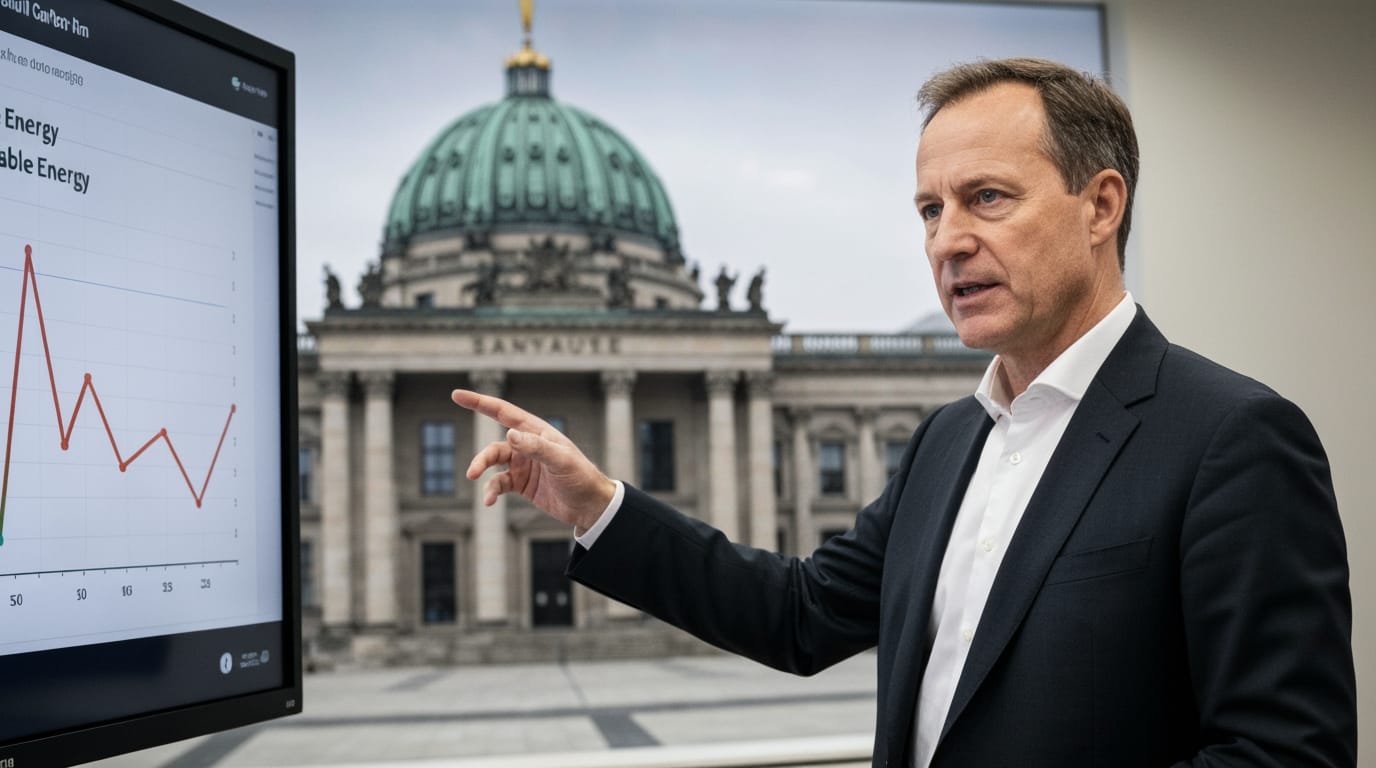
BERLIN – Germany's Chancellor Friedrich Merz has positioned economic competitiveness as a paramount consideration in the nation's ambitious climate protection efforts, asserting that the pursuit of environmental goals must not jeopardize the country's industrial foundation. This perspective marks a significant recalibration in Germany's approach to the energy transition, reflecting a shift towards a more pragmatic, industry-focused strategy amid global energy instability and domestic economic challenges. Speaking at the Petersberg Climate Dialogue, Merz underlined Germany's commitment to international climate targets, including achieving climate neutrality by 2045, but stressed the imperative of integrating economic and energy policies to ensure sustained public support and industrial strength.
Reconciling Climate Ambition with Economic Stability
At the core of Chancellor Merz's policy is the conviction that climate protection and economic prosperity are not mutually exclusive but must be pursued in tandem. His administration argues for a "non-ideological" and "technology-open" pathway to decarbonization, a stance that diverges from the more regulatory-heavy approach of the preceding government. Merz has consistently voiced concerns that overly stringent or rapid climate policies could lead to deindustrialization, undermine innovation, and erode social cohesion, making it clear that any transformation perceived as a threat to Germany's industrial base would not gain popular acceptance. This delicate balancing act seeks to maintain Germany's position as a leading industrial nation while progressing towards its environmental commitments.
The global energy crisis, exacerbated by geopolitical events, and Germany's recent economic downturn provide a critical backdrop to this evolving policy. High energy costs have placed considerable pressure on German industries and households, fueling a political discourse that emphasizes affordability and security of supply alongside climate action. The government's strategy now explicitly links climate policy with energy security, aiming to ensure a reliable and cost-effective energy supply for both its citizens and its formidable industrial sector.
The Role of Industry and Technological Openness
A central pillar of Merz's vision is the sustained support for Germany's energy-intensive industries, including chemicals, mining, and energy. He has pledged to aid these sectors in their transition to climate neutrality, acknowledging that they require sufficient time and regulatory frameworks that do not impose uncompetitive costs. This includes advocating for adjustments to mechanisms like the European Union's Carbon Border Adjustment Mechanism (CBAM) and the Emissions Trading System (ETS), pushing for the allocation of free allowances beyond current schedules to prevent unfair burdens on domestic businesses.
The principle of "technology openness" is another hallmark of the new policy direction. Rather than exclusively relying on renewables, Merz has expressed openness to a broader mix of energy technologies. This includes the planned expansion of gas-fired power plants, viewed as a "bridge technology" to ensure energy security, and an exploration into new nuclear technologies. While German law mandates adherence to climate targets, the Merz government aims for flexibility in how these are achieved, supporting research into fourth and fifth-generation nuclear technology and small modular reactors. This contrasts with the previous government's approach, which saw the shutdown of Germany's last nuclear power plants in April 2023.
Shifting Political Landscape and Implementation
The shift in emphasis has been underscored by a reorganization within the German government. The current coalition, a "grand coalition" of the Christian Democratic Union (CDU/CSU) and the Social Democrats (SPD), has consolidated climate policy responsibilities primarily within the Environment Ministry. This contrasts with the previous administration, where climate considerations were more broadly integrated across multiple ministries, including a dedicated "Ministry for Economics and Climate Protection." This restructuring signals a deliberate move away from what the current government views as an overly integrated and, at times, rigid approach.
Despite the changed tone, Germany remains legally bound by its Climate Protection Act of 2019, which mandates a 65% reduction in greenhouse gas emissions by 2030 compared to 1990 levels, and climate neutrality by 2045. The current government acknowledges these targets and aims to achieve them through economic measures, focusing on carbon taxes and stimulating the transformation of key sectors. However, there are areas of contention, such as the future of the Building Energy Law, which mandated the use of at least 65% renewable energy for new heating systems. The CDU has expressed a desire to amend or abolish this law, arguing for more flexible and consumer-friendly solutions.
International Commitments and European Context
On the international stage, Chancellor Merz has reaffirmed Germany's role as a dependable partner in global climate action, emphasizing multilateralism and effective implementation to secure public support and economic competitiveness. Germany continues its commitment to the Paris Agreement and European climate targets. However, the Merz government is also advocating for changes within the European framework, for instance, pushing back against the EU's planned 2035 ban on new combustion engine cars, signaling a desire to protect the interests of its prominent automotive industry.
The focus on climate action as a tool for industrial competitiveness and economic growth is not unique to Germany. Across Europe, there is a growing debate about the pace and cost of green regulations, particularly in the face of economic headwinds. Merz's approach seeks to demonstrate that climate action can be achieved without sacrificing industrial strength, positioning Germany as a proponent of a pragmatic energy transition that prioritizes both environmental stewardship and economic resilience.
The coming years will test how effectively Germany can reconcile these potentially competing priorities. The success of Merz's integrated climate-economy strategy will hinge on its ability to drive decarbonization while fostering industrial growth, ensuring energy security, and maintaining public acceptance amidst an increasingly complex global landscape.


