Gkolomeev Shatters 50m Freestyle Mark in Enhanced Games Debut, Igniting Global Sports Debate
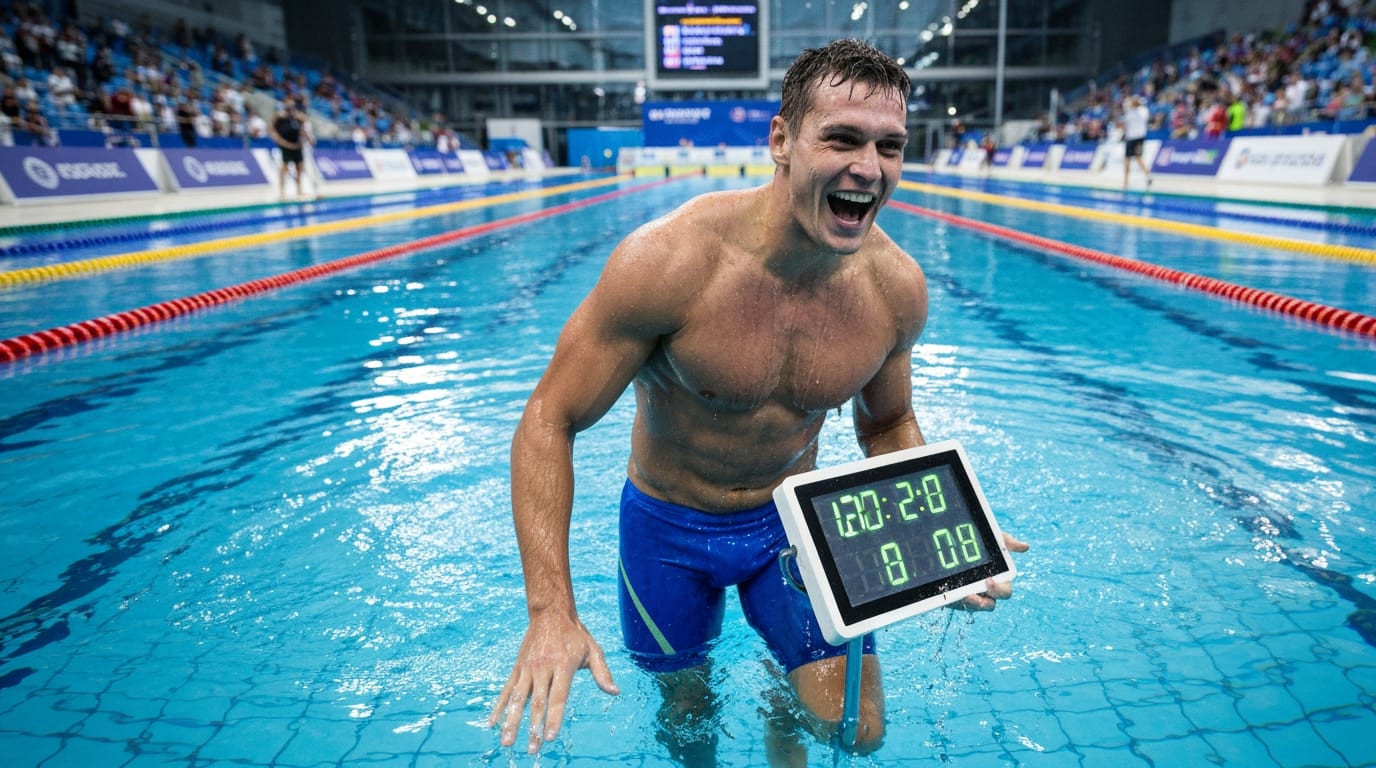
Las Vegas, Nevada – In a polarizing display of athletic prowess and defiance of traditional sporting norms, Greek swimmer Kristian Gkolomeev carved a blistering 20.81 seconds in the men's 50-meter freestyle at the inaugural Enhanced Games in Las Vegas on Sunday, May 24, 2026. The time unofficially eclipses the current official world record of 20.88 seconds set by Australia's Cameron McEvoy in March, instantly crowning Gkolomeev as the event's first "world record" breaker and securing a staggering $1 million bonus, alongside $250,000 for winning the race. However, Gkolomeev's achievement, celebrated within the confines of the controversial Games, will not be recognized by global aquatic authorities, deepening the rift between the nascent organization and the established sporting world.
The Controversial Splash: A Record Unrecognized
Kristian Gkolomeev's electrifying swim was the undeniable highlight of the Enhanced Games' opening day, delivering on the organizers' promise of pushing human performance limits. The 32-year-old Greek Olympian, who had previously failed to medal in four Olympic appearances, powered through the pool at Resorts World Las Vegas, leaving competitors in his wake. His time of 20.81 seconds not only surpassed McEvoy's recent benchmark but also improved upon Gkolomeev's own earlier "record" of 20.89 seconds, achieved in a private event in February 2025, which had itself bested Cesar Cielo's 2009 record of 20.91 seconds. Gkolomeev's performance in Las Vegas was further aided by a polyurethane "super suit," a technology banned in official competitions since 2010 due to its significant performance-enhancing properties.
The jubilant scenes in Las Vegas, with Gkolomeev celebrating with his young son by the poolside, starkly contrasted with the widespread condemnation from international sporting federations. World Aquatics, the global governing body for swimming, has unequivocally stated that Gkolomeev's time, and any records set at the Enhanced Games, will not be officially recognized. This stance is rooted in the fundamental departure of the Enhanced Games from anti-doping regulations, viewing the event as a "circus, built on short-cuts" rather than a legitimate sporting competition. For Gkolomeev, however, the financial reward is life-changing. "It's a big help for me and my family. And yeah, I'm going to continue next year. Maybe I'll break it again," he stated, reflecting on his earnings.
The Enhanced Games: A Vision of "Bodily Autonomy"
The Enhanced Games, founded by Australian businessman Aron D'Souza, positions itself as a revolutionary multi-sport event challenging the very foundations of traditional athletics. Its core philosophy hinges on "bodily autonomy," explicitly permitting and even encouraging athletes to use performance-enhancing substances (PEDs). Organizers claim that any such substances must be FDA-approved and administered under strict medical supervision, aiming to bring what they describe as a "shadow" practice into the light of transparency and scientific oversight.
D'Souza, who has been replaced as CEO by Maximilian Martin but remains a key figure, founded the Games on the premise that the International Olympic Committee (IOC) maintains an exploitative relationship with athletes and that existing anti-doping agencies are "anti-science." The Enhanced Games seeks to redefine human limits, arguing that scientific advancement should be embraced rather than policed in sports. The event's financial model offers substantial incentives, including $250,000 for event winners and a $1 million bonus for breaking officially recognized world records, a stark contrast to traditional Olympic events where prize money is often limited or non-existent from the organizing body directly. The inaugural Games featured swimming, track and field, and weightlifting, held in Las Vegas and attended by a curated audience of approximately 2,500.
A Swirl of Controversy: Traditional Sports Push Back
The very existence of the Enhanced Games has unleashed an avalanche of criticism and sparked a heated global debate within the sporting community. Mainstream sports organizations, including the International Olympic Committee (IOC), the World Anti-Doping Agency (WADA), World Aquatics, and World Athletics, have vehemently condemned the event. Sebastian Coe, President of World Athletics, dismissed the Games as "bollocks," asserting that any athlete from traditional sports participating would face lengthy bans. WADA has characterized the Enhanced Games as a "dangerous and irresponsible concept," warning athletes and support personnel of not only potential bans but also serious long-term health risks associated with performance-enhancing drug use.
Critics argue that the event undermines the principles of fair play, integrity, and the health and well-being of athletes. World Aquatics described it as fundamentally at odds with "universal values like honesty, fairness and equity." The US Anti-Doping Agency (USADA) CEO Travis Tygart called it a "dangerous clown show, not real sport," raising concerns about the ethical implications and potential legal ramifications, particularly regarding the legality of certain steroids in various jurisdictions. Despite the backlash, Enhanced Games advocates maintain that they are fostering transparency in an area where doping is already prevalent but often concealed, arguing that their approach allows for medically supervised and safer use of enhancements.
Beyond the Pool: Mixed Results and Broader Implications
While Gkolomeev's swim dominated headlines, the broader results from the inaugural Enhanced Games presented a mixed bag. Organizers had anticipated numerous world records to fall due to the permissive environment for performance enhancement. However, Gkolomeev's swimming achievement stood out as the sole "world record" broken across all disciplines. Notably, some events were won by athletes who claimed to be competing "clean," without the aid of PEDs. American Fred Kerley, a former world champion in the 100m sprint, won his event in 9.97 seconds, though this was slower than his personal best of 9.76. Hunter Armstrong, another American, won the 50m backstroke, also reportedly competing clean and defeating enhanced rivals.
Conversely, high-profile athletes who publicly embraced enhancement did not always deliver on expectations. Australian former world champion James Magnussen, a vocal proponent of the Enhanced Games' philosophy, finished last in the 100-meter freestyle final, his time significantly slower than his career best, despite reportedly two years of supervised doping. These varying outcomes, witnessed by a specially invited audience, further fuel the debate about the true impact of unregulated performance enhancement and whether it guarantees superior results, or merely alters the playing field.
Charting Unknown Waters
Kristian Gkolomeev's "record-breaking" swim at the Enhanced Games marks a pivotal, albeit controversial, moment in the ongoing discourse about the future of sport. It underscores the profound ideological chasm between traditional athletic institutions, which champion drug-free competition, and the Enhanced Games, which advocates for a future where science and "bodily autonomy" redefine human potential. While Gkolomeev walks away with a life-altering sum, his achievement remains in a gray area, recognized by a movement that actively rejects the rules of global sport.
The inaugural Enhanced Games has undeniably forced a broader conversation about the limits of human performance, the ethics of enhancement, and the commercialization of athletic endeavor. As the dust settles in Las Vegas, the questions linger: Can a sports league built on controversial principles gain mainstream acceptance? What are the long-term health implications for athletes involved? And how will traditional sports bodies respond to this audacious challenge to their authority and values? The waters of professional sports have become increasingly complex, with the Enhanced Games charting a bold, yet uncertain, course into unknown territory.


