Hopes Dim for Stranded Humpback Whale in German Baltic Sea
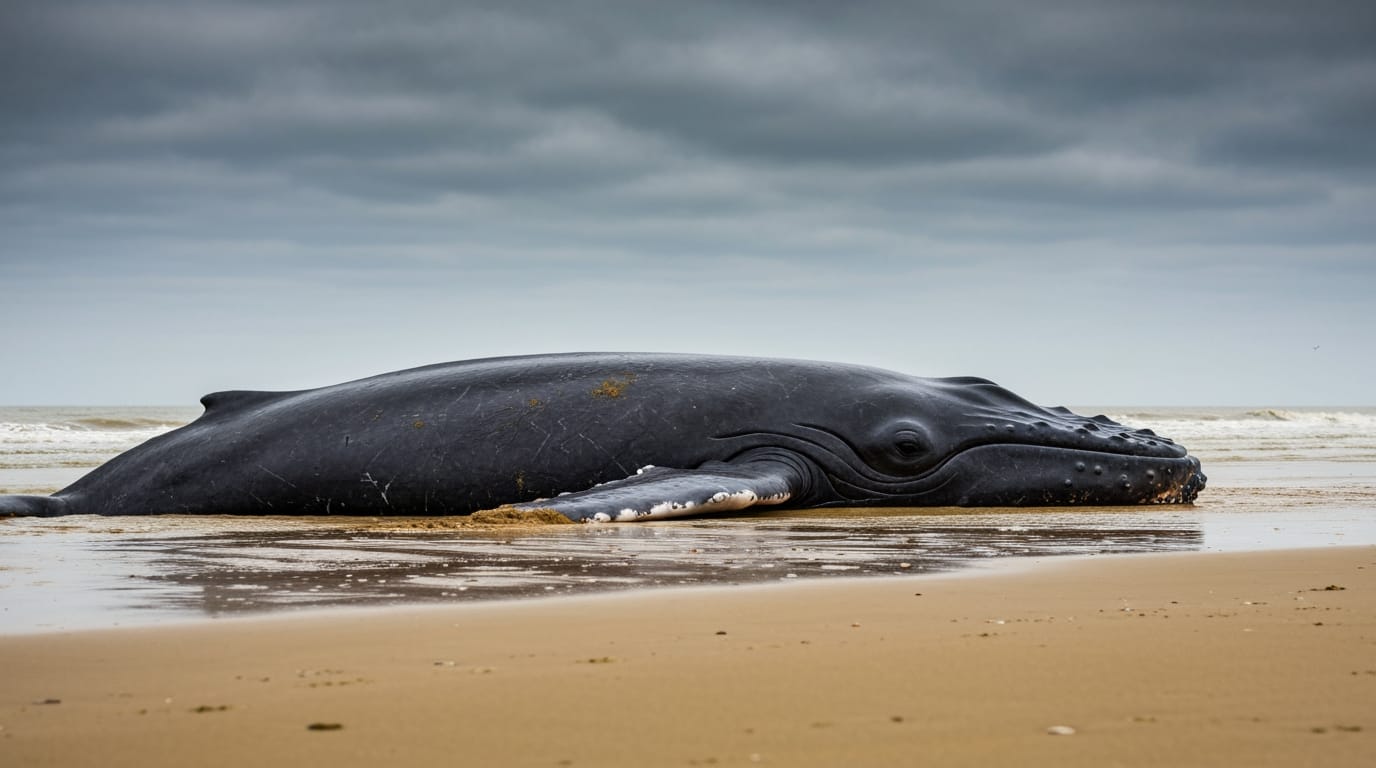
WISMAR, Germany – A struggling humpback whale, believed to be a male, remains trapped in the shallow, brackish waters of Germany's Baltic Sea, with marine experts and environmental officials expressing diminishing hope for its survival. Despite multiple intensive rescue attempts over the past week, the whale, estimated to be between 10 and 15 meters (33 to 49 feet) long, has become increasingly weak and disoriented, far from its natural oceanic habitat. Its plight has captivated public attention across Germany, as rescuers battle against unfavorable environmental conditions and the animal's rapidly deteriorating health.
A Rare Visitor's Dire Predicament
The whale, affectionately dubbed "Timmy" by some, was first spotted in the Baltic Sea on March 3rd, an unusual presence given that humpbacks are not native to these waters. It subsequently became stranded on a sandbank at Timmendorfer Strand beach in late March, initiating a series of desperate rescue operations. Scientists speculate the young whale may have been lured into the Baltic Sea while following a shoal of herring, or perhaps became disoriented during migration or by underwater noise, such as from a submarine. Regardless of the cause, the Baltic Sea presents an inhospitable environment for a creature accustomed to the vastness and higher salinity of the Atlantic Ocean. Its low salt concentration is detrimental to the whale's long-term health, and the region lacks the specific nutrition required for humpbacks to thrive. The whale has already developed a skin disease, further complicating its chances of recovery.
Relentless, Yet Challenged, Rescue Efforts
The initial stranding at Timmendorfer Strand spurred a 76-hour rescue effort that involved a coalition of authorities, volunteers, and marine biologists. Early attempts to free the massive mammal from the sandbank included using an excavator to dig a channel and deploying boats to create large waves, hoping to dislodge it. Marine biologist Robert Marc Lehmann, among the first to examine the whale in the water, initially estimated its chances of survival at a mere 0.1%, describing its situation as the "worst possible". The lack of strong tides in the Baltic Sea proved a significant obstacle, as natural tidal forces could have aided in its liberation. However, a fortunate turn of events on the night of March 26th saw strong winds push water into Lübeck Bay, raising water levels by half a meter and allowing the whale to free itself early on March 27th.
Following its initial release, the humpback was escorted by a flotilla of vessels aiming to guide it through German and Danish waters towards the Atlantic. Despite these efforts, the whale's ordeal was far from over. It became stranded again on Saturday, March 28th, in Wismar Bay, and once more on Sunday, March 29th, solidifying fears that its strength was critically diminished. In response, a 500-meter restricted area was enforced around the whale near Wismar, intended to provide it with crucial rest and a chance to regain enough strength to free itself independently.
A Grim Prognosis and Deteriorating Health
By Sunday, March 29th, the whale's condition had visibly worsened, leading experts to a near-unanimous conclusion that its chances of navigating back to the Atlantic were slim to none. Stefanie Groß of the Institute for Terrestrial and Aquatic Wildlife Research at the University of Veterinary Medicine Hannover observed a significant decrease in the animal's activity, noting that its respiratory rate had dropped considerably and it no longer reacted to nearby vessels. "It is very noticeable that the animal is showing significantly less activity," Groß stated.
Burkard Baschek, a marine scientist and director of the German Maritime Museum in Stralsund, echoed these concerns, stating that the "prognosis as a whole doesn't look good". He emphasized that even if the whale were to free itself again, it would face a daunting journey of approximately 310 miles through narrow straits to reach relative safety, a feat deemed "relatively slim" given its current state. Till Backhaus, the environment minister of Mecklenburg-Western Pomerania, confirmed the whale was not only weakened but also sick, suggesting potential injuries from contact with a fishing net. Humpbacks are known to endure weeks without food, but the prolonged stress, unsuitable environment, and visible ailments present an overwhelming challenge.
Broader Implications and Public Sentiment
The saga of the stranded humpback has resonated deeply with the German public, with media outlets providing continuous updates, including live video streams from the scene, captivating a nation. This widespread public interest underscores a growing global awareness of marine conservation and the fragile balance of oceanic ecosystems. While whale strandings are not uncommon worldwide, the appearance of a humpback in the Baltic Sea is a rare event, highlighting potential ecological shifts or individual disorientation that can lead to such tragic outcomes.
The efforts to save "Timmy" serve as a poignant reminder of the complex challenges involved in wildlife rescue, particularly for large marine mammals. The dedication of rescuers, despite overwhelming odds, reflects a collective human desire to protect vulnerable species and intervene when nature's course takes a perilous turn for individual animals.
An Uncertain Future
As days turn into weeks, the hope that once fueled the initial rescue operations has largely given way to a somber acceptance of the inevitable. The whale's weakened state and its inability to respond to external stimuli signal a nearing end to its struggle. While the possibility of a miraculous recovery and successful return to the Atlantic ocean persists in the minds of some, experts continue to prepare for the most likely outcome. The fate of the stranded humpback whale in Germany's Baltic Sea stands as a somber testament to both the unpredictable beauty of nature and the profound challenges faced by marine life in an ever-changing world.


