Hungarian Political Earthquake: Péter Magyar Challenges Orbán's Decades-Long Dominance
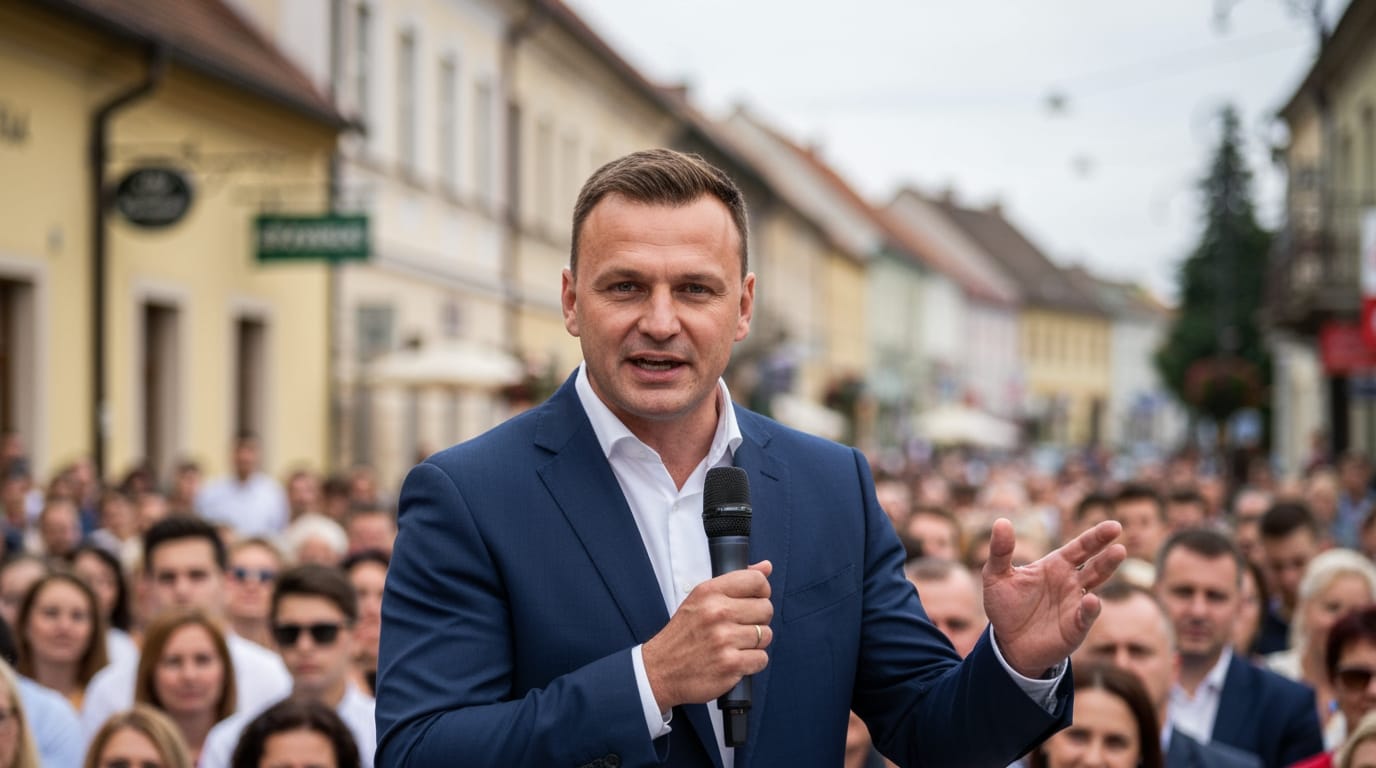
Budapest, Hungary – A political seismic shift is underway in Hungary, as Péter Magyar, a former insider of the ruling Fidesz party, has emerged as the most formidable challenger to Prime Minister Viktor Orbán's 16-year grip on power. His meteoric rise, fueled by public discontent over corruption and a desire for change, signals a potentially transformative moment for a nation long dominated by a single political force. Magyar's newly invigorated Tisza (Respect and Freedom) Party has not only captured the imagination of a significant portion of the electorate but is now seen as a genuine threat to Orbán's long-established political machine.
For over a decade, Hungarian politics has largely revolved around the figure of Viktor Orbán and his Fidesz party, which has systematically consolidated control over the country's institutions. However, the unexpected emergence of Péter Magyar, following a high-profile scandal involving a presidential pardon, has injected an unprecedented level of competition into the political landscape. With opinion polls now frequently placing Tisza ahead of Fidesz, the upcoming general election is shaping up to be a pivotal referendum on Hungary's future direction, both domestically and within the European Union.
The Unprecedented Ascent of a Former Insider
Péter Magyar, a 45-year-old lawyer, was born into a prominent Hungarian family, with his great-uncle, Ferenc Mádl, having served as President of Hungary. For years, Magyar moved comfortably within the circles of Orbán's Fidesz party, even marrying Judit Varga, who later became Orbán's Justice Minister. However, his public break with the government in February 2024 marked a dramatic turning point. This schism was triggered by a presidential pardon scandal, where a high-ranking official was pardoned despite being involved in covering up a child sex abuse case. Magyar publicly resigned from his government-related positions, accusing Fidesz officials of scapegoating women and expressing deep dissatisfaction with the party's governance.
From this dramatic departure, Magyar rapidly carved out a new political path. He took over the obscure Tisza Party to bypass the arduous process of forming a new political entity, transforming it overnight into a powerful vehicle for his burgeoning movement. His platform resonated deeply with voters, centering on anti-corruption, transparency, and a commitment to the rule of law. Magyar, who identifies as a "critical" pro-European and conservative liberal, advocates for deeper cooperation within the European Union and aligning with Western democratic values, a direct contrast to Orbán's often confrontational stance. His rapid ascent was underscored by the 2024 European Parliament elections, where Tisza secured nearly 30% of the vote and seven seats, establishing itself as Hungary's strongest opposition force. Magyar has since embarked on an intensive campaign, crisscrossing the country and attracting tens of thousands to his rallies, even in traditionally Fidesz strongholds.
Orbán's Enduring Legacy and the 'Illiberal State'
Viktor Orbán, who has served as Prime Minister since 2010 (and previously from 1998 to 2002), holds the distinction of being Hungary's longest-serving head of government. His return to power in 2010 was followed by a series of constitutional and institutional changes, facilitated by Fidesz's supermajority in parliament. These reforms have led many international observers and European institutions to describe Hungary under Orbán as an "illiberal democracy" or a "hybrid regime of electoral autocracy," where democratic processes exist but are systematically undermined to maintain power.
Fidesz's dominance has been cemented through various means, including re-rigging the electoral system, stacking courts with loyalists, and extending control over key positions in state institutions with unusually long terms. A significant portion of Hungary's media (estimated at 80%) is controlled by Fidesz loyalists, limiting independent discourse and often portraying government critics as "enemies of the Hungarian nation." Orbán's political ideology champions national conservatism and a "Christian democratic alternative" to Western liberalism, marked by anti-migrant and anti-LGBT+ policies. These policies and the broader shift have frequently strained relations with the European Union, leading to ongoing rule of law concerns and the withholding of significant EU funds, totaling approximately €18 billion.
A Nation Grappling with Discontent and Economic Challenges
The fertile ground for Magyar's emergence can be attributed to growing public dissatisfaction within Hungary. Concerns over pervasive corruption, rising living costs, and the deterioration of public services have become increasingly prominent. According to a 2025 Gallup poll, "politics and government" was identified by 28% of Hungarians as the most important problem facing their country, outpacing concerns about the economy. Adding to this, a majority of Hungarians (57%) expressed a lack of confidence in the honesty of elections, a critical indicator of public trust in the democratic process.
Economically, Hungary, a high-income mixed economy with a strong manufacturing base, particularly in the automotive and electronics sectors, has faced significant headwinds. After experiencing the highest inflation in the EU in 2023, averaging 17.1% and peaking above 25% in early 2023, real wages have eroded and consumer purchasing power has diminished. GDP growth has been sluggish, reaching only 0.3% in 2025, placing Hungary among the lowest performers in the EU. The budget deficit has remained above EU stability criteria, and the country's reliance on EU funding, much of which is currently frozen due to rule of law concerns, further complicates the economic outlook. These economic struggles, combined with persistent EU criticisms regarding judicial independence, media freedom, and the misuse of EU funds, paint a picture of a nation at a crossroads.
The Stakes: A Referendum on Hungary's Future
The current election is widely considered a "milestone election" for Hungary, with the potential to either entrench Orbán's "illiberal state" further or initiate a significant shift towards more democratic governance. Péter Magyar has pledged to implement anti-corruption reforms, address institutional failures, and work to mend Hungary's often contentious relationship with the European Union. His platform signals a departure from Orbán's confrontational approach, with Tisza aiming for a more constructive engagement with Brussels and advocating for Hungary's continued integration within the EU and NATO.
However, even if Magyar's Tisza Party achieves an electoral victory, the path to enacting substantial change will be fraught with challenges. Orbán's Fidesz has meticulously woven its influence throughout the state apparatus, media, and judiciary, creating a system that is resilient to external pressures. Undoing these entrenched reforms would likely require a two-thirds parliamentary majority, a high bar to clear. Political analysts suggest that a Magyar-led government would need to navigate a complex landscape where Fidesz's networks and institutional control could limit the new administration's room for maneuver. Despite these obstacles, the groundswell of support for Magyar represents a powerful demand for change, potentially signaling the beginning of the end for the political paradigm that has defined Hungary for the past decade and a half.
The outcome of this election will undoubtedly shape Hungary's trajectory for years to come. It will determine whether the nation continues on its current "illiberal" course or embarks on a new chapter, one that seeks to reconcile domestic concerns with its place within the broader European community. The battle between the established power and the emerging challenger is more than just a political contest; it is a fundamental debate over Hungary's identity and future.


