Imran Khan Transferred to Private Hospital Following Supreme Court Order, Igniting Political Tensions

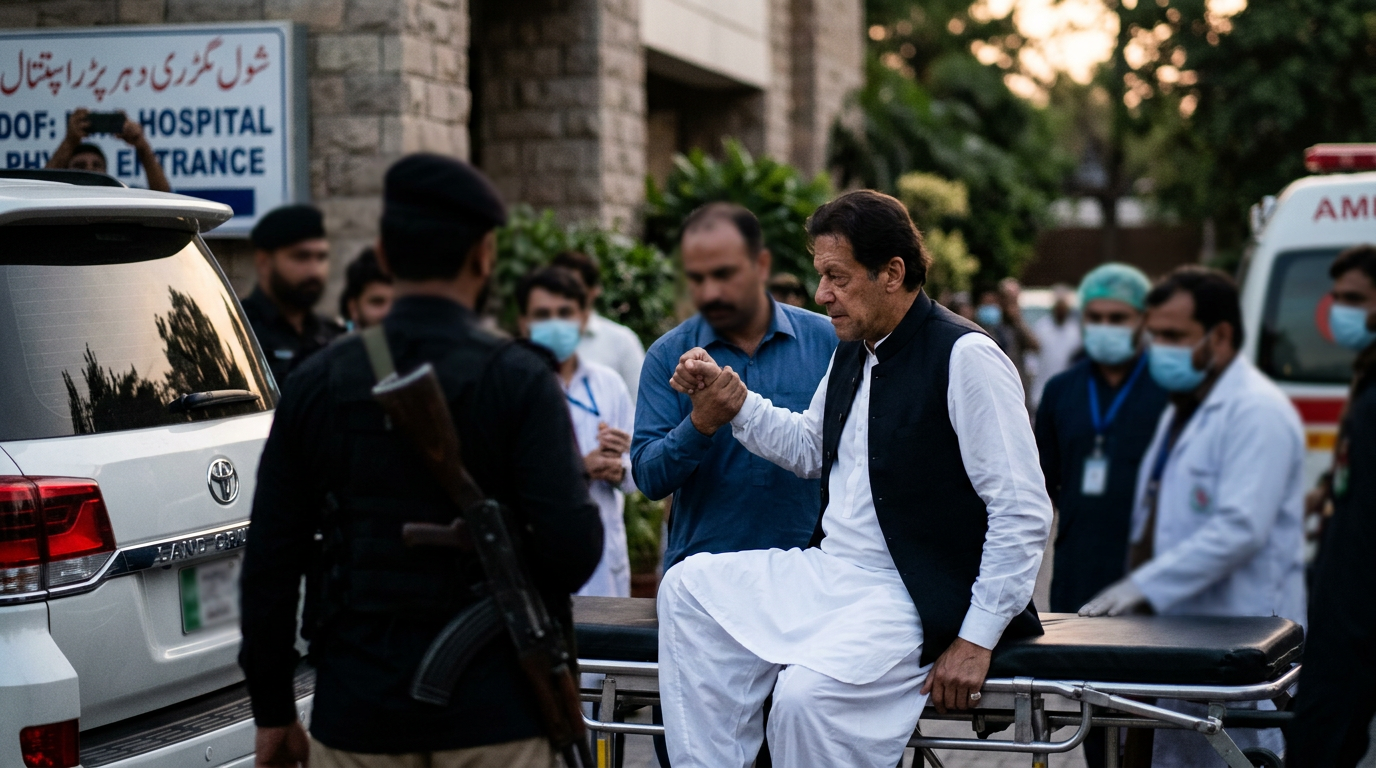
ISLAMABAD, Pakistan – Former Pakistani Prime Minister Imran Khan was transferred to Shifa International Hospital in Islamabad after midnight Thursday for comprehensive medical examinations, a move mandated by the Supreme Court amid escalating concerns over his health and ongoing detention. The transfer, which followed a Supreme Court order issued on Tuesday, August 18, 2026, has further intensified the deeply fractured political landscape of the South Asian nation, with the government signaling its intent to challenge the judicial directive.
The Supreme Court's intervention came after months of persistent pleas from Khan's family and his Pakistan Tehreek-e-Insaf (PTI) party, who have consistently voiced alarms about the former premier's deteriorating health while in custody. Khan, 73, has been incarcerated for three years at Adiala Jail in Rawalpindi, facing numerous charges that he and his party maintain are politically motivated. His move to a private medical facility underscores the judiciary's increasing role in the contentious debate surrounding his well-being and legal status.
Judicial Intervention Amid Growing Health Concerns
The Supreme Court's three-member bench, responding to petitions highlighting Khan's health, ordered his immediate transfer to Shifa International Hospital. This directive includes the formation of a specialized medical board to conduct a thorough assessment, with provisions for his personal physician, Dr. Faisal Sultan, and his sister, Dr. Uzma Khan, a qualified surgeon, to be part of the examination team. The court explicitly warned against the politicization of Khan's health and instructed the PTI to refrain from organizing rallies or protests outside the hospital, emphasizing that his medical treatment should remain separate from political activities. The decision grants Khan a stay at the hospital until the next hearing scheduled for September 16.
Reports submitted to the court, including those from Adiala Jail authorities, indicated that Khan was experiencing fluctuating blood pressure, palpitations, headaches, restlessness, and significant anxiety. Former President Arif Alvi, a senior PTI member, had previously declared Khan's medical reports "alarming," citing rising blood pressure, palpitations, and extreme psychological stress after three years of imprisonment. Concerns were also raised regarding Khan's vision, with claims of severe vision loss in one eye due to central retinal vein occlusion (CRVO), an issue his family attributes to delayed medical care during his confinement. The Adiala Jail medical records detailed 39 check-ups by various specialists between November 2023 and August 2026, noting some improvement in his eye condition after previous treatments at Pakistan Institute of Medical Sciences (PIMS).
Government's Resistance and Legal Challenge
Despite the clear directive from the nation's highest court, the Pakistani government has expressed strong reservations about the ruling. Law Minister Azam Nazeer Tarar publicly stated the government's intention to challenge the Supreme Court's order, arguing that treating a convicted prisoner in a private hospital deviates from standard prison protocols. The government filed a review petition contending that the order bypassed established prison rules, particularly section 197 of the Pakistan Prison Rules, 1978, and raised concerns about equitable treatment for other inmates.
Government officials, including Parliamentary Affairs Minister Tariq Fazal Chaudhry, had previously indicated a willingness to comply with court orders regarding Khan's care, even considering treatment abroad if domestic facilities proved inadequate. However, the pushback against his transfer to a private facility suggests a deeper reluctance to afford Khan what they perceive as preferential treatment. The Law Minister reiterated that health issues should be separated from politics and that, under law, prisoners should receive medical attention within prison or at government hospitals.
The Context of Khan's Confinement
Imran Khan's three-year imprisonment began in August 2023, following his ouster from power in April 2022 through a no-confidence vote. He has since been embroiled in a multitude of legal battles, including convictions in the Toshakhana corruption case and the Al-Qadir Trust case. Khan and the PTI maintain that these cases are politically motivated and orchestrated by the establishment to sideline him from Pakistan's political arena.
His detention at Adiala Jail has been a constant source of controversy. The high-security facility in Rawalpindi, known for housing high-profile political prisoners, has faced scrutiny over its conditions. While jail authorities have claimed that Khan was provided facilities "beyond what is normally allowed for B-Class prisoners," including a secure seven-cell area, an open courtyard, and access to books and television, his family and party have painted a starkly different picture. They allege prolonged solitary confinement, restricted access to lawyers and family, and inadequate medical care, directly attributing some of his health issues, such as the severe vision loss, to these conditions. Amnesty International has also raised concerns about the denial of fair trial rights, prolonged solitary confinement, and limited access to medical care and visitation rights for Khan, stating his imprisonment was "unlawful and politically motivated."
PTI's Stance and Heightened Political Discourse
The PTI has consistently rallied for Khan's release and proper medical care. Party leaders welcomed the Supreme Court's order but strongly condemned the government's attempts to challenge it. PTI Secretary-General Barrister Salman Akram Raja warned of potential contempt of court proceedings if the government failed to comply with the order by Thursday afternoon. He emphasized the criticality of an independent medical evaluation at a reputable hospital, particularly given the long delays in his medical care during imprisonment.
The health and detention of Imran Khan remain highly sensitive topics that continue to fuel political discourse and tensions across Pakistan. His party retains significant public support, and his situation is intertwined with the broader struggle for political influence in the country. The Supreme Court's decision to ensure his access to private medical care has provided a temporary reprieve for Khan and his supporters, even as the government's challenge signals continued legal and political friction.
The coming weeks will reveal the extent to which the government adheres to the Supreme Court's directive or succeeds in its legal challenge, further shaping the narrative around justice, human rights, and political power in Pakistan. The focus remains on Khan's health and the broader implications for the rule of law in a nation perpetually grappling with political instability.
Related Articles

Ratko Mladić, "Butcher of Bosnia" and Convicted War Criminal, Dies at 84
THE HAGUE, Netherlands – Ratko Mladić, the former Bosnian Serb military commander known as the "Butcher of Bosnia" and convicted of genocide, war crimes, and crimes against humanity, has died at the age of 84. Serbian...

Long-Awaited 9/11 Mastermind Trial Set for 2028, Decades After Attacks
GUANTANAMO BAY, Cuba – Nearly a quarter-century after the devastating terror attacks of September 11, 2001, a military judge has finally set a trial date for Khalid Sheikh Mohammed, the alleged mastermind behind the...