India Hikes Fuel Prices Amid Mounting Iran War Economic Pressures
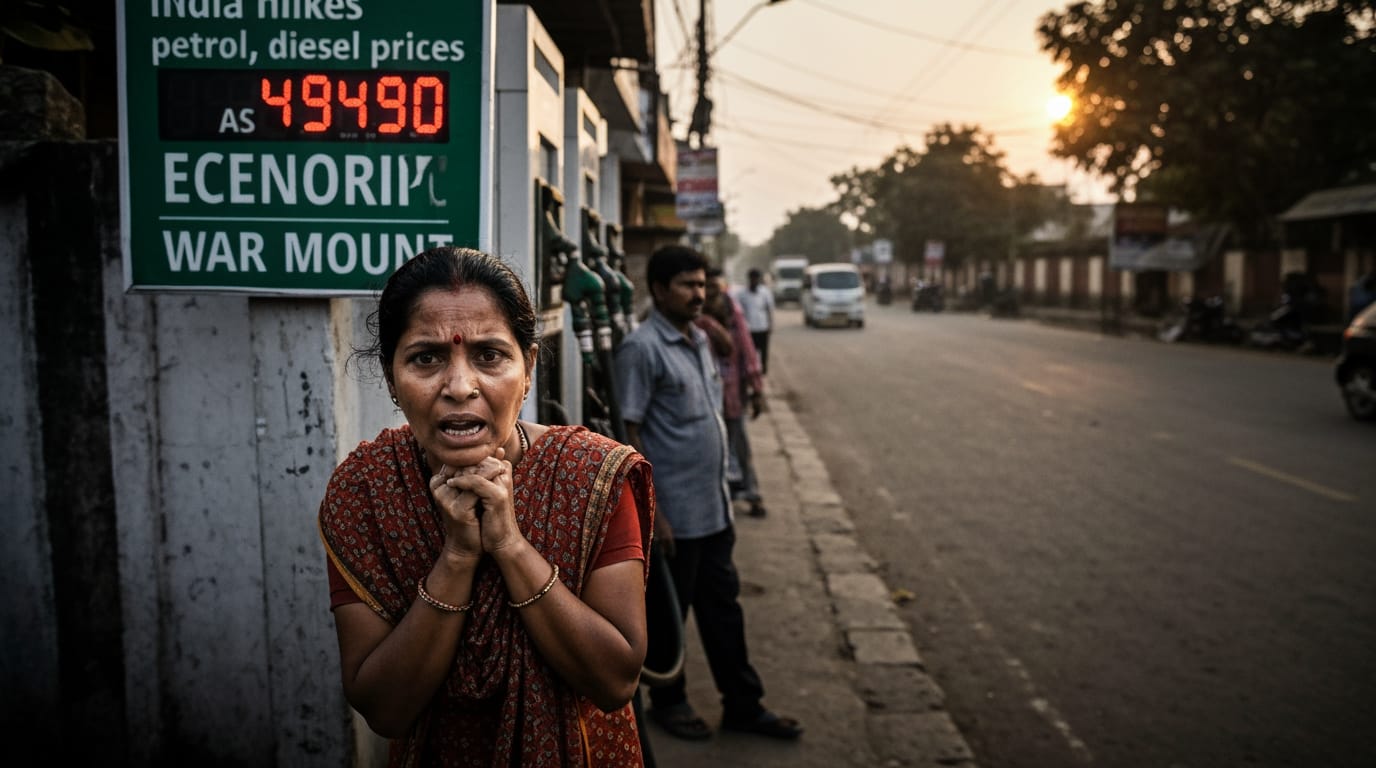
NEW DELHI – In a significant move that reverberated across the nation, India on Friday implemented its first major hike in petrol and diesel prices in four years, a direct consequence of the escalating "Iran war" and its profound impact on global crude oil markets. Consumers are now grappling with an immediate increase of ₹3 per litre for both petrol and diesel, while Compressed Natural Gas (CNG) prices also saw a ₹2 per kilogram rise, marking a critical juncture for the world's third-largest oil importer. This long-anticipated adjustment reflects the severe financial strain on state-owned oil marketing companies (OMCs) that have been absorbing soaring international crude costs, propelled by unprecedented supply disruptions emanating from the West Asian conflict. The decision underscores the deep interconnectedness of global geopolitics and domestic economics, threatening to ignite inflationary pressures across India's vast economy.
The Geopolitical Tremor: Iran War's Global Reach
The recent fuel price hike is inextricably linked to the ongoing conflict between Iran and a U.S.-Israel coalition, which has unleashed significant volatility in global energy markets since its outbreak. At the heart of this crisis lies the Strait of Hormuz, a critical maritime chokepoint through which approximately 20% of the world's oil supplies and substantial volumes of liquefied natural gas (LNG) normally traverse. The near-closure and severe disruption of this vital waterway, triggered by the conflict, has been characterized by the International Energy Agency (IEA) as the "largest supply disruption in the history of the global oil market" and the "greatest global energy security challenge in history."
Before the onset of the conflict, Brent crude oil prices hovered around $70-72 per barrel. However, in the wake of escalating tensions, prices surged dramatically, peaking above $120 per barrel before settling in the $100-$110 range. This drastic increase in international benchmarks has cascaded into a worldwide fuel crisis, prompting fears of stagflation and recession across many economies. Exports from the Gulf region, which account for a significant portion of Asian energy imports, have been particularly affected, forcing importing nations to secure alternative supplies at premium prices.
India's Vulnerability and the Delayed Reckoning
India, which imports a staggering 85-91% of its crude oil requirements, is exceptionally vulnerable to such global oil shocks. Government data reveals that in February 2026, nearly 91% of India's crude oil needs were met through imports, a historic high, with over 54% originating from West Asian countries. This heavy reliance means that any disruption in the region directly translates into increased procurement costs for Indian oil marketing companies.
For the past four years, state-owned OMCs—Indian Oil Corporation (IOC), Bharat Petroleum Corporation Ltd (BPCL), and Hindustan Petroleum Corporation Ltd (HPCL)—had largely frozen retail fuel prices, shielding consumers from the volatility of international markets. This policy, in place since April 2022 following Russia's invasion of Ukraine, led to immense financial losses for these companies. Union Petroleum Minister Hardeep Singh Puri recently stated that OMCs were incurring losses of approximately ₹1,000 crore per day due to the widening gap between international crude prices and stagnant domestic retail rates, with cumulative losses estimated to be nearing ₹1 lakh crore.
While the government had previously attempted to cushion consumers by reducing excise duty on petrol and diesel by ₹10 per litre in March 2024, and a one-time price cut of ₹2 per litre ahead of the Lok Sabha elections, these measures proved insufficient to offset the mounting losses. The timing of the current ₹3 per litre hike, announced just weeks after the conclusion of state assembly elections in Assam, Kerala, Tamil Nadu, and West Bengal, has drawn criticism from opposition parties, who allege the government deliberately deferred the decision to avoid electoral repercussions. Industry sources, however, described the increase as a "calibrated" step aimed at partially easing the pressure on OMCs without triggering a major inflation shock. Nevertheless, analysts suggest that the current hike may be just the beginning, as OMCs still face a substantial gap of ₹15-20 per litre to fully cover their costs.
Ripple Effects on the Indian Economy
The fuel price hike is expected to send ripples across the Indian economy, most notably by exacerbating inflationary pressures. As transportation and logistics costs increase, these expenses are invariably passed on to consumers, leading to higher prices for essential goods, food, and manufactured products. Economists estimate that a ₹3 per litre increase could directly add around 0.15 percentage points to the Consumer Price Index (CPI), with the indirect impact being even larger due to cascading effects through supply chains.
India's Wholesale Price Index (WPI) had already surged to an 8.3% high in April 2026, the highest in 42 months, largely driven by elevated fuel and energy prices. Retail inflation (CPI) stood at 3.48% in April, and analysts now forecast it to rise to 4.1% for May. The common citizen is already expressing anxiety, with cab drivers and daily commuters lamenting the increased cost of living. Transport operators are expected to demand fare revisions, further burdening households and businesses.
Beyond inflation, the higher fuel prices pose broader economic challenges. They will put additional pressure on government finances, potentially widening the fiscal deficit and increasing the energy subsidy bill, especially for liquefied petroleum gas (LPG). The higher oil import bill is also expected to widen the current account deficit and exert further pressure on the Indian rupee, which depreciated by approximately 9% in FY2025-26. This depreciation makes imports more expensive, creating a negative feedback loop. For the Reserve Bank of India, sustained fuel inflation complicates monetary policy decisions, making it harder to consider interest rate cuts.
The Path Forward and Public Response
Acknowledging the severe economic strain, Prime Minister Narendra Modi has urged citizens to adopt fuel conservation measures, including using public transport, carpooling, and working from home, to help reduce foreign exchange outflows spent on oil imports. India has also been actively diversifying its crude oil sources, importing from around 40 countries, and investing in domestic renewable energy to reduce its long-term import dependence.
However, the immediate impact on households and businesses remains a significant concern. While some consumers acknowledge the global nature of the crisis, many express frustration over the timing and the potential for a cascading effect on prices. The current hike, modest as it may seem to experts considering the global surge, could very well be the first of several adjustments. Analysts predict that if global crude oil prices remain elevated, further increases of potentially ₹14-15 per litre might be necessary in the coming months.
Conclusion
India's decision to raise petrol and diesel prices after a four-year hiatus underscores the profound and far-reaching economic consequences of the ongoing Iran war. The complex interplay of geopolitical tensions, disrupted global supply chains, and India's heavy reliance on oil imports has created an unavoidable financial burden. While the hike is a necessary step to alleviate the losses of state-owned oil companies, it places significant pressure on the common citizen through inflationary impacts and complicates the government's efforts to maintain economic stability. As the nation navigates this challenging period, the need for adaptive energy strategies, continued diversification of import sources, and robust measures to protect vulnerable populations from rising costs will be paramount.


