Judge Orders Removal of Trump's Name from Kennedy Center, Upholding Congressional Authority
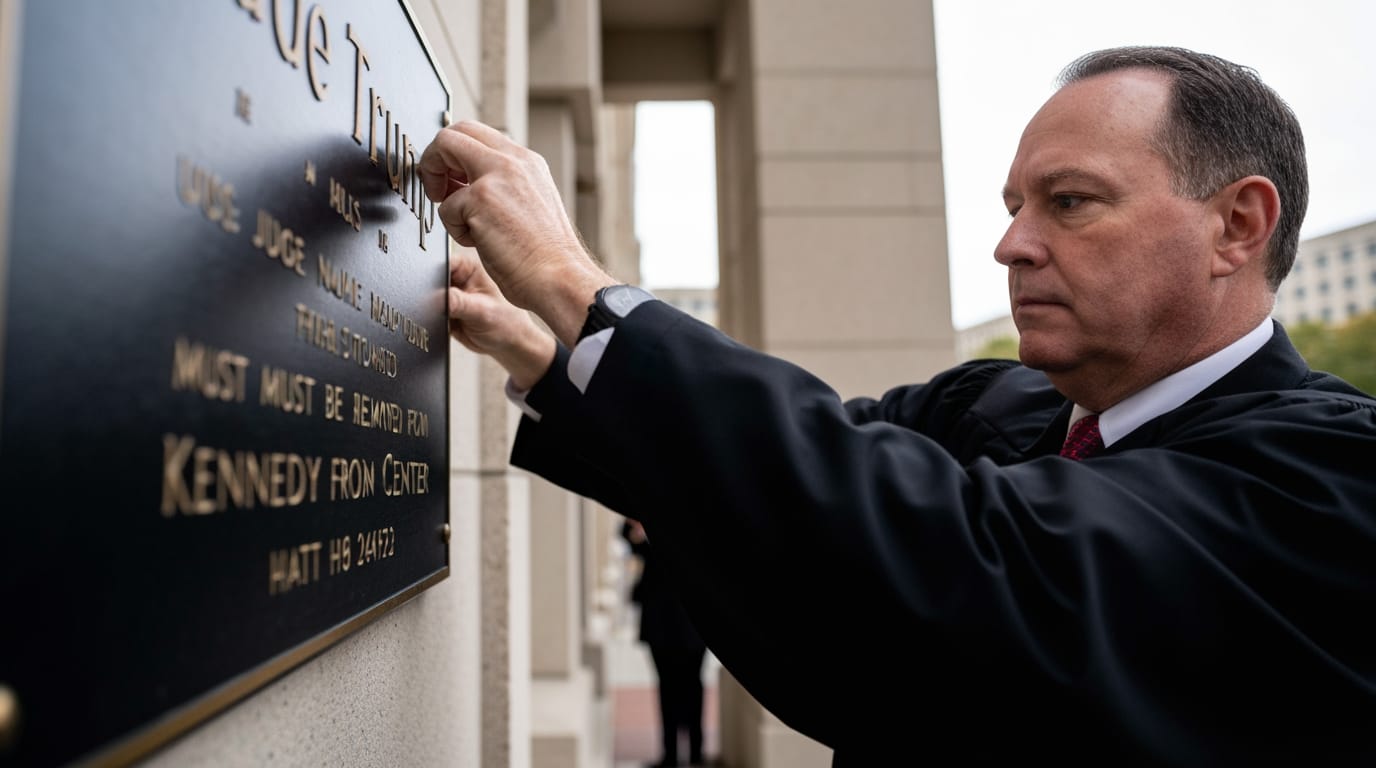
Washington D.C. – In a significant legal rebuke to the Trump administration's cultural initiatives, a federal judge today ordered the immediate removal of former President Donald Trump's name from the John F. Kennedy Center for the Performing Arts. The ruling, handed down by U.S. District Judge Christopher Cooper, unequivocally states that the prestigious national memorial cannot bear any name other than that of President John F. Kennedy without direct congressional approval. This decision marks a pivotal moment in the ongoing battle over the integrity of national cultural institutions and the limits of executive power.
The Bench's Mandate: Upholding Statutory Intent
Judge Cooper's 94-page opinion, issued on Friday, May 29, 2026, directs the Trump administration to expunge all physical signage, digital references, and official materials bearing Trump's name from the Kennedy Center within 14 days. The judge's core argument rests on the Kennedy Center's "organic statute" from 1964, a law passed by Congress that explicitly designated the institution as a "living memorial" to President Kennedy. "The Kennedy Center's organic statute makes crystal clear that the Center is to be named for President Kennedy, and it cannot bear any other formal name or public memorial based on the Board's unilateral say-so," Cooper wrote. He further emphasized that "Congress gave the Kennedy Center its name, and only Congress can change it," concluding that the Board of Trustees had "overstepped its statutory bounds by unilaterally renaming the Kennedy Center after President Trump."
The lawsuit that led to this ruling was filed in December by Representative Joyce Beatty (D-Ohio), an ex officio member of the Kennedy Center's Board of Trustees. Beatty had become a vocal critic of the administration's actions regarding the center, citing concerns over the legality and propriety of the name change. Her legal challenge asserted that the board, under the influence of the Trump administration, had acted without the necessary legislative authority. In a statement following the ruling, Beatty applauded Cooper's decision, stating, "The Kennedy Center is an institution that belongs to the American people, not to Donald Trump. He has desecrated this sacred memorial for his own vanity. I am proud to have fought for the rule of law and to protect this sacred institution." While the Kennedy Center's spokeswoman, Roma Daravi, expressed confidence that the ruling would be overturned on appeal, reiterating the institution's commitment to recognizing what she termed President Trump's "historic contributions," the immediate impact requires the physical and digital alteration of the center's branding.
A Controversial Renaming: From Board Takeover to Legal Challenge
The saga surrounding the Kennedy Center's name began shortly after President Trump took office. In a move that sparked immediate controversy, Trump appointed himself chair of the Kennedy Center's board of trustees in February last year, describing it as a "take-over." This action was followed by a purge of the existing board members, who were subsequently replaced by Trump's own appointees and close allies. This reconstituted board then voted in December to add Trump's name to the institution, officially designating it as "The Donald J. Trump and The John F. Kennedy Memorial Center for the Performing Arts."
The process of this renaming drew sharp criticism, particularly from Rep. Beatty, who claimed she was "muted on the call and not allowed to speak or voice [her] opposition to this move" during the decisive board meeting. Reports also indicated that the proposal to add Trump's name was not on the agenda for the December 18 meeting and only emerged at the very end. Judge Cooper's ruling specifically noted the lack of discussion regarding the legal risks of renaming the institution and the absence of evidence that board counsel advised trustees on compliance with federal law.
The original establishment of the Kennedy Center dates back to 1958 when President Dwight D. Eisenhower signed the National Cultural Center Act. However, it was after President Kennedy's assassination in November 1963 that Congress, in 1964, passed legislation renaming the National Cultural Center as a "living memorial" to him, solidifying its identity as the John F. Kennedy Center for the Performing Arts. This historical context, emphasizing the legislative intent behind the naming, proved central to Judge Cooper's decision. Even prior to the board's vote, John F. Kennedy's grandnephew, Joe Kennedy III, a former congressman, expressed doubts about the legality of any name change, stating, "The Kennedy Center is a living memorial to a fallen president and named for President Kennedy by federal law. It can no sooner be renamed than can someone rename the Lincoln Memorial, no matter what anyone says."
Broader Implications: Renovation Plans and Political Tensions
Beyond the contentious name change, Judge Cooper's ruling also addressed the administration's plan to close the Kennedy Center for two years for extensive renovations. The judge blocked this proposed shutdown, finding that the board had "overstepped its statutory authority bounds" by unilaterally adding Trump's name and had made the closure decision based on "an insufficient, one-sided presentation of information." He concluded that the board was "derelict in discharging the full range of its responsibilities to the Center" by failing to consider the potential adverse consequences of such a closure on programming and memorial functions.
The Kennedy Center had cited a need for repairs, and its spokeswoman, Roma Daravi, stated that "$257 million secured by President Trump and approved by Congress, the resources are in place." However, the judge's order now requires the board, should it pursue future renovation closures, to make an "independent decision" with sufficient information, balancing its duty to "maintain and operate a premiere arts venue and its solemn duty to memorialize a fallen President."
President Trump reacted to the judge's decision in a Truth Social post, appearing to distance himself from the institution. He stated that he would work with Congress to "transfer this failing Institution back to them so they can make a determination as to what to do with it," adding that "Unless I am free to do what I do better than anyone else, bring this Institution back, physically, financially, and artistically, I have no interest in continuing what could only be a hopeless journey into 'NEVER NEVER LAND.'" This response underscores the broader political tensions that have characterized Trump's involvement with the Kennedy Center. His tenure as chair has been marked by artist boycotts, canceled performances, criticism from LGBTQ+ advocates, and a decline in ticket sales. Notably, the Washington National Opera also ended its half-century residency at the center during this period.
The Kennedy Center controversy is not an isolated incident in the administration's attempts to reshape Washington D.C.'s cultural landscape. Other initiatives, such as a proposed "First Lady Melania Trump Opera House" and a review of the Smithsonian Institution, have also surfaced, alongside legal challenges to the construction of a White House ballroom.
Preserving Memorials: A Question of National Identity
The judge's ruling serves as a powerful affirmation of the principle that national memorials, established through legislative acts, hold a distinct status that transcends the preferences of any single administration or appointed board. By emphasizing that "Congress gave the Kennedy Center its name, and only Congress can change it," Judge Cooper has drawn a clear line in the sand, protecting such institutions from unilateral alteration.
This decision underscores the delicate balance between recognizing private contributions and preserving the symbolic significance of nationally designated sites. The ruling reinforces the idea that memorials, particularly those honoring past presidents, are not merely buildings but embody collective memory and historical reverence, requiring a broad consensus, typically through legislative action, for any fundamental changes to their identity. The integrity of these institutions, as monuments to national figures and values, is paramount, and the court's decision ensures that their names remain protected by the legislative process that initially bestowed them.
The judicial order to remove Trump's name from the Kennedy Center is more than a legal technicality; it is a declaration on the proper governance and respect for America's cultural heritage. As the Kennedy Center's management weighs a potential appeal, the ruling stands as a powerful reminder that the enduring legacy of national institutions is ultimately safeguarded by the rule of law and the original intent of Congress.


