Landmark National Security Trial Begins for Hong Kong Tiananmen Vigil Organizers
HONG KONG – In a pivotal legal proceeding widely viewed as a significant test of Hong Kong's judicial autonomy and the scope of its national security legislation, three prominent pro-democracy activists faced trial today on charges of "inciting subversion of state power." Chow Hang-tung, Lee Cheuk-yan, and Albert Ho, former leaders of the now-disbanded Hong Kong Alliance in Support of Patriotic Democratic Movements of China (HKASPDMC), appeared before the High Court, marking another critical moment in the city's rapidly evolving political landscape under Beijing’s imposed National Security Law. The case centers on the Alliance's long-standing tradition of organizing annual vigils commemorating the 1989 Tiananmen Square crackdown, an event once a beacon of Hong Kong's distinct freedoms now deemed an act of subversion by authorities.
The Charges and the Defendants
The trio, key figures in the city's pro-democracy movement, are accused under Hong Kong's National Security Law, which Beijing enacted in June 2020. Prosecutors allege that the Alliance's core objective of "ending one-party rule" in China constitutes an incitement to subvert state power, thereby violating the country's constitution. If convicted, Chow, 40, Lee, 68, and Ho, 74, face potential prison sentences of up to 10 years.
At the trial's opening, Lee Cheuk-yan and Chow Hang-tung entered pleas of not guilty, asserting their innocence against the subversion charges. Albert Ho, however, pleaded guilty, a move that could potentially lead to a sentence reduction later in the proceedings. The trial, presided over by a panel of government-vetted national security judges, is anticipated to last approximately 75 days, underscoring the complexity and gravity of the accusations. The court itself has stated it "will not allow trials to become a tool for political repression ... or an abuse of judicial procedures," seeking to uphold legal principles.
A Vigil's Legacy Under Scrutiny
For over three decades, the Hong Kong Alliance in Support of Patriotic Democratic Movements of China was instrumental in organizing the annual candlelight vigil in Victoria Park, a powerful and symbolic act of remembrance for the victims of the 1989 Tiananmen Square crackdown. This event was unique, standing as the only large-scale public commemoration of the crackdown on Chinese territory. It embodied Hong Kong's distinctive freedoms and its commitment to historical memory, even after its handover from British to Chinese rule in 1997.
The ability to openly mourn and demand accountability for the Tiananmen events was long held as a testament to Hong Kong's high degree of autonomy, promised under the "One Country, Two Systems" framework. However, this tradition came to an abrupt halt in 2020 when authorities banned the vigil, citing public health concerns related to the COVID-19 pandemic. The ban persisted even after pandemic restrictions eased, with the National Security Law coming into full effect and fundamentally altering the landscape for civil liberties in the city. The Alliance officially disbanded in September 2021, following intense pressure and the arrests of its key members.
The prosecution's case meticulously details how the Alliance, through its annual vigils, the operation of a museum dedicated to the 1989 crackdown, and other related activities, actively promoted its call to "end one-party rule." This call, historically viewed by many as an exercise in free speech, is now positioned by the government as a direct challenge to the Chinese state and an act of subversion.
Erosion of Freedoms and International Concern
The trial of the Tiananmen vigil organizers is widely seen as a significant indicator of the shrinking civic space and the suppression of dissent in Hong Kong since the implementation of the National Security Law. Rights groups and international observers have consistently voiced concerns that the law is being used to target activists, journalists, and civil society organizations for actions that would typically be protected under international human rights standards.
Amnesty International has criticized the trial, stating it is "not about national security – it is about rewriting history and punishing those who refuse to forget the victims of the Tiananmen crackdown." Sarah Brooks, Amnesty International's Deputy Regional Director, Asia, emphasized that the defendants' "principal 'crime' has been to seek truth and justice" for the Tiananmen victims, highlighting the "cynical case" as an illustration of how "vague and overly broad national security laws" are employed as tools of repression. Conversely, Beijing maintains that the National Security Law was a necessary measure to restore stability in Hong Kong following the large-scale and sometimes violent pro-democracy protests of 2019.
The resilience of defendants like Chow Hang-tung, a Cambridge-educated barrister who has been held on remand for over 1,500 days and has chosen to represent herself, has also drawn attention. Her assertion that "The state can lock up people but not their thinking, just as it can lock up facts but not alter truth," encapsulates the defiance of many facing these charges.
Human Elements Amidst the Legal Battle
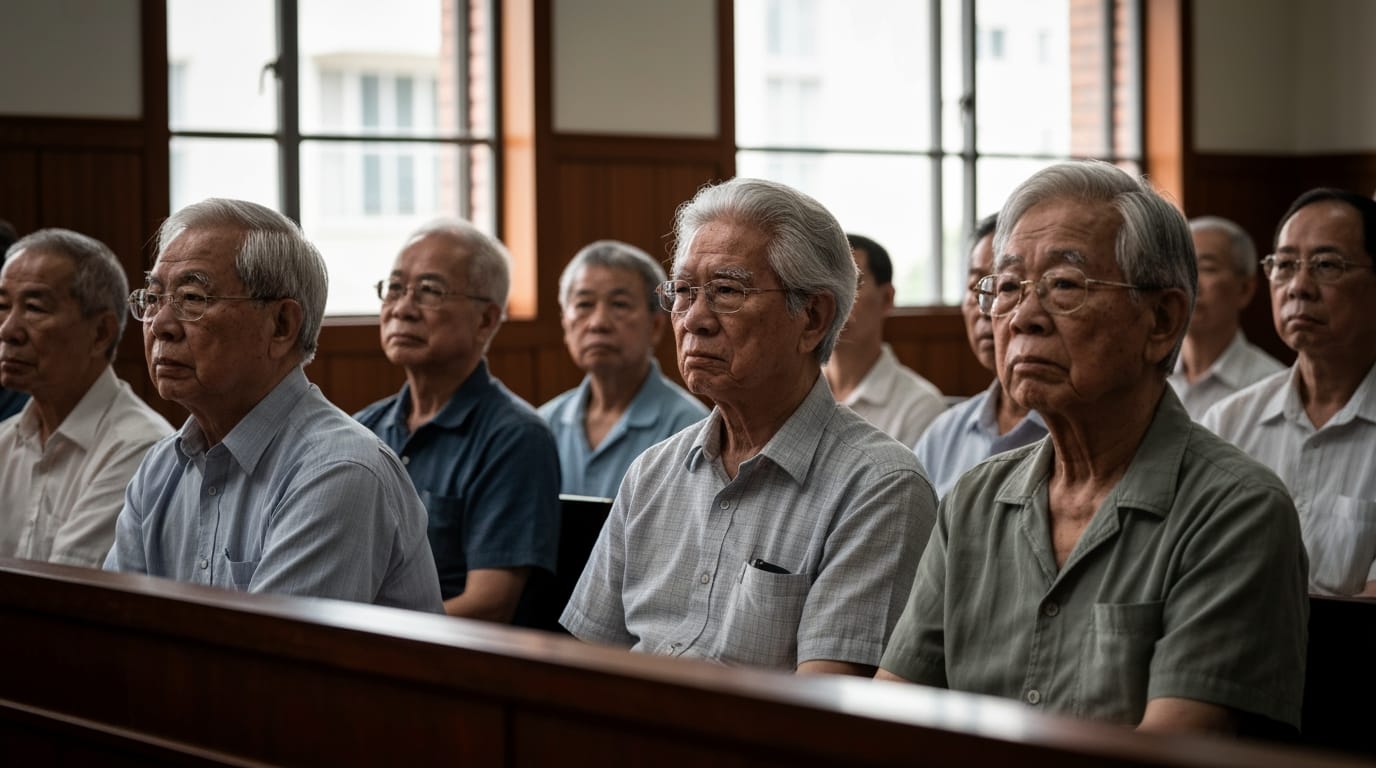
Despite the chill of a cold weather warning, dozens of individuals queued overnight outside the West Kowloon Magistrates' Courts building to secure seats in the public gallery, underscoring the enduring public interest and sentiment surrounding the trial. The strong police presence around the courthouse further highlighted the sensitivity of the proceedings.
Supporters like Tang Ngok-kwan, a former senior member of the disbanded Alliance, eloquently expressed the underlying sentiment of many. As he waited outside the court, he remarked, "Justice resides in the hearts of the people, and history will bear witness." Similarly, retiree Simon Ng reflected on how the annual vigils once symbolized Hong Kong's fundamental differences from mainland China, praising the activists as "honourable" for supporting China's democratization. The moments of defendants Lee and Chow waving to their supporters upon entering the courtroom served as small but poignant reminders of the human element at the core of this high-stakes legal battle.
Conclusion: A Defining Moment
The trial of Chow Hang-tung, Lee Cheuk-yan, and Albert Ho represents a defining moment for Hong Kong, testing the boundaries of fundamental freedoms in a city where such rights were once taken for granted. The prosecution's assertion that calls for "ending one-party rule" constitute subversion marks a significant departure from previous interpretations of free expression and political discourse. The outcome of this trial will not only determine the fate of these three activists but will also send a powerful message about the future of civil liberties, historical memory, and the rule of law in Hong Kong, placing the city under intense international scrutiny as it navigates its complex relationship with mainland China.


