Merkel's Chosen Legacy: Official Portrait Unveiled in Berlin
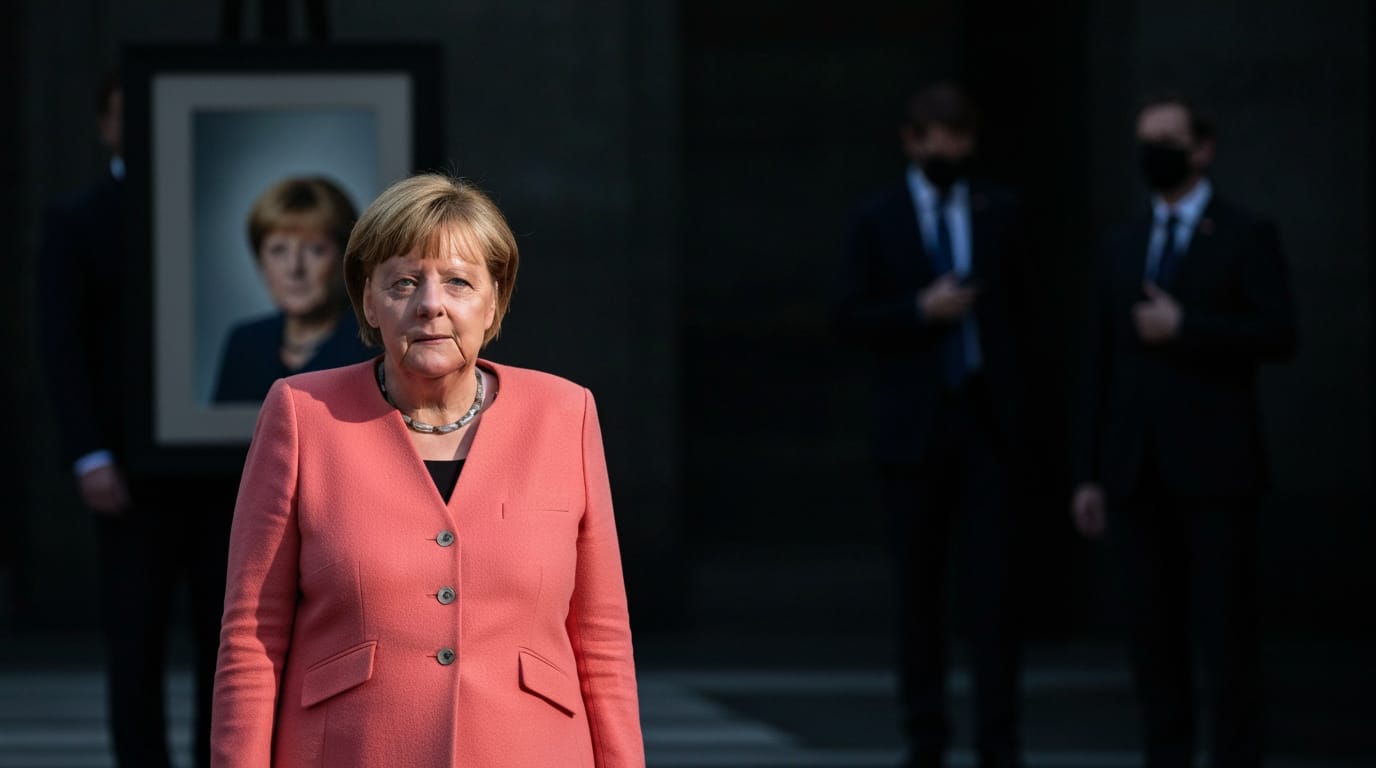
BERLIN – Former German Chancellor Angela Merkel, a figure synonymous with stability and leadership on the global stage for 16 years, formally unveiled her official portrait today in a ceremony marking her definitive transition from active political life to historical memory. The highly anticipated artwork, created by the relatively unknown German-French artist Jérémie Queyras, offers a reflective and carefully curated image of the former chancellor, now destined to join a distinguished gallery of her predecessors. The unveiling took place at the Bode Museum in Berlin, where the painting will be publicly displayed until October before taking its permanent place in the Chancellery.
A Deliberate Choice: Artist and Process
The selection of Jérémie Queyras, a young artist largely outside mainstream art circles, represents a notable departure from tradition for the usually conventional Merkel. Speculation had long surrounded who Merkel would choose to capture her likeness, with many anticipating a female artist or one hailing from her East German roots. Instead, her choice reflects a personal and deliberate approach, opting for an emerging talent to encapsulate her complex legacy.
The creation of the portrait itself was a process shrouded in secrecy, reportedly spanning twelve sessions and conducted over several months in a private studio in Berlin. Queyras meticulously studied Merkel’s gestures, expressions, and background, even undertaking a visit to Templin, the town where the former chancellor spent her formative years. This intensive collaboration underscores Merkel's characteristic pragmatism and her desire for a representation that truly resonated with her self-perception, rather than merely adhering to established artistic norms. Her decision not to rush the process, waiting until she found both the right artist and method, speaks volumes about her meticulous nature.
The Canvas and Its Subtle Narratives
Measuring 110 by 140 centimeters, the oil painting portrays Merkel in a blue blazer, a color that became a central element of the composition and a hallmark of her public image. The choice of attire, often seen as symbolic of her steadfast and no-nonsense approach to governance, is subtly reinforced by other details woven into the artwork. Among these is a discreet rendering of a silver cube, an object frequently seen on her Chancellery desk, engraved with the German phrase "In der Ruhe liegt die Kraft" – "In calmness lies strength." This inclusion serves as a poignant reminder of Merkel’s enduring leadership philosophy, particularly during periods of intense national and international crisis.
The portrait aims to capture not just a physical likeness, but also the essence of a leader known for her composure and analytical mind. Unlike some grand, ceremonial portraits, Queyras's work appears to lean towards a more intimate, yet authoritative, depiction, reflecting a figure who navigated global politics with quiet determination. The artist’s exploration of her childhood environs suggests an effort to connect with the deeper, foundational elements of her identity, beyond the public persona of the chancellor.
Securing a Personal Legacy
In a further break from precedent, Angela Merkel personally funded the creation of the portrait, covering both the artist's fees and material costs. Crucially, the portrait will remain her private property and will be loaned to the state rather than becoming a permanent government acquisition. This arrangement grants Merkel ultimate control over the artwork's future display and management, an uncommon assertion of personal autonomy over an official state commission. This decision aligns with her often private and guarded nature, ensuring her chosen image for posterity is managed according to her wishes.
Merkel herself acknowledged the weight of the moment, stating to Die Zeit newspaper, "It is strange when you slowly become history." This reflection encapsulates the significance of the portrait: it is the image she has elected to present to the world as her enduring legacy, a visual summation of her time at the helm of Germany. This level of personal involvement in shaping her historical representation underlines her profound awareness of her place in German and European history.
A Place in the Chancellors' Gallery
The unveiling of an official portrait is a long-standing tradition for German chancellors, with every leader since 1949 having their likeness displayed in the Chancellery. Angela Merkel’s portrait will soon join this esteemed collection, solidifying her position alongside figures like Konrad Adenauer, Helmut Schmidt, and Helmut Kohl. This gallery serves as a powerful visual timeline of Germany's post-war leadership, each portrait offering a unique artistic interpretation of the individual who guided the nation.
While Queyras's painting represents the official, chosen image for the Chancellery, Merkel’s journey into the historical record has also been uniquely chronicled by photographer Herlinde Koelbl. Koelbl’s extraordinary 30-year photographic project, spanning from 1991 to 2021, documented Merkel’s political evolution from an inexperienced minister to a global leader. Koelbl's series captured the subtle yet profound physical and psychological transformations brought about by power, showcasing Merkel's body language shifting from cautious to confidently assured, and the emergence of her iconic "Merkel diamond" hand gesture. These two distinct artistic endeavors—Koelbl’s chronological study and Queyras’s singular painted statement—offer complementary perspectives on one of Germany's most influential leaders.
Conclusion
The unveiling of Angela Merkel's official portrait marks a significant cultural and historical event, formally enshrining her image in Germany's national narrative. Her deliberate choice of a younger, less-known artist, coupled with her personal oversight of the project and retention of ownership, underscores her enduring control over her public image and historical legacy. This painting, with its subtle symbolism and reflective tone, serves as a capstone to a remarkable career, ensuring that the visual representation of Germany's first female chancellor is one carefully shaped by her own vision as she passes into the annals of history.