Myanmar's Orchestrated Elections: A Facade of Choice Amidst Deepening Conflict
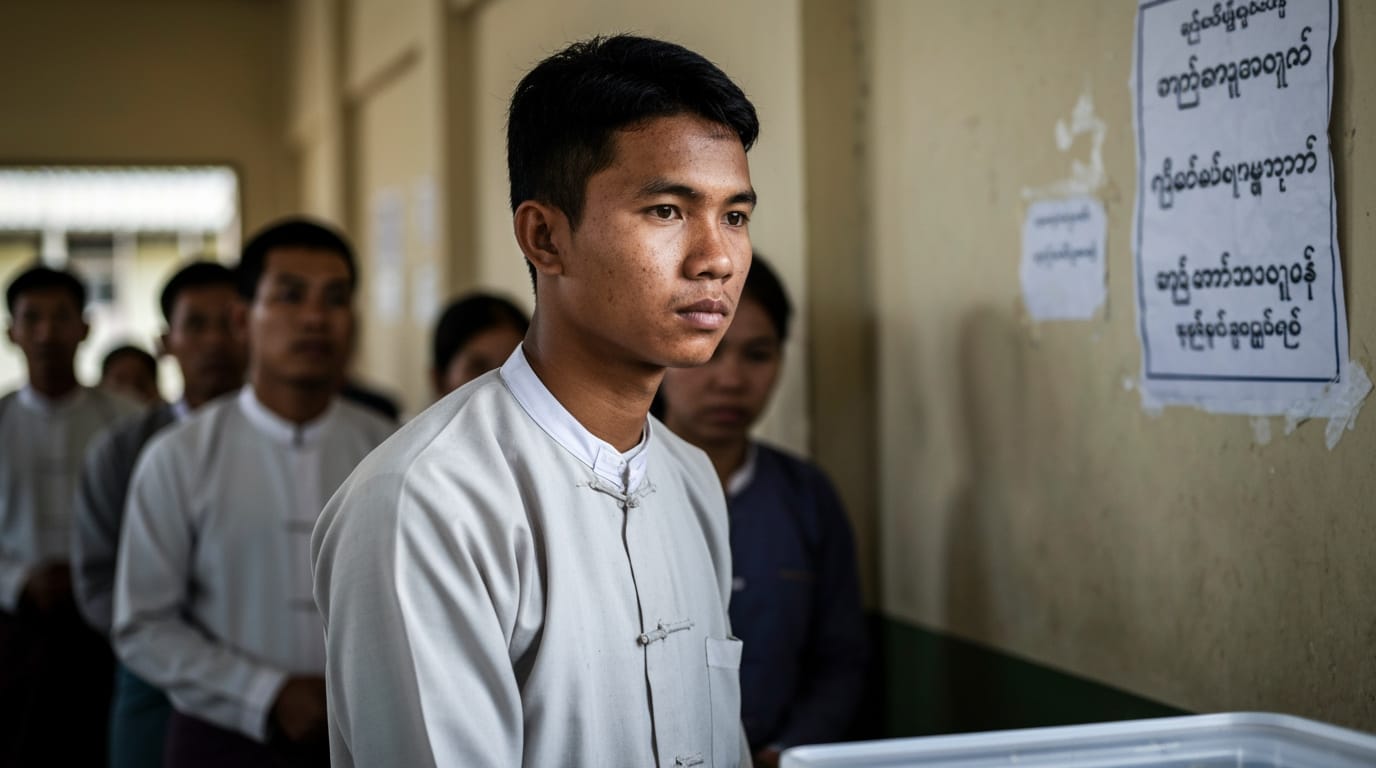
Myanmar's military junta has initiated a series of staggered elections across the nation, an exercise widely condemned by international observers and domestic opposition alike as a deliberate move to legitimize its rule rather than genuinely restore democracy. These polls, commencing December 28, 2025, and continuing into January 2026, unfold against a backdrop of escalating civil war, systemic repression, and the calculated exclusion of popular pro-democracy voices, presenting the populace with a stark absence of meaningful electoral choice.
The Coup's Shadow: Undoing Democratic Gains
The current political landscape in Myanmar is inextricably linked to the events of February 1, 2021. That day, the Tatmadaw, Myanmar's armed forces, seized power, arresting elected civilian leaders, including State Counsellor Aung San Suu Kyi and President Win Myint, and abruptly ending a decade of nascent democratic transition. The coup was justified by the military with unsubstantiated claims of widespread fraud in the November 2020 general election, where Aung San Suu Kyi's National League for Democracy (NLD) had secured a resounding victory, winning 396 out of 476 parliamentary seats – an even larger margin than in 2015. Independent election observers, however, found no significant irregularities that would have altered the election's outcome, dismissing the military's allegations as baseless. The military's refusal to accept these legitimate results and its subsequent overthrow of the democratically elected government plunged Myanmar into a profound political and humanitarian crisis, sparking widespread protests and an armed resistance movement that continues to challenge military authority across the country.
Engineering an Uncontested Outcome: Laws and Dissolution
In the lead-up to its planned elections, the junta has meticulously dismantled political opposition through a series of legislative and executive actions designed to guarantee its preferred outcome. In January 2023, the military enacted a stringent new electoral law that significantly tightened requirements for political party registration. This legislation notably banned individuals convicted of crimes from participating, a provision directly impacting Aung San Suu Kyi and other detained NLD leaders, effectively removing them from the political arena.
Crucially, the new law also mandated that existing political parties re-register within 60 days or face dissolution. The National League for Democracy, overwhelmingly victorious in 2020, refused to comply with what it deemed an illegitimate directive from an unlawful military council. Consequently, in March 2023, the junta's election commission officially dissolved the NLD, alongside 39 other political parties that similarly declined to register under the restrictive new conditions. This act removed the most popular political force in Myanmar from the electoral landscape, ensuring that the upcoming polls would proceed without its primary democratic challenger. Furthermore, the military transitioned the electoral system from a first-past-the-post model to proportional representation for the Amyotha Hluttaw election, a change analysts perceive as specifically intended to bolster the performance of the military's proxy party, the Union Solidarity and Development Party (USDP).
The 'Sham' Elections of 2025-2026: A Ritual of Ratification
The elections now underway, organized in three phases starting December 28, 2025, are widely characterized as a "sham" designed not to gauge public will but to manufacture an illusion of legitimacy for the ruling junta. The military government has presented these polls as a return to multi-party democracy, yet the conditions under which they are held belie such claims. The Union Election Commission (UEC), installed by the junta, is overseeing the process with dubious voter lists, opaque advance voting mechanisms, and untested electronic voting machines.
Voting is being conducted in a staggered manner across 102 townships in the first phase, with subsequent phases planned for January 11 and January 25, 2026. However, substantial portions of the country, including 56 townships under martial law and thousands of village tracts, are excluded from the vote due to ongoing armed conflict and resistance control. Critics point out that the junta's electoral framework lacks requirements for minimum voter turnout or nationwide coverage, allowing it to claim a "national" election based on limited and controlled areas. With the NLD dissolved and its leaders imprisoned, the military-backed Union Solidarity and Development Party (USDP) stands as the dominant force, with over a thousand candidates registered and dozens already elected unopposed. This engineered environment leaves electors with no genuine choice, as the most credible opposition has been systematically removed or suppressed.
Repression, Resistance, and International Condemnation
The junta has implemented an "election protection law," imposing severe penalties, including prison sentences ranging from three years to life, and even the death penalty, for anyone who criticizes, opposes, or disrupts the electoral process. This draconian law has led to numerous arrests, with individuals reportedly detained for merely liking social media posts criticizing the vote or displaying anti-election materials. Moreover, reports from various regions indicate that soldiers have resorted to threats and coercion to compel citizens to participate in the voting, with residents feeling pressured to cast ballots against their will.
The international community has largely rejected the legitimacy of these elections. The United Nations, the European Union, the United States, the United Kingdom, and Australia have unequivocally labeled them a "sham," citing the exclusion of pro-democracy parties and the prevailing climate of violence and repression. UN Special Rapporteur for Myanmar, Tom Andrews, has urged the international community to "unequivocally reject" these elections, describing them as a "charade" aimed at preserving military dominance. In contrast, a handful of countries, including China, Russia, Vietnam, Cambodia, Belarus, India, and Kazakhstan, have sent observers, a move seen by critics as lending undue credibility to the junta's performance. Domestically, the National Unity Government (NUG), formed by deposed lawmakers, and other resistance movements have called for a boycott, asserting that the elections are illegal and an attempt to unlawfully seize the sovereign power of the people. They maintain that the 2020 election results remain the only legitimate mandate.
A Future Defined by Control, Not Choice
The elections orchestrated by Myanmar's military junta are not perceived as a pathway to genuine democracy but rather as a strategic maneuver to consolidate power and manufacture a veneer of civilian legitimacy over continued military rule. The systematic elimination of opposition, the imposition of draconian laws to suppress dissent, and the control over the electoral process underscore the absence of any real choice for the people of Myanmar. Instead of fostering stability, these elections are widely expected to deepen the existing conflict and further entrench repression, prolonging the nation's profound political and humanitarian crisis. The international community and a significant portion of the Myanmar populace recognize these polls as a carefully constructed ritual of ratification, designed to serve the military's interests, rather than reflect the democratic aspirations of its citizens.


