Nepal's Political Earthquake: Rapper-Engineer Balen Shah Poised to Become Prime Minister
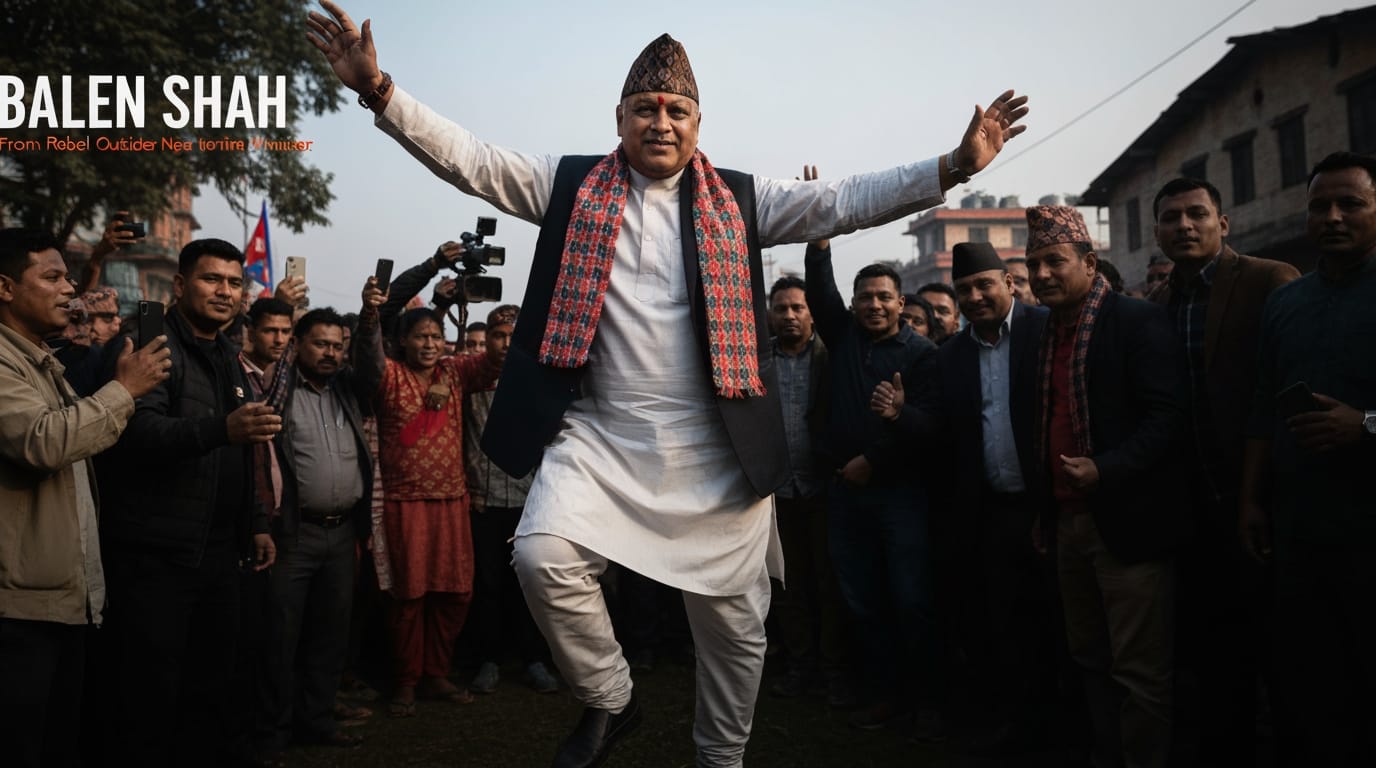
Kathmandu, Nepal – In a seismic shift that has redefined Nepal's political landscape, Balendra Shah, widely known by his stage name Balen, a 35-year-old rapper, structural engineer, and former independent mayor of Kathmandu, is set to become the nation's next Prime Minister. His party, the Rastriya Swatantra Party (RSP), secured a landslide victory in the recent parliamentary elections, marking an unprecedented rejection of the country's long-entrenched political establishment and heralding a new era of leadership shaped by youth activism and anti-corruption sentiment. Shah's meteoric rise from an independent mayoral candidate challenging the status quo to the brink of the prime minister's office epitomizes a profound desire for change among the Nepali populace, particularly its burgeoning youth demographic.
The Unconventional Path of an Outsider
Balen Shah's journey into the apex of Nepali politics is anything but traditional. Born on April 27, 1990, in Naradevi, Kathmandu, to a Madheshi family, Shah initially pursued an academic and professional career in engineering, earning a Bachelor's degree in civil engineering and a Master's in structural engineering. Simultaneously, he cultivated a significant presence in Nepal's underground hip-hop scene, emerging as a prominent voice since 2012. His rap lyrics were not merely entertainment; they were potent social commentary, often dissecting themes of corruption, inequality, and the frustrations of Nepal's youth. Songs like "Sadak Balak" and "Balidan" resonated deeply with a generation disillusioned by the political elite, laying the groundwork for his future political appeal.
The first major jolt to Nepal's political establishment came in December 2021, when Shah, then largely unknown in mainstream politics, declared his independent candidacy for the Kathmandu mayoral election. His campaign, largely fueled by social media and grassroots support, eschewed traditional political machinery. He promised to tackle critical urban issues such as waste management, traffic congestion, and corruption, while also championing public service delivery and cultural heritage preservation. In May 2022, defying all expectations, Shah clinched a stunning victory, becoming Kathmandu's first independent mayor, securing 38.6% of the vote and defeating seasoned candidates from the Nepali Congress and CPN (UML) by a margin exceeding 23,000 votes. This landmark win was widely seen as a significant upset and a harbinger of a broader shift in Nepali voter sentiment.
A Mayoralty of Reform and Controversy
During his nearly four-year tenure as the 15th Mayor of Kathmandu, Shah earned a reputation for his direct, often confrontational, approach to governance. He initiated various reforms, prominently live-streaming municipal council meetings to promote transparency, a stark contrast to the opaque practices of the past. His administration focused on practical urban improvements, including visible advancements in waste management, urban clean-up drives, and efforts to streamline traffic. Education reforms were also a hallmark, with initiatives such as "textbook-free Fridays" introduced in community schools to foster creative learning.
However, his leadership was not without its share of controversies. Shah earned the moniker "bulldozer mayor" for his assertive demolition of illegally constructed structures and his handling of squatter settlements and street vendors, actions that garnered both praise for efficiency and criticism for their heavy-handedness. His administration also faced challenges, including disputes with the federal government that led to delays in paying municipal staff. Despite these complexities, his ability to cut through bureaucratic red tape and deliver tangible results resonated with many citizens, cementing his image as an action-oriented leader.
The 2025 Protests and a National Calling
The pivotal moment that propelled Balen Shah from municipal leader to national figure occurred during the widespread "Gen Z protests" of 2025. These demonstrations, initially sparked by a government ban on social media apps, rapidly escalated into a nationwide movement fueled by deep-seated public disillusionment over political corruption, pervasive unemployment, and a stagnant economy. The protests, which ultimately led to the resignation of then-Prime Minister K.P. Sharma Oli and resulted in at least 77 fatalities, exposed the fragility of Nepal's traditional political order.
During this turbulent period, Shah emerged as a vocal supporter of the protesters, embodying the anti-establishment sentiment sweeping the nation. Although initially considered for an interim leadership role, he strategically opted to support former Chief Justice Sushila Karki for the post. This move was interpreted by analysts as a calculated decision, allowing him to bypass a temporary role for a more substantial bid for national leadership.
From Independent to Prime Minister Designate
In a move that solidified his national ambitions, Shah resigned from his mayoral post in January 2026 and formally joined the Rastriya Swatantra Party (RSP), an alternative political force founded in 2022, becoming its prime ministerial candidate. The RSP, much like Shah himself, had positioned itself as a fresh alternative to Nepal's long-dominant political parties, capitalizing on widespread public frustration.
The 2026 general election became a direct referendum on the future of Nepali politics. Shah made a bold strategic choice by contesting the parliamentary seat of Jhapa 5, directly challenging the stronghold of former Prime Minister K.P. Sharma Oli. The result was an astonishing landslide victory: Shah secured an overwhelming 68,348 votes, more than triple Oli's tally of 18,734. This resounding win was not an isolated incident; the RSP achieved a sweeping victory nationwide in the March 5, 2026 parliamentary elections. The party secured 182 seats in the 275-member House of Representatives—125 through direct election and 57 through proportional representation—placing it just two seats shy of a two-thirds supermajority and positioning it to form the next government. Shah is now set to become Nepal's first Madheshi prime minister, a significant milestone in the country's diverse political landscape.
A New Chapter for Nepal, Fraught with Challenges
Balen Shah's ascent to prime minister-designate signals a profound generational shift in Nepali politics. His victory is largely attributed to the immense support from young voters, who are deeply concerned about unemployment, economic stagnation, and rampant corruption that have plagued the country for decades. It represents a clear rejection of the established political parties and a yearning for effective, transparent governance.
However, the path ahead for Prime Minister-designate Shah and the RSP is formidable. High expectations from a hopeful populace, coupled with the party's relatively limited legislative and administrative experience, present significant challenges. Shah will need to translate his electoral success into tangible policy outcomes, address Nepal's pressing economic issues, manage the ongoing problem of youth migration, and carefully navigate the country's complex relationships with its powerful neighbors, India and China. His confrontational style and unpredictable temperament, previously observed during his mayoral tenure, will be scrutinized as he transitions from a disruptive outsider to a national leader tasked with fostering stability and progress. Nepal stands at a critical juncture, with Balen Shah's leadership poised to either usher in an era of transformative change or face the same frustrations that have destabilized past governments.


