North Korea Unveils Advanced Missile Systems in Latest Provocation
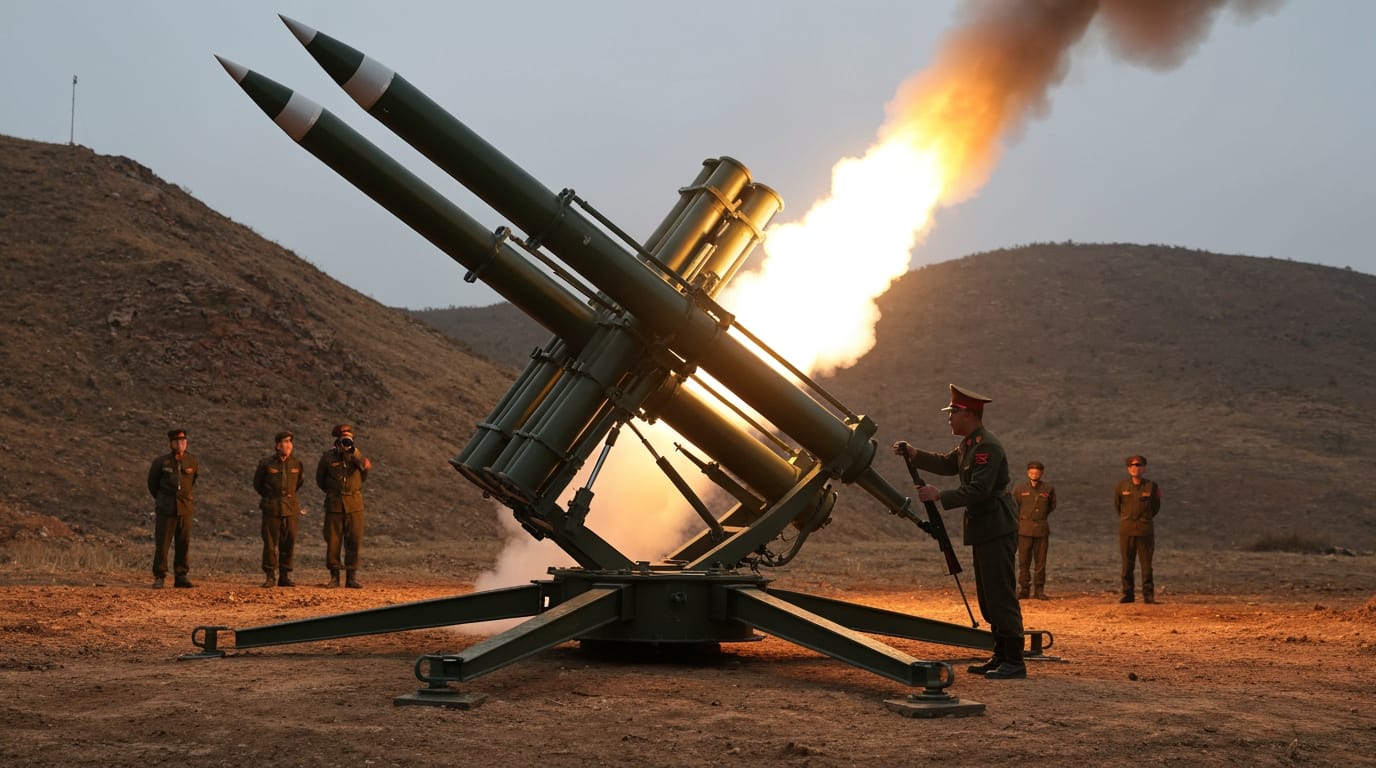
Pyongyang's recent tests of a "lightweight multi-purpose missile launching system" and a "multiple tactical cruise missile weapon system" signal a significant leap in its military capabilities, further intensifying regional tensions and drawing condemnation from international observers.
North Korea conducted a series of missile and artillery tests on May 26, 2026, showcasing what state media described as advanced weapon systems designed for modern warfare. The launches, overseen by leader Kim Jong Un, mark the eighth such test this year and underscore Pyongyang's unwavering commitment to expanding its military might despite international sanctions and widespread condemnation. The sophisticated nature of the newly revealed systems, which reportedly include AI-guided cruise missiles capable of striking targets up to 100 kilometers away, raises alarms across the Korean Peninsula and beyond, threatening to destabilize an already volatile geopolitical landscape.
A New Generation of Weapons Unveiled
The tests, originating from near Chongju in North Pyongan Province and directed towards the Yellow Sea, involved a complex array of projectiles. South Korea's military initially reported the firing of multiple projectiles, including a short-range ballistic missile that flew approximately 80 kilometers (50 miles). However, North Korea's state-run Korean Central News Agency (KCNA) later provided more granular details, asserting the successful testing of a "lightweight multi-purpose missile launching system" and a "multiple tactical cruise missile weapon system."
According to KCNA, the tests were meticulously designed to assess several key components: the power of a "special mission warhead" intended for tactical ballistic missiles, the enhanced reliability and expanded firing range of 240mm controlled artillery rockets equipped with ultra-precision autonomous navigation systems, and, notably, the accuracy of "AI-guided" tactical cruise missiles. These cruise missiles reportedly integrate precision navigation, terrain mapping, and artificial intelligence for targeting, allowing them to accurately hit objectives up to 100 kilometers away. This range is particularly significant as it places central Seoul, the densely populated capital of South Korea, well within striking distance if deployed near the Demilitarized Zone. Military analysts have suggested that the simultaneous launch of diverse weapon types, including ballistic missiles and rocket artillery, may be a deliberate tactic to overwhelm and evade existing missile defense systems.
Kim Jong Un's Assertive Stance
North Korean leader Kim Jong Un personally oversaw the launches and, according to state media, expressed "great satisfaction" with the results. He reportedly characterized the new weapon systems as a "clear signal of upgrading of our military force and an event of showing great technical progress." Kim's statements emphasized the "destructive power" of these new armaments, asserting that they are capable of making any opposing force "impossible to survive theoretically."
These tests are explicitly framed by Pyongyang as part of its ongoing "five-year goal for national defense development" and broader efforts to modernize its artillery and missile forces. Kim further indicated that the newly tested tactical cruise missiles are slated for deployment to long-range artillery units positioned along the southern border. This move reinforces Kim Jong Un's earlier declaration in March that North Korea's status as a nuclear-armed state is "irreversible" and that expanding a "self-defensive nuclear deterrent" is paramount to national security.
Mounting Regional and International Concerns
The latest missile launches have predictably drawn swift reactions from neighboring countries and the international community. South Korea's military confirmed the launches and stated it is maintaining a heightened state of surveillance and readiness to counteract any potential provocations from the North. South Korean officials have reiterated calls for Pyongyang to engage in dialogue and work towards de-escalating tensions on the Korean Peninsula.
North Korea's continued development and testing of ballistic missile technology explicitly violate multiple United Nations Security Council resolutions. Since 2006, the UN Security Council has imposed numerous sanctions on North Korea, aiming to curb its nuclear weapons and missile programs. However, Pyongyang has consistently flouted these restrictions, accelerating its arsenal buildup in recent years.
Analysts suggest that North Korea's recent flurry of missile tests, including the current advanced display, may be an attempt to capitalize on a perceived erosion of international norms and to solidify its status as a nuclear power. This strategy appears to be aimed at leveraging its enhanced military capabilities to gain concessions, such as sanctions relief, should diplomatic engagements resume.
A Pattern of Escalation
The May 26 launches are not isolated incidents but rather part of a persistent pattern of weapon demonstrations by North Korea. This year alone, Pyongyang has conducted eight missile tests. In April, for instance, North Korea tested a ballistic missile to "verify the characteristics and power of a cluster bomb warhead," following earlier tests of a new cluster-bomb warhead and an electromagnetic weapon.
Beyond these recent tests, North Korea has also engaged in military cooperation with Russia, reportedly supplying ballistic missiles and artillery rockets for use in the conflict in Ukraine since late 2023. This collaboration is believed to have provided Pyongyang with valuable battlefield data, potentially contributing to the rapid advancements observed in its domestic weapons development. The transfer of arms between North Korea and Russia is also a direct violation of UN Security Council resolutions, further complicating the international effort to curb Pyongyang's military ambitions.
The international community, particularly the United States, Japan, and South Korea, remains committed to the complete denuclearization of the Korean Peninsula. However, North Korea's continuous pursuit of sophisticated weaponry and its aggressive rhetoric present significant challenges to achieving this goal, demanding a delicate balance of diplomatic engagement and robust deterrence.
The latest revelations surrounding North Korea's "lightweight multi-purpose missile launching system" and "multiple tactical cruise missile weapon system" underscore a concerning trend of accelerating military modernization. These advancements, coupled with Kim Jong Un's defiant statements and the ongoing geopolitical shifts, highlight the urgent need for a concerted international response to prevent further escalation and ensure stability in East Asia. The world watches closely as Pyongyang continues its aggressive trajectory, with the implications of its growing arsenal reverberating across global security frameworks.


