North Korea Unveils Advanced Nuclear-Capable Rocket Launchers, Escalating Regional Tensions
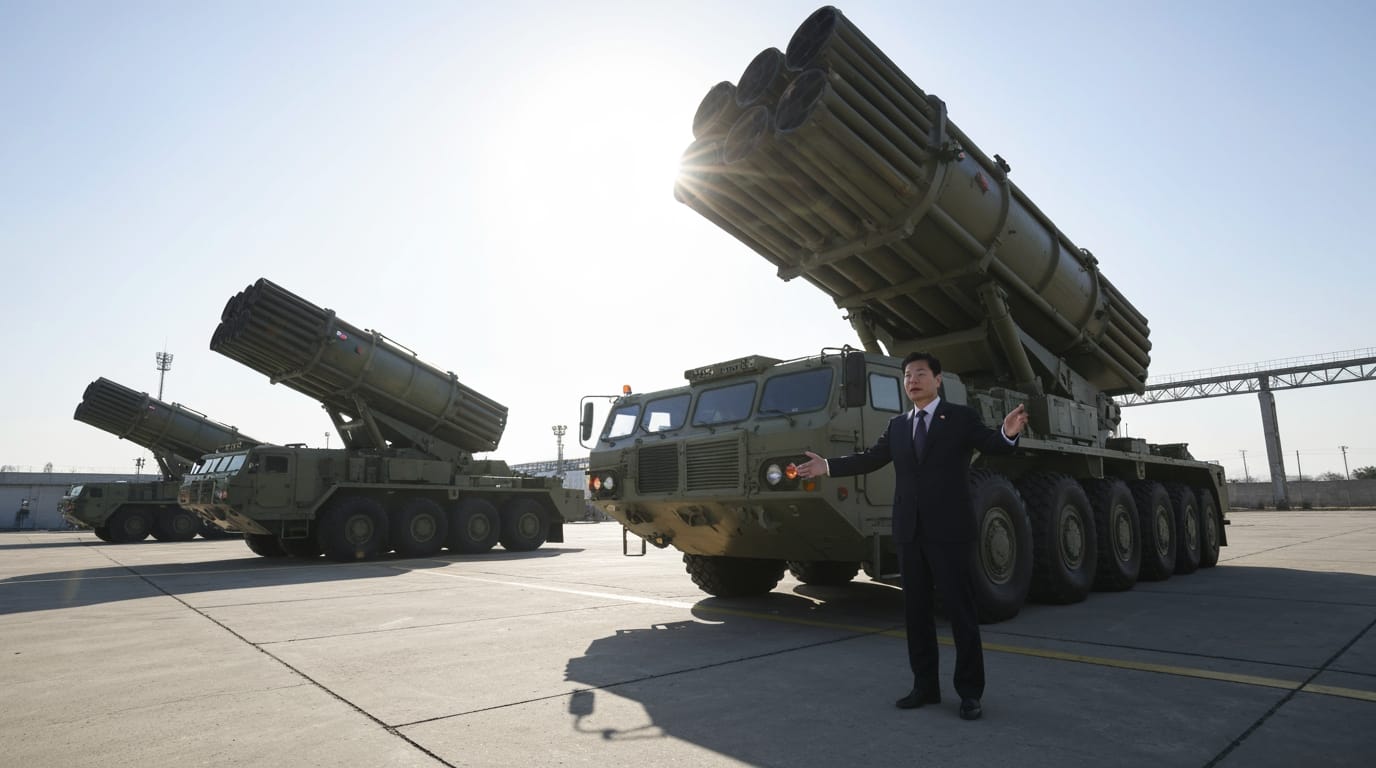
Pyongyang, North Korea – North Korea has formally unveiled and begun the deployment of 50 new, nuclear-capable multiple rocket launchers, a significant escalation in its ongoing military modernization efforts that analysts say further solidifies its tactical nuclear capabilities and poses a direct threat to South Korea. The highly publicized event, presided over by leader Kim Jong Un, showcased the 600mm-caliber systems just ahead of a pivotal ruling party congress, underscoring Pyongyang's unwavering commitment to expanding its arsenal as a cornerstone of national defense. This development is poised to intensify an already volatile security landscape on the Korean Peninsula and further complicate international efforts toward denuclearization.
A Grand Unveiling for a Strategic Mission
The official state media, KCNA, reported on Thursday, February 19, 2026, that leader Kim Jong Un attended a ceremony the previous day to mark the deployment of 50 new launch vehicles for the advanced 600mm multiple rocket launcher systems. This grand unveiling occurred in Pyongyang, with photographs showing rows of the formidable military hardware displayed prominently. During his address, Kim Jong Un lauded the new system as the "world's most advantageous weapon for concentrated super-powerful attack," asserting its uniqueness and suitability "for a special attack, that is, for accomplishing a strategic mission." This phrasing is widely interpreted as a euphemism for nuclear weapons usage, signaling the explicit nuclear role of these new artillery systems.
Kim Jong Un further emphasized that the launchers were intended as a "deterrent" against unnamed adversaries, primarily understood to be South Korea and the United States. He reportedly stated that "when this weapon is used actually, no force would be able to expect God's protection," portraying the new armament as a "wonderful and attractive weapon." The timing of this showcase is notable, preceding the Ninth Congress of the ruling Workers' Party, a landmark meeting expected to outline the country's next five-year defense strategy and economic goals. The delivery of these 50 units was presented as a "gift" to the congress by munition workers, highlighting the regime's focus on military strength as a key political achievement.
The KN-25: A Hybrid Threat with Nuclear Potential
The 600mm multiple rocket launcher system, often identified by the U.S. designation KN-25, represents a critical advancement in North Korea's short-range missile capabilities. While North Korean state media refers to it as a "super-large multiple rocket launcher," its size and operational range have led U.S. Forces Korea (USFK) to classify it as a short-range ballistic missile (SRBM). The system boasts an impressive range of approximately 380 to 400 kilometers, placing vital South Korean facilities, including the capital Seoul (which lies less than 50 kilometers from the border), squarely within its striking distance.
Crucially, North Korea has explicitly stated that the KN-25 is capable of carrying both conventional and tactical nuclear warheads. This dual-capability, combined with its large caliber, makes it a particularly potent and versatile asset in Pyongyang's arsenal. Recent tests, including one in January 2026 overseen by Kim Jong Un and his daughter, Kim Ju-ae, demonstrated the system's enhanced precision. During these tests, four rockets successfully hit a target 358.5 kilometers from the launch site, with Kim emphasizing the "perfect" mobility of the modernized launcher and a "self-steered precisely guided flight system" that can negate external interference. Reports also suggest the weapon could be equipped with artificial intelligence technology and a compound guidance system, further improving its accuracy and effectiveness. The mass production of tracked launchers for the KN-25 was also revealed in May 2025, indicating a concerted effort to rapidly integrate these systems into the Korean People's Army.
Shifting Strategic Doctrine and Regional Instability
The unveiling of these nuclear-capable rocket launchers signals a notable shift in North Korea's strategic doctrine, increasingly prioritizing large-caliber multiple launch rocket systems (MLRS) as core strike assets. This move suggests a strategy to overwhelm missile defenses with salvo launches, as a single 600mm system could potentially fire multiple warheads, each possibly nuclear. This presents a formidable challenge for South Korea's missile defense planning, which would need to intercept numerous incoming projectiles simultaneously. Kim Jong Un highlighted this strategic advantage, stating that the new launchers would provide his frontline units with "overwhelming" firepower over South Korea and enhance the practicality and efficiency of tactical nuclear operations. He claimed this system would "completely change the role and conception of artillery accepted by modern warfare" and lead to the breakdown of "belligerents' military infrastructure and command system" if used.
This accelerated military development also comes amid reports of North Korea transferring quantities of its conventional M1989 "Koksan" 170mm self-propelled artillery systems to Russia. In return, Russia is believed to have supplied North Korea with missile and nuclear-related technologies, potentially including miniaturization techniques for thermonuclear warheads. Such an exchange, if confirmed, would represent a significant geopolitical quid pro quo, further boosting Pyongyang's weapons programs. The deployment of these sophisticated land-based systems complements North Korea's broader ambition to develop a more survivable and sophisticated nuclear force, exemplified by its recent unveiling of a nuclear-powered ballistic missile-capable submarine in December 2025. Such a platform would offer a second-strike capability, complicating regional missile defense and early warning systems.
International Apprehension and Stalled Diplomacy
The latest display of North Korea's expanding nuclear capabilities has drawn immediate apprehension from the international community, particularly from South Korea and the United States. Concerns about Kim's nuclear program have intensified as he has demonstrated an intent to deploy battlefield nuclear weapons and authorized preemptive nuclear strikes if his leadership is perceived to be under threat. Both Washington and Seoul have consistently called for a strong response to North Korea's "destabilizing behavior," while reiterating their openness to dialogue "anywhere, without any conditions."
However, North Korea has repeatedly rejected these overtures, asserting that the United States must first abandon its "hostile policy" before any talks can resume. Pyongyang views its nuclear arsenal as a non-negotiable deterrent against perceived external threats, a stance underscored by the failed denuclearization summit between Kim Jong Un and then-President Donald Trump in 2019. The United Nations Security Council has previously imposed multiple rounds of sanctions on North Korea over its nuclear tests and ballistic missile launches, with member states urging a "strong reaction" to such violations. Despite these sanctions and condemnations, North Korea has steadfastly pursued its weapons development, leveraging geopolitical shifts, such as Russia's war in Ukraine, as a distraction to further accelerate its programs.
A Persistent Challenge to Global Security
The unveiling and deployment of North Korea's advanced nuclear-capable rocket launchers mark a new and concerning phase in the country's military development. These systems provide Pyongyang with a more versatile and potentially overwhelming strike capability, specifically targeting its immediate southern neighbor with both conventional and tactical nuclear options. The explicit designation of these systems for "strategic missions" leaves little doubt about their intended role in North Korea's nuclear doctrine.
As regional tensions escalate, the international community faces the persistent challenge of curbing North Korea's nuclear ambitions. The current stalemate in denuclearization talks, coupled with Pyongyang's continued military advancements, suggests a protracted period of instability on the Korean Peninsula. The deployment of these new weapons not only heightens the risk of regional conflict but also underscores North Korea's determined pursuit of its self-defined security interests, further cementing its position as a nuclear-armed state in defiance of global norms and sanctions.


