Pope Leo XIV Delivers Scathing Critique of Inequality and Corruption in Oil-Rich Equatorial Guinea
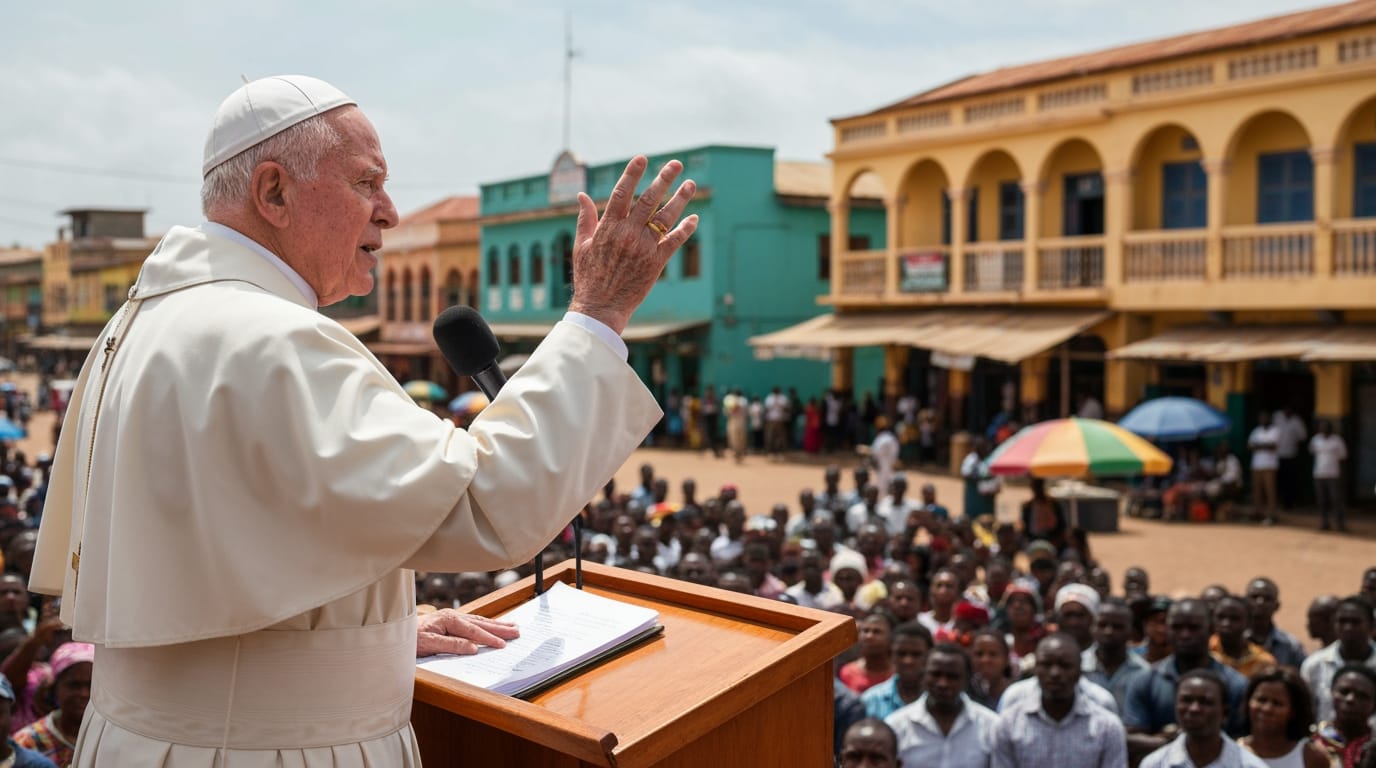
MALABO, Equatorial Guinea – In a historic and politically charged visit, Pope Leo XIV, on the final leg of his four-nation African tour, delivered an unequivocal condemnation of the stark wealth inequality and endemic corruption plaguing Equatorial Guinea. During his two-day visit on April 21-22, 2026, the Pontiff challenged the nation's leadership to prioritize the common good over private interests, declaring that an "economy of exclusion and inequality" ultimately "kills." His powerful words resonated through a nation where immense oil wealth has conspicuously failed to translate into widespread prosperity, leaving the majority of its citizens in profound poverty under a long-standing authoritarian regime.
The Pontiff's Unflinching Message
Pope Leo XIV's visit to Equatorial Guinea, a predominantly Catholic nation, marked a pivotal moment, as he became the first Pope to visit the country since John Paul II in 1982. Addressing authorities and a massive congregation estimated at 100,000 faithful, the Pontiff called upon Equatorial Guineans "to serve the common good rather than private interests, bridging the gap between the privileged and the disadvantaged." His arrival in Malabo, and subsequent Mass in Mongomo, an eastern city, saw him directly confront the deep-seated issues that define the Central African state.
Echoing the sentiments of his predecessor, Pope Francis, Leo XIV quoted the late pontiff, stating, "today we also have to say 'thou shalt not' to an economy of exclusion and inequality. Such an economy kills." This direct critique highlighted the moral imperative for leaders to "dismantle the obstacles to integral human development." Beyond economic disparities, the Pope also raised concerns about human rights, specifically decrying the poor treatment of prisoners and their "troubling hygienic and sanitary conditions," and was scheduled to visit a high-security detention facility. His statements underscored a broader message against the "colonization" of Africa's minerals and the "lust for power" that he observed driving global dynamics.
Equatorial Guinea's Paradox of Plenty
Equatorial Guinea presents a striking paradox: it is one of Sub-Saharan Africa's largest oil producers and boasts a high GDP per capita, comparable to developed nations like Italy and South Korea. However, this immense wealth, largely derived from offshore oil discovered in the mid-1990s, has not benefited its population equitably. More than half of the country's nearly 2 million inhabitants live in poverty, with some estimates indicating over 60 percent survive on less than $1 a day. This dramatic disparity is a direct consequence of wealth concentration in the hands of a small elite, primarily the family and associates of President Teodoro Obiang Nguema Mbasogo.
President Obiang, who seized power in 1979, is the world's longest-serving president not a monarch, and his four-decade rule has been consistently marred by accusations of authoritarianism and widespread corruption. Human Rights Watch and other organizations have extensively documented how the nation's oil revenues have enriched the ruling family while leaving the broader population without access to essential services like healthcare and education. The country's Gini index, a measure of income inequality, stood at 38.5 in 2022, notably higher than the global average of 35.16, reflecting the profound economic imbalance.
A System Plagued by Corruption and Rights Abuses
The allegations of systemic corruption in Equatorial Guinea are not merely anecdotal; they are widely documented by international bodies and have led to legal repercussions for high-ranking officials. Transparency International consistently ranks Equatorial Guinea among the most corrupt states globally. A prominent example includes the President's son and Vice President, Teodoro Nguema Obiang Mangue, who was convicted in France for money laundering and embezzling public funds, resulting in a suspended sentence and the seizure of luxury assets. Similar investigations have been pursued in other countries, highlighting a pattern of illicit wealth accumulation.
Beyond financial misconduct, the country's human rights record is deeply troubling. Credible reports detail instances of unlawful killings, torture, arbitrary detention, and politically motivated imprisonment. Political prisoners are often held in abusive conditions, with limited access to legal counsel, a concern directly addressed by Pope Leo XIV during his visit. Civil liberties are severely restricted, with limitations on freedom of expression, assembly, and the operation of non-governmental organizations, many of which are unable to function within the country. These abuses, coupled with the opaque budgetary processes, paint a picture of a governance system that prioritizes control and personal enrichment over the welfare of its citizens.
A Nation's Hopes and a Pope's Challenge
Pope Leo XIV's visit was met with fervent enthusiasm by the predominantly Catholic populace, who saw it as a moment of spiritual encouragement and hope for change. The presence of President Obiang and his son at the papal Mass in Mongomo underscored the delicate diplomatic balance the Pope had to strike: supporting the faithful while challenging the regime without appearing to legitimize its authoritarian rule. Vatican officials acknowledged this challenge, noting the Pope's consistent messaging on peace, accountability, and the moral responsibilities of leadership throughout his African tour.
The Pontiff's willingness to speak frankly about corruption and inequality, even in the presence of the very leaders accused of these transgressions, offered a beacon of hope for many. Activists, such as those from EG Justice, a human rights group, had urged the Pope to leverage his moral authority to speak out against abuses and the detention of political activists. His criticisms, while not directly naming individuals or specific policies, served as a profound moral call to action for a government that has long faced international scrutiny for its governance practices.
Conclusion
Pope Leo XIV's courageous denunciation of inequality and corruption in Equatorial Guinea serves as a powerful reminder of the Church's role in advocating for social justice. His words, delivered amidst a backdrop of vast wealth concentrated in few hands and widespread human suffering, challenge the very foundations of the nation's governance. The visit has placed a renewed international spotlight on Equatorial Guinea's ongoing struggle with equitable resource distribution, human rights, and democratic principles. While the immediate impact remains to be seen, the Pontiff's unwavering call for justice and the common good has undeniably amplified the voices of those who suffer in silence, urging both local leadership and the global community to confront the deep-seated issues that prevent true prosperity for all Equatoguineans.


