Rare Meeting of US and Cuban Generals Signals Cautious Dialogue Amidst Rising Tensions
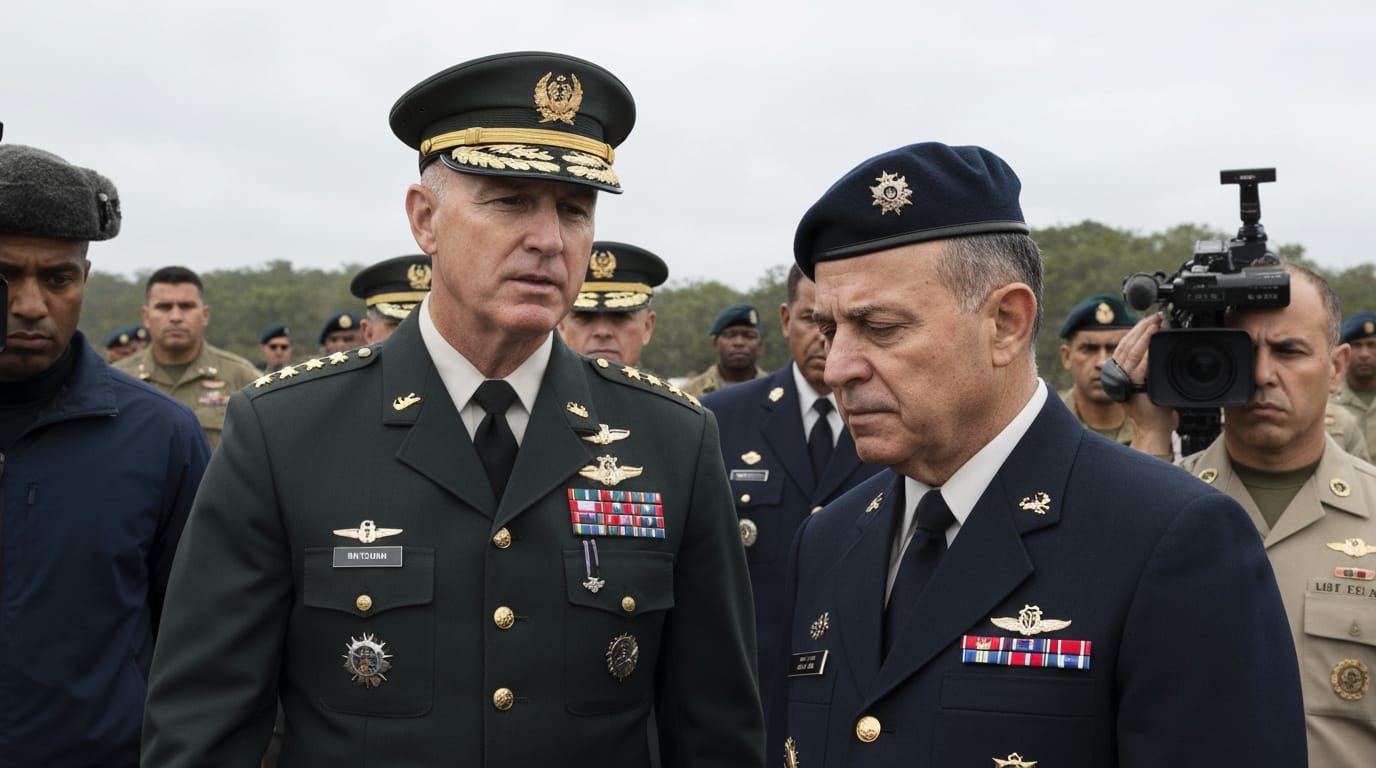
GUANTANAMO BAY, CUBA – In a development underscoring the complex and often fraught relationship between the United States and Cuba, top military officials from both nations held a rare, face-to-face meeting on Friday, May 29, 2026, at the perimeter of the U.S. Naval Station Guantanamo Bay. This unprecedented engagement, the first in recent memory involving a head of U.S. Southern Command, saw U.S. General Francis Donovan and Cuban General Roberto Legra Sotolongo discuss operational security matters, a brief exchange that analysts suggest could be a tentative step toward de-escalation amidst a period of heightened regional tensions.
Unprecedented Dialogue at Disputed Border
The meeting took place at the demarcation line of the U.S. naval base, a site that has long symbolized the enduring friction between the two countries. General Donovan, who commands U.S. forces across Latin America and the Caribbean, engaged with General Legra Sotolongo, the first deputy minister of the chief of the Cuban General Staff, along with other senior Cuban military representatives.
The primary agenda of the discussion centered on operational security concerns. U.S. Southern Command confirmed that General Donovan also conducted a perimeter security assessment of the naval installation, addressing issues related to force protection, the safety of service members and their families, and overall operational readiness. Both sides reportedly evaluated the meeting positively and agreed on the importance of maintaining communication channels between their respective military commands. This mutual agreement suggests a recognition of shared security interests, despite the deeply rooted political disagreements that continue to define the bilateral relationship.
A Backdrop of Heightened Tensions
The dialogue between these high-ranking military officers unfolds against a backdrop of escalating rhetoric and increased pressure from the U.S. government on the Communist-run island. Cuban officials have expressed growing concerns regarding the possibility of a U.S. military attack, with Cuban President Miguel Díaz-Canel issuing a stark warning earlier this month that any such action would result in a "bloodbath with incalculable consequences."
The Trump administration has intensified its stance toward Havana, frequently citing Cuba as a key foreign policy focus. This has translated into concrete actions, including the formal charging of former Cuban President Raul Castro with murder in connection with the 1996 downing of civilian aircraft operated by Miami-based exiles. Furthermore, new sanctions and a "fuel blockade" imposed by the U.S. since January have severely impacted Cuba's economy, leading to widespread power outages and shortages of essential goods.
Adding to the complexity, U.S. Secretary of State Marco Rubio, a vocal critic of the Cuban government and a potential contender for the 2028 Republican presidential nomination, has openly voiced concerns about Cuba posing a national security risk due to its proximity to Florida. Weeks before the military meeting, Rubio and General Donovan notably posed together in a photo with a map of Cuba, a post on X by Southern Command that spoke to "U.S. efforts to counter threats that undermine security, stability and democracy in our hemisphere."
The military meeting at Guantanamo Bay also follows a separate, rare visit earlier in May by CIA Director John Ratcliffe to Havana, indicating a flurry of high-level, albeit often discrete, engagements between the two adversaries. Concurrently, there has been a visible U.S. military buildup near Cuba, including the presence of the USS Nimitz carrier strike group in the Caribbean, contributing to the atmosphere of unease on the island.
Guantanamo Bay: A Symbol of Complex Relations
The choice of U.S. Naval Station Guantanamo Bay as the venue for these discussions is profoundly symbolic, given its contentious history. The United States first gained control of the bay in 1898 during the Spanish-American War, establishing a naval base that has remained under its de facto jurisdiction ever since. A 1903 lease, reaffirmed in 1934, granted the U.S. permission for a perpetual naval station, with an annual payment that Cuba has not cashed since the 1959 revolution.
Cuba has consistently protested the U.S. presence, arguing that the base was imposed by force and is illegal under international law, maintaining that Cuba retains ultimate sovereignty over the territory. For the U.S., the base represents a vital strategic location in the Caribbean, providing logistical support for maritime forces and serving various operational needs throughout its history.
Beyond its strategic significance, Guantanamo Bay gained international notoriety as the site of a controversial detention facility established after the September 11, 2001, attacks. This facility, which has housed alleged unlawful combatants, has faced global criticism regarding its legal framework and treatment of detainees, further complicating the base's image and its role in U.S. foreign policy. Therefore, a military-to-military dialogue at such a historically charged location highlights the delicate balance both nations attempt to strike between acknowledging practical realities and upholding long-standing ideological positions.
Implications for a Shifting Geopolitical Landscape
The meeting between General Donovan and General Legra Sotolongo, while focused on specific operational security matters, carries broader implications for the future trajectory of U.S.-Cuba relations. It suggests a pragmatic recognition by both military establishments of the need for some level of communication, particularly in a volatile region. This could be interpreted as a limited, functional engagement aimed at preventing miscalculation or unintended escalation, especially given the current geopolitical climate and the visible military posturing by the U.S.
However, the deep-seated mistrust, decades of antagonism stemming from Fidel Castro's 1959 revolution, and the ongoing political and economic pressure exerted by the U.S. mean that any significant diplomatic breakthroughs remain highly improbable in the short term. The meeting’s limited scope to "operational security matters" may signal a deliberate effort to keep military-to-military channels open without implying a broader shift in political relations.
The rare military-to-military dialogue at Guantanamo Bay marks a notable, albeit cautious, deviation from the predominantly antagonistic posture that has characterized U.S.-Cuba relations. While far from signaling a thaw in diplomatic ties, this engagement between high-ranking generals represents an intriguing moment where practical security concerns briefly superseded profound ideological differences. Its long-term impact on the delicate balance of deterrence and dialogue in the Caribbean remains to be seen, but it undoubtedly underscores the complex and enduring nature of the relationship between Washington and Havana.


