Russia Intensifies Deadly Missile Barrages on Kyiv, Civilian Casualties Mount

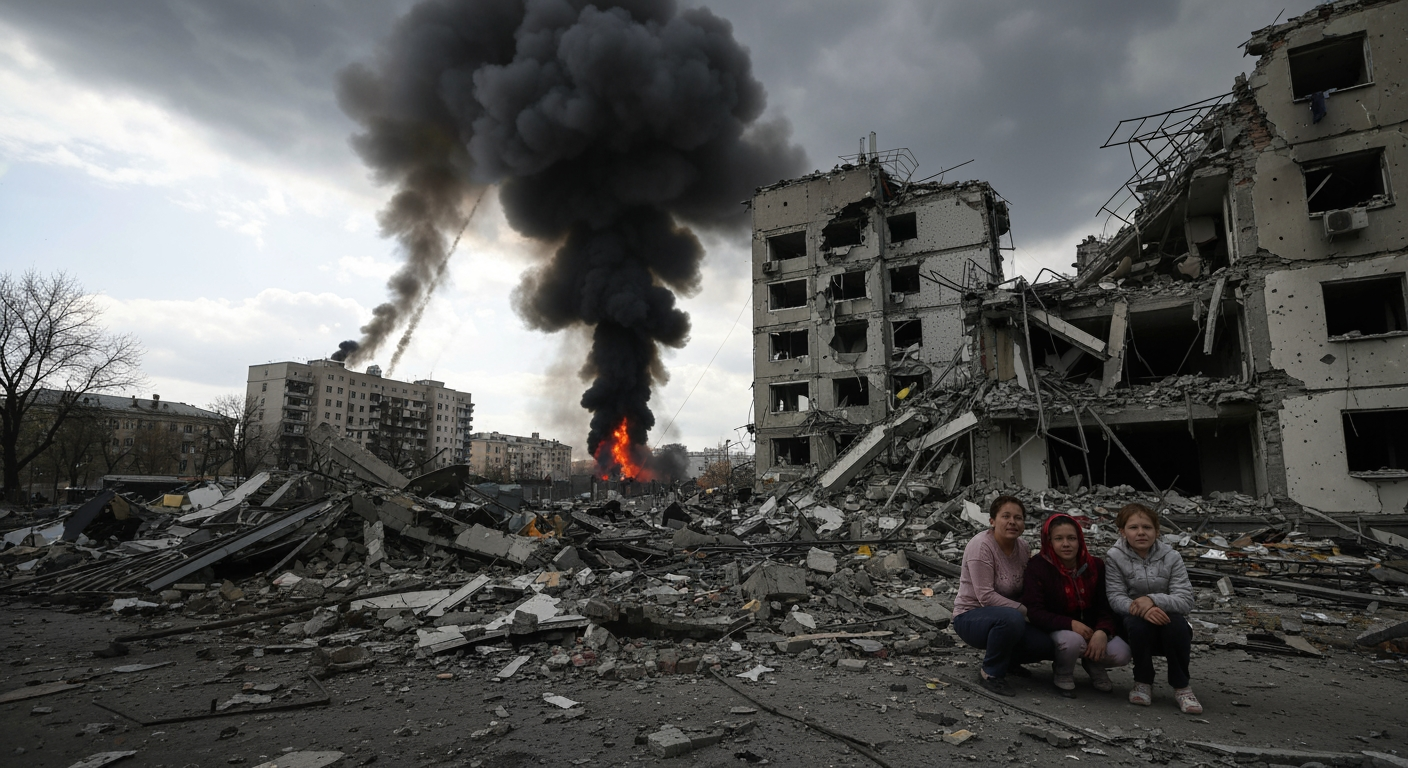
KYIV, UKRAINE – Russia has significantly escalated its missile and drone attacks on Ukraine, with Kyiv enduring particularly brutal and deadly barrages in recent weeks, resulting in numerous civilian casualties and widespread destruction. These intensified strikes underscore Russia's ongoing strategy to target Ukrainian cities and infrastructure, exploiting perceived vulnerabilities in Ukraine's air defense capabilities. The capital city, a symbol of Ukrainian resilience, faces a relentless aerial assault, prompting international condemnation and renewed calls for robust defensive support.
Escalation and Devastation in Late July
The closing days of July 2026 saw a sharp increase in the intensity and lethality of Russian missile and drone attacks across Ukraine, with Kyiv bearing a substantial brunt of the aggression. On July 30, a sweeping ballistic missile and drone barrage across Ukraine killed at least eight civilians, including children, and wounded dozens more. In Kyiv, specifically, a 31-year-old man was killed, and two others were wounded as residential buildings, a market, a garage cooperative, storage facilities, and vehicles sustained significant damage. Ukrainian President Volodymyr Zelenskyy reported that a 6-year-old girl and two boys aged 11 and 17 were among the dead in other regions, their parents also perishing in the same attacks, with a ballistic missile described as having "blown (to) smithereens" an ordinary home.
Just days prior, on July 25, a Russian ballistic missile strike in the Kyiv region tragically claimed 10 lives and injured nearly 100 individuals at the site of a defense industry event. Ukrainian emergency services depicted scenes of devastation, with teams sifting through rubble at the attack site, which was adjacent to several residential houses north of the capital. This incident drew sharp criticism from President Zelenskyy, who lamented that such an event should never have taken place under the circumstances. Adding to the regional tension, NATO member Poland initiated an investigation into reports that a Russian cruise missile entered its airspace during one of the July 30 barrages and subsequently fell on its territory.
The Enduring Ordeal: Kyiv Under Siege
Kyiv, home to nearly three million residents, has been a frequent target of the Russian Armed Forces since the full-scale invasion began in February 2022. Following the initial failed attempt to capture the city, remote airstrikes have become a persistent threat. The capital has endured an extensive and relentless campaign of aerial bombardment, with Russian forces utilizing a diverse arsenal ranging from Iranian-made Shahed drones to various cruise and ballistic missiles, including Kalibr, Kh-101/Kh-555, Iskander-M, S-400, and even North Korean Hwasong-11A ballistic missiles.
Statistics paint a grim picture of the constant peril faced by Kyiv's inhabitants. In 2024 alone, the city weathered 1,300 drone attacks and over 250 missile strikes, distributed across approximately 200 airstrikes. That year, air raid sirens blared 500 times, resulting in damage to 550 residential buildings and an average of nine hours of daily power outages. The first three years of the full-scale war saw 210 civilians killed in Kyiv, including 11 children.
The intensity continued into 2025, with a record number of drones and missiles targeting the Kyiv metropolitan area during an overnight airstrike on July 3/4, a daily record for long-range drone launches across Ukraine since the invasion's outset. Further escalations occurred on July 8/9, when 728 drones and 11 missiles targeted the capital region and ten other Ukrainian oblasts. Early 2026 brought its own challenges, as a January 9 strike left half of all residential buildings without heating, prompting Kyiv Mayor Vitali Klitschko to report that 600,000 residents had left the capital. In early February, residents faced extreme electricity shortages, with power available for less than two hours a day due to sustained strikes.
Civilian Impact and Resilience
The human cost of these relentless attacks is immeasurable. Beyond the tragic loss of life and physical injuries, the psychological toll on Kyiv's population is profound. Residents like Maryna, who sought shelter with her children in a metro station during a July 30 overnight attack, describe the attacks as "getting worse". Her six-year-old daughter, Milana, articulated a universal desire for normalcy, stating, "I want to be in my own bed, with my own toys". The UN Children's Fund (UNICEF) reported that multiple children were among the dead and injured in attacks across Ukraine in late July, underscoring that "more young lives [are] devastated by war as deadly attacks persist".
The strikes consistently target civilian infrastructure, damaging homes, schools, and essential services. The UN emergency relief agency, OCHA, noted that families in regions including Kyiv have "lost loved ones or been left without homes" following recent large-scale Russian attacks. Despite the constant threat, there are efforts to maintain a semblance of normalcy. However, a government commission in June 2023 found that only half of Kyiv's 1,078 bomb shelters were usable, highlighting ongoing challenges in protecting the populace.
Ukraine's Air Defense Challenges and International Response
The recent intensification of attacks has brought into sharp focus Ukraine's critical shortage of advanced anti-ballistic missile defenses. President Zelenskyy has consistently appealed for swifter and larger deliveries of Western-supplied air defense systems, particularly Patriot systems, which are considered the most effective against Russia's ballistic assaults. He emphasized that, given these shortages, Ukrainian "warriors are accomplishing truly incredible things, demonstrating a very high level of professionalism".
During a meeting in Washington, President Zelenskyy discussed these urgent needs with President Trump and representatives of American defense companies. While President Trump reportedly promised to grant Ukraine licenses to build its own Patriot systems, the establishment of production capabilities is expected to be a lengthy process. The global demand for American-made interceptors, partly due to conflicts such as the Iran war, has reportedly strained existing stockpiles.
Internationally, the United Nations has unequivocally condemned the attacks. UN Secretary-General António Guterres called for de-escalation and a ceasefire, with UN Deputy Spokesperson Farhan Haq stating that "Any attacks against civilians and civilian infrastructure, wherever they occur, are a clear violation of international humanitarian law and must stop immediately". Concerns also remain over military activity near nuclear power plants, including Zaporizhzhia, which complicates efforts to ensure nuclear safety and security, as noted by the International Atomic Energy Agency (IAEA).
Conclusion
The unrelenting missile and drone attacks on Kyiv and other Ukrainian cities represent a grave and escalating humanitarian crisis. The high civilian death toll, widespread destruction of residential areas, and continuous disruption of essential services underscore the severe human cost of Russia's aggression. While Ukrainian forces demonstrate remarkable resilience in defending their skies, the critical need for advanced air defense systems remains paramount. The international community continues to grapple with how best to support Ukraine in the face of this sustained onslaught, as Kyiv stands as a stark reminder of the devastating impact of modern warfare on urban populations.
Related Articles

Ratko Mladić, "Butcher of Bosnia" and Convicted War Criminal, Dies at 84
THE HAGUE, Netherlands – Ratko Mladić, the former Bosnian Serb military commander known as the "Butcher of Bosnia" and convicted of genocide, war crimes, and crimes against humanity, has died at the age of 84. Serbian...


Long-Awaited 9/11 Mastermind Trial Set for 2028, Decades After Attacks
GUANTANAMO BAY, Cuba – Nearly a quarter-century after the devastating terror attacks of September 11, 2001, a military judge has finally set a trial date for Khalid Sheikh Mohammed, the alleged mastermind behind the...