Russia Strikes Lviv World Heritage Site, Igniting Global Outcry Over Cultural Destruction
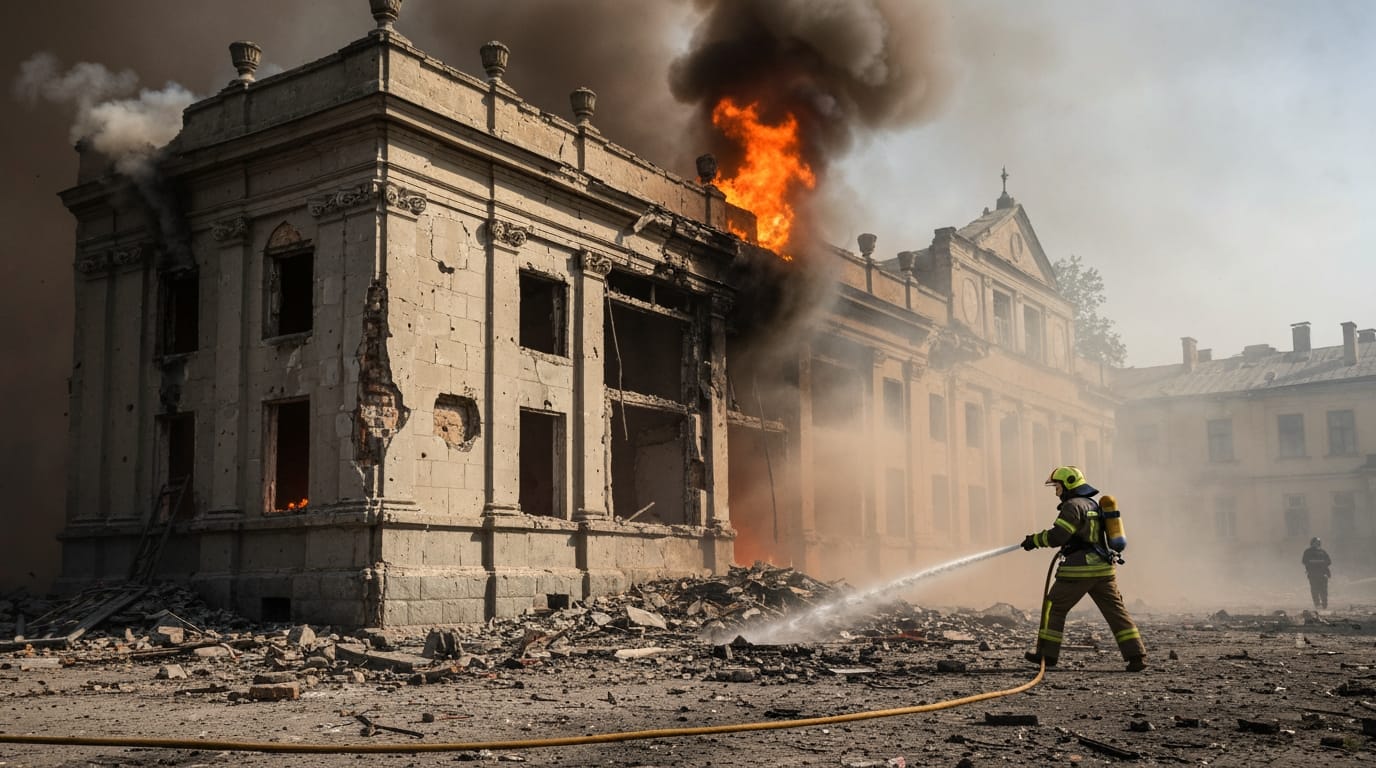
Lviv, Ukraine – A Russian drone strike on March 24, 2026, inflicted significant damage upon the historic center of Lviv, a site recognized globally for its immense cultural value and designated as a UNESCO World Heritage property. The attack, which targeted civilian infrastructure and the revered Bernardine Monastery complex, has drawn sharp condemnation from Ukrainian officials and ignited a fierce debate regarding the protection of cultural heritage during armed conflict. The incident underscores the escalating threat to Ukraine's historical treasures and has prompted renewed calls for robust international action against attacks on cultural sites.
The Unprecedented Daytime Assault
The March 24 drone strike was a component of one of Russia's most extensive and prolonged aerial assaults on Ukraine since the full-scale invasion commenced in February 2022. Unlike previous nighttime raids, this attack occurred in broad daylight, a tactic observers note as unusual and indicative of an escalating strategy. A residential building situated in close proximity to the Bernardine Monastery complex sustained extensive damage, with reports indicating two individuals suffered serious injuries. The broader assault across Ukraine led to at least 27 injuries and two fatalities.
Beyond civilian residences, the historic Bernardine Monastery itself, a 17th-century architectural marvel, suffered damage. The Lviv City Council later reported that a building within the monastery complex was in an emergency state, deemed uninhabitable, with its roof and floors destroyed, wooden structures incinerated, and load-bearing walls compromised. Other cultural landmarks impacted by the strike included the Lviv Organ Hall, housed within the 17th-century Church of St. Mary Magdalene, and the Museum of the Prison on Lontskoho. Video footage reportedly showed a Russian drone striking a building in central Lviv, suggesting a targeted air raid.
Lviv: A Crossroads of Culture Under Siege
Lviv's historic center has held UNESCO World Heritage status since 1998, celebrated for its unique urban fabric and architecture that embodies a remarkable fusion of Eastern European, Italian, and German traditions. The city's historical role as a trade hub attracted diverse ethnic groups, whose cultural and religious influences are still evident in its rich townscape. This designation highlights Lviv not merely as a Ukrainian city but as a repository of shared human history and artistry.
However, the ongoing conflict has placed this invaluable heritage under severe threat. In 2023, UNESCO's World Heritage Committee added Lviv's historic center, along with sites in Kyiv and Odesa, to the official List of World Heritage in Danger, acknowledging that optimal conditions for protection could no longer be guaranteed due to the war. The March 24 strike is not an isolated incident; previous attacks have also impacted the city's protected areas. For instance, a Russian drone struck central Lviv near the Stepan Bandera monument on January 15, and a missile attack in July 2023, which killed nine civilians, also affected the UNESCO buffer zone. These repeated assaults fuel accusations of a deliberate campaign aimed at undermining Ukrainian cultural identity. Lviv also notably hosts the first UNESCO Cultural Hub in Ukraine, established with international support to protect, restore, and preserve Ukrainian culture amidst the conflict.
International Condemnation and Diplomatic Friction
The international community swiftly reacted to the drone strike. UNESCO expressed deep alarm over the attacks, particularly those affecting the Bernardine Monastery area, and emphasized that cultural property is protected under the 1954 Hague Convention and the 1972 World Heritage Convention. The organization offered its support to Ukrainian authorities for damage assessments, protective measures, and emergency assistance. Experts from UNESCO are expected to visit Lviv to document the aftermath and evaluate the extent of the damage.
Ukrainian officials, however, voiced strong disapproval of UNESCO's initial statement, which did not explicitly attribute responsibility for the attack to Russia. Ukrainian Foreign Ministry spokesperson Heorhiy Tykhyi criticized UNESCO's perceived reluctance to directly name Russia, characterizing it as a display of the organization's "dysfunctionality" and inability to "call a spade a spade". Foreign Minister Andrii Sybiha had earlier urged UNESCO's Director-General to issue a forceful condemnation, describing the attack as not merely targeting Lviv's buildings but as an assault on UNESCO itself and on all who value cultural heritage worldwide. Ukraine's Ministry of Foreign Affairs underscored that the attack constituted a war crime and a direct assault on humanity's cultural heritage, which falls under international protection.
In light of these events, Ukraine has intensified its calls for more decisive international action against Russia. The Ministry of Foreign Affairs advocates for Russia to be stripped of its influence within international institutions and to face severe consequences, including cultural sanctions. The Ukrainian Institute of National Remembrance also urged the public to sign an open letter demanding Russia's exclusion from UNESCO, citing consistent attacks on Ukrainian cultural sites.
The Enduring Threat to Ukrainian Heritage
The strike on Lviv's World Heritage site serves as a stark reminder of the continuous and profound threat posed to Ukraine's cultural patrimony by the ongoing conflict. Attacks on historical monuments and civilian infrastructure not only cause irreparable physical destruction but also aim to erode national identity and shared historical memory. Ukrainian officials contend that Russia's actions systematically violate international agreements designed to safeguard cultural assets during wartime, such as the 1954 Hague Convention for the Protection of Cultural Property in the Event of Armed Conflict.
The deliberate targeting of a city like Lviv, with its deep historical roots and designation as a UNESCO World Heritage site, carries significant symbolic weight. It transforms cultural landmarks into collateral damage or, in some interpretations, deliberate targets, in a broader conflict that extends beyond military objectives to the very essence of a nation's identity. The widespread international condemnation of this incident reflects a global understanding that the destruction of cultural heritage diminishes not only the affected nation but also the collective legacy of humanity.
The attack on Lviv's historic center on March 24, 2026, marks a critical moment in the ongoing conflict, highlighting the vulnerability of irreplaceable cultural heritage amidst armed aggression. While UNESCO has expressed alarm and offered support for recovery efforts, the Ukrainian government's strong condemnation and demand for explicit accountability reflect a growing impatience with what it perceives as insufficient international response. The incident reignites urgent discussions on the mechanisms for protecting cultural sites in war zones and the necessary steps to ensure that those responsible for their destruction are held to account. The world watches as Lviv, a symbol of European heritage, confronts the challenge of preserving its past in the face of an uncertain future.


