Sir Tom Stoppard, Intellectual Colossus of the Stage, Dies at 88
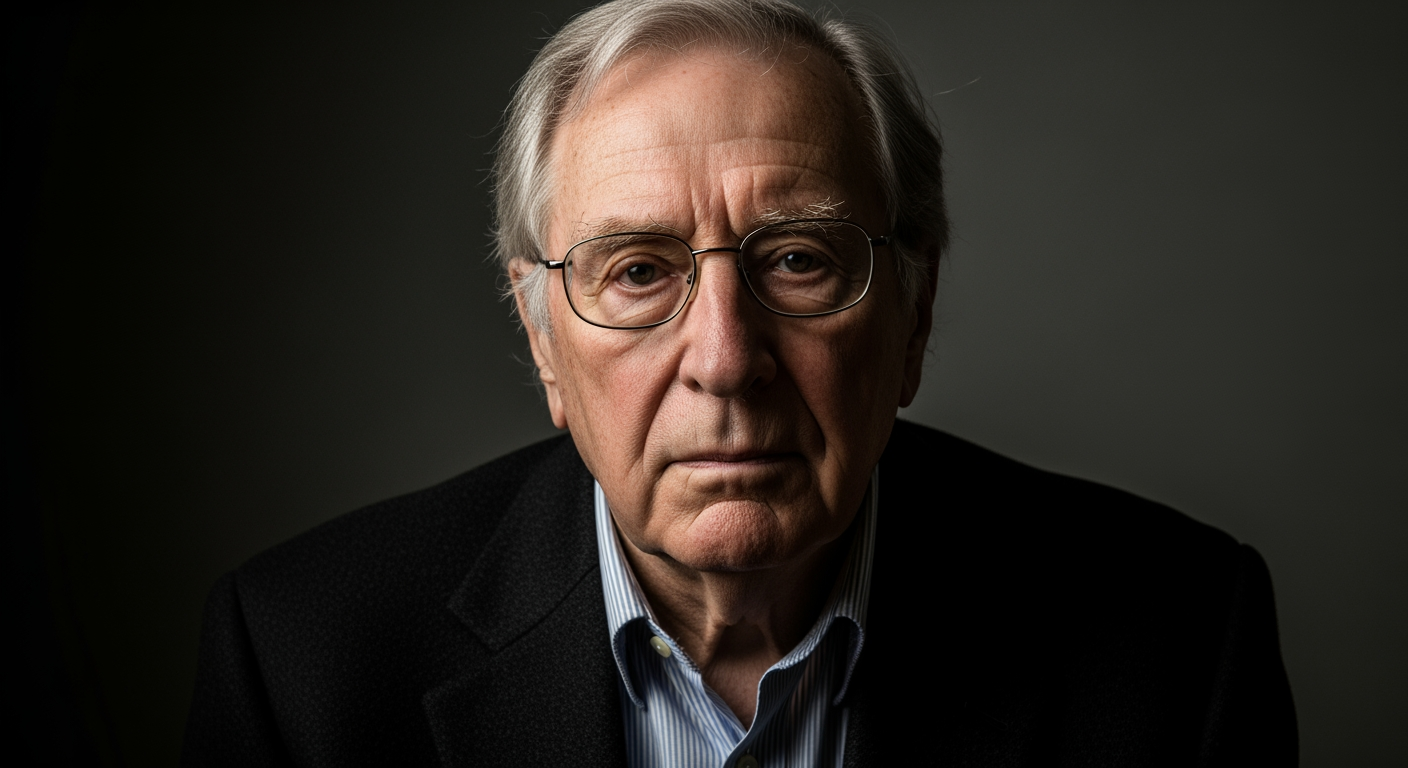
LONDON, England – Sir Tom Stoppard, the Czech-born British playwright and screenwriter whose dazzling intellect, linguistic brilliance, and profound philosophical inquiries reshaped modern theater for over six decades, passed away peacefully on November 29, 2025, at his home in Dorset, England. He was 88 years old. His death marks the end of an extraordinary career that saw him garlanded with numerous accolades, including an Academy Award, five Tony Awards, and three Laurence Olivier Awards, solidifying his reputation as one of the most significant dramatists of his era.
Stoppard's unique blend of highbrow wit, intricate narrative structures, and deeply humanistic concerns consistently challenged and captivated audiences worldwide, establishing a "Stoppardian" style that became shorthand for erudition and effervescence on stage and screen. Tributes from across the cultural spectrum have poured in, with figures like Mick Jagger calling him his "favourite playwright" and King Charles III describing him as "a dear friend who wore his genius lightly." West End theaters in London are scheduled to dim their lights in his honor, a testament to his immense and lasting influence on British theater.
From Refugee to Literary Luminary
Born Tomáš Sträussler on July 3, 1937, in Zlín, Czechoslovakia, Stoppard's early life was marked by the profound displacements of the 20th century. His parents, non-observant Jews, fled the impending Nazi invasion in 1939, relocating to Singapore. As Japanese forces advanced on Singapore in 1942, his mother, Martha, along with young Tomáš and his brother, Petr, escaped to British India. His father, a doctor employed by the Bata shoe company, remained behind and tragically died when his ship was bombed while attempting to flee Singapore.
This harrowing experience, though initially shrouded in mystery for Stoppard, profoundly shaped his later work and his deep commitment to themes of human rights, censorship, and political freedom. In 1946, his mother married British army major Kenneth Stoppard, whose surname Tomáš adopted upon the family's relocation to England. The young Stoppard, who famously described himself as a "bounced Czech," often spoke of "putting on Englishness like a coat," embracing his new identity wholeheartedly. He left school at 17, bypassing university to begin a career as a journalist in Bristol, and later as a drama critic, a path that sharpened his ear for dialogue and his understanding of theatricality.
The Dawn of "Stoppardian" Brilliance
Stoppard's meteoric rise to prominence began with the 1966 Edinburgh Festival Fringe premiere of Rosencrantz and Guildenstern Are Dead. The play, which reimagined Shakespeare's Hamlet from the bewildered perspective of two minor characters, immediately captivated critics and audiences with its dazzling wordplay, existential themes, and audacious theatricality. Its subsequent transfer to London's National Theatre in 1967 and then to Broadway in 1968, where it won a Tony Award for Best Play, cemented Stoppard's status as an overnight sensation.
This breakthrough work established the hallmarks of the "Stoppardian" style: a masterful blend of intellectual curiosity, philosophical debate, and comedic timing, often delivered with rapid-fire dialogue. He skillfully explored themes of chaos versus order, reality versus illusion, and the intricacies of language and identity, inviting audiences to engage with complex ideas while being thoroughly entertained. Critics noted his ability to inject serious issues into comedic frameworks, earning his style the description "philosophical farce."
Following Rosencrantz and Guildenstern Are Dead, Stoppard continued to produce a string of acclaimed plays that further showcased his unique voice. These included Jumpers (1972), a murder mystery entwining moral philosophy and gymnastics, and Travesties (1974), a kaleidoscopic romp through history featuring real-life figures like James Joyce, Tristan Tzara, and Vladimir Lenin in 1917 Zürich. Both plays garnered significant critical praise, with Travesties also winning a Tony Award for Best Play.
A Master of Ideas and Emotions
As his career progressed, Stoppard's works evolved, delving deeper into human emotions and historical contexts without sacrificing his signature intellectual rigor. The Real Thing (1982), his first romantic comedy, explored the nature of love, authenticity, and fidelity, earning him another Tony Award.
The 1990s brought forth what many consider his masterpiece, Arcadia (1993), a play that seamlessly interweaves 19th-century Romanticism with 20th-century chaos theory, exploring themes of love, loss, mathematics, and the relentless passage of time. Arcadia received immense critical acclaim and an Olivier Award for Best New Play. Later works like The Invention of Love (1997) explored the life of poet A.E. Housman, while the epic trilogy The Coast of Utopia (2002) delved into the philosophical debates among 19th-century Russian revolutionary figures, earning yet another Tony Award for Best Play. These plays cemented his reputation for combining diverse disciplines – science, history, poetry, and philosophy – into compelling dramatic narratives.
Beyond the Footlights: Screenwriting and a Personal Reckoning
While his impact on theater was monumental, Stoppard's versatility extended to film, radio, and television. He penned acclaimed screenplays for films such as Terry Gilliam's dystopian classic Brazil (1985) and Steven Spielberg's Empire of the Sun (1987). However, it was his co-writing credit for the 1998 romantic comedy Shakespeare in Love that earned him an Academy Award for Best Original Screenplay, showcasing his ability to blend historical fiction with witty dialogue and compelling storytelling. He also contributed uncredited script doctoring to several major films, including Indiana Jones and the Last Crusade.
In his later years, Stoppard embarked on a more personal exploration of his heritage. He discovered in his fifties, particularly after his mother's death in 1996, the full extent of his Jewish ancestry and the tragic fate of his grandparents and other relatives in the Holocaust. This deeply personal revelation informed his final play, Leopoldstadt (2020), an epic spanning over 50 years in the life of a wealthy Jewish family in Vienna. The play, which premiered when he was 82, became a powerful and poignant reflection on identity, memory, and the impact of history, earning him Olivier and Tony Awards for Best New Play. Stoppard himself acknowledged the play's profound personal significance, stating that in Leopoldstadt, "This was the character I didn't have to create because he was me."
An Unmatched Legacy
Sir Tom Stoppard's contributions to the arts are immeasurable. He was a playwright who dared theater to be clever without being cold, emotional without sacrificing rigor. He trusted his audiences with complexity, offering plays that were rich with jokes, riddles, and philosophical puzzles. Beyond his dramatic works, he was also a staunch advocate for free speech, serving on the advisory board of Index on Censorship and consistently speaking out against repression.
His influence on British and international theater is profound and enduring. The National Theatre hailed him as a "cornerstone" for 50 years, noting his "immense" impact and his ability to make audiences "reflect on history, philosophy, and the human experience." Stoppard's remarkable career demonstrates a continuous evolution, from the exuberant intellectualism of his early work to the deeply personal and reflective themes of his later years. He leaves behind a majestic body of work that will continue to provoke thought, stir empathy, and delight audiences for generations to come.
Sources
- cbc.ca
- studysmarter.co.uk
- oxfordhomeschooling.co.uk
- westendtheatre.com
- thewrap.com
- t2conline.com
- 1news.co.nz
- writersguild.org.uk
- thewire.in
- broadway.com
- miscelana.com
- click2houston.com
- theweek.com
- wordpress.com
- nationaltheatre.org.uk
- lsj.org
- people.com
- forward.com
- latimes.com
- cbsnews.com
- grokipedia.com
- ibtimes.co.uk
- newyorktheatreguide.com
- medium.com
Related Articles

Ratko Mladić, "Butcher of Bosnia" and Convicted War Criminal, Dies at 84
THE HAGUE, Netherlands – Ratko Mladić, the former Bosnian Serb military commander known as the "Butcher of Bosnia" and convicted of genocide, war crimes, and crimes against humanity, has died at the age of 84. Serbian...


Long-Awaited 9/11 Mastermind Trial Set for 2028, Decades After Attacks
GUANTANAMO BAY, Cuba – Nearly a quarter-century after the devastating terror attacks of September 11, 2001, a military judge has finally set a trial date for Khalid Sheikh Mohammed, the alleged mastermind behind the...