Skies Ablaze: Intense Solar Storm Ignites Dazzling Auroras Across Northern Hemisphere
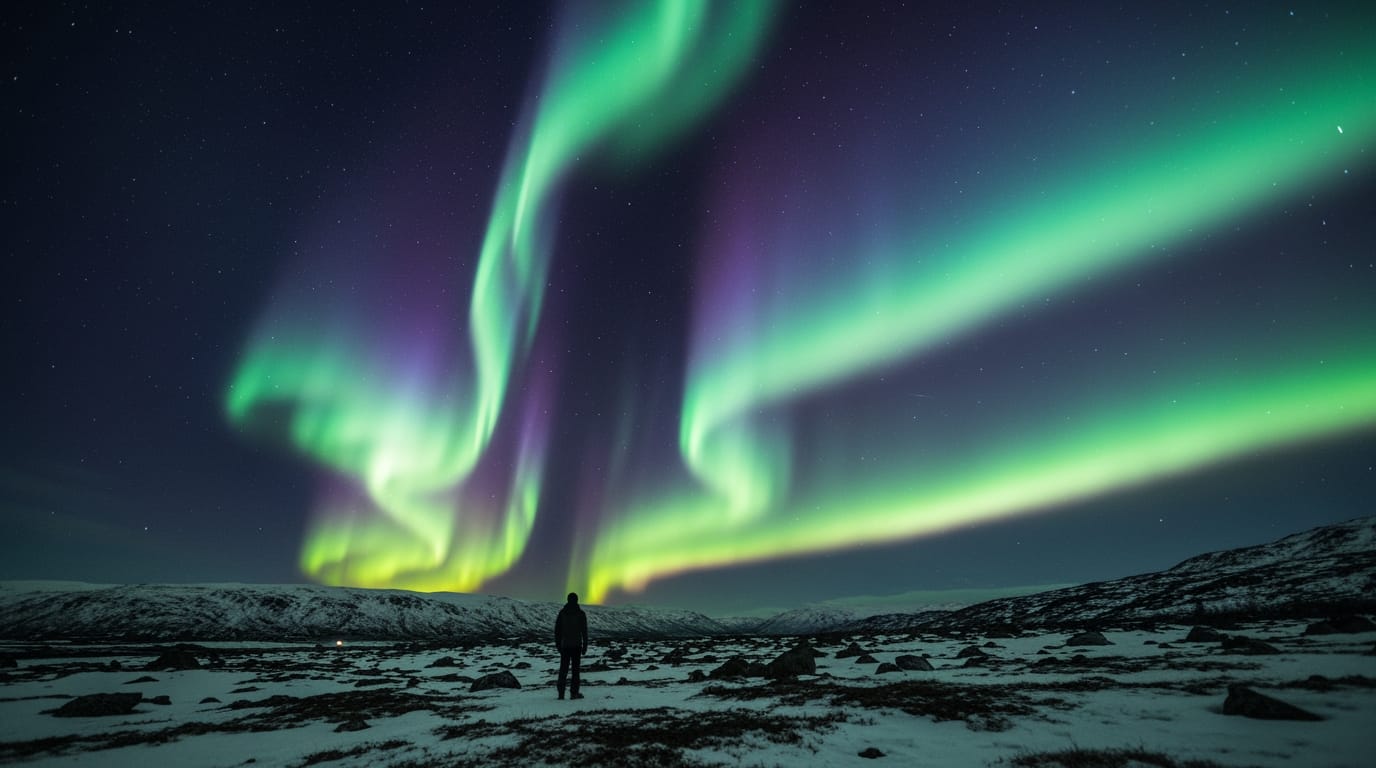
A powerful solar storm has unleashed a breathtaking display of auroras, painting the night skies with vibrant hues across North America and Europe, reaching latitudes rarely treated to such celestial spectacles. The geomagnetic disturbance, peaking at severe levels, has offered millions a rare opportunity to witness the Northern Lights while also prompting advisories regarding potential impacts on modern technology.
The awe-inspiring light show began to unfold as a severe G4-class geomagnetic storm, with a potential to escalate to an extreme G5 level, impacted Earth on Monday, January 19, 2026, extending into the early hours of Tuesday, January 20. This event follows similar widespread aurora sightings in May 2024 and November 2023, where charged particles from the sun pushed the aurora borealis far beyond its usual polar haunts, surprising skywatchers from the United States to Ukraine.
The Celestial Canvas Expands Southward
Residents across a vast swathe of the Northern Hemisphere, from northern Europe to the United States, reported vivid auroral displays. In North America, the Northern Lights were anticipated to be visible as far south as Kansas, Colorado, Utah, Nevada, West Virginia, Virginia, Maryland, and Delaware, with clearer, more intense views expected in states like Washington, Oregon, Idaho, Montana, Wyoming, North Dakota, South Dakota, Wisconsin, Minnesota, Iowa, Michigan, and Maine. Even in areas with significant light pollution, such as Phoenix, Arizona, a red glow to the north was expected to be discernible. The unusual reach allowed observers in regions like the Appalachian Mountains in Virginia and as far south as Alabama and northern California to witness the phenomenon during similar storms in May 2024 and November 2023.
Across the Atlantic, European skies also shimmered with greens, reds, and purples. Countries from the United Kingdom, where the phenomenon was seen as far south as London and southern England, to Prague, Barcelona, and even Ukraine, were treated to the rare spectacle. Social media platforms quickly filled with images captured by delighted onlookers, many utilizing phone cameras, which are often better at capturing faint light than the naked eye. The widespread visibility underscores the intensity of the solar storm responsible for energizing Earth's upper atmosphere.
The Science Behind the Spectacle
The dazzling auroras are the direct result of a powerful geomagnetic storm, a disturbance in Earth's magnetic field triggered by solar activity. The most recent event stemmed from a significant solar flare on Sunday, January 18, 2026, which launched a Coronal Mass Ejection (CME) – a massive expulsion of plasma and magnetic field from the Sun's corona – towards Earth. These charged particles, traveling at immense speeds, reached Earth's magnetic field on Monday afternoon, earlier than some predictions.
When a CME impacts Earth's magnetosphere, it allows charged particles, primarily electrons and protons, to filter into the upper atmosphere around the magnetic poles. These particles then collide with gases like oxygen and nitrogen, exciting them and causing them to emit light. The varying colors of the aurora – often green, red, and sometimes purple – depend on the type of gas being excited and the altitude at which the collisions occur. Geomagnetic storms are classified on a G-scale, ranging from G1 (minor) to G5 (extreme). The current storm was classified as a G4 (severe) with the potential to reach G5 (extreme), indicating a significant interaction with Earth's magnetic field and explaining the unusually broad visibility of the auroras. Previous strong displays in May 2024 were linked to a G5 storm, and a G3 storm was responsible for the widespread November 2023 sightings.
A Rare and Recurring Phenomenon
While auroras are a regular occurrence in high-latitude regions, their visibility at lower latitudes is a rarer event, contingent on the strength of geomagnetic storms. Historical records indicate that such "great aurora storms" occur every 40 to 60 years, with studies identifying numerous instances over the past 500 years where auroras were visible at or below 30 degrees magnetic latitude, in places like Florida, Cuba, and Samoa. The most intense solar storm in recorded history, the 1859 "Carrington Event," produced auroras visible even in the tropics, prompting widespread disruptions to telegraph systems of the era.
Ancient civilizations from Scandinavia, China, and Greece have documented strange lights in the sky for thousands of years, with the oldest known written records dating back over 2,600 years. These historical accounts, often describing the lights as fiery or ghostly phenomena, underscore humanity's long-standing fascination with this celestial dance. The current period is considered an era of auroral maximum, similar to the Medieval Maximum in the twelfth century and the Roman Maximum preceding the birth of Christ.
Potential Impacts and Vigilant Monitoring
Beyond their visual splendor, intense solar storms carry the potential for significant technological disruption. The charged particles and rapidly fluctuating magnetic fields associated with strong geomagnetic storms can interfere with satellite operations, including those vital for GPS navigation and telecommunications. The May 2024 solar storm, for instance, caused problems for farmers who rely on GPS equipment for cultivation and planning.
Power grids are also vulnerable, as geomagnetic currents induced in power lines can cause saturation of transformer cores, potentially leading to increased heating, unwanted relay operations, and even widespread blackouts. The 2003 "Halloween Storms" damaged transformers in South Africa and caused power outages in Sweden, while a 1989 storm resulted in power failures in Quebec, Canada. Space weather agencies, such as the US National Oceanic and Atmospheric Administration (NOAA) Space Weather Prediction Center, issued severe geomagnetic storm warnings, alerting operators of power plants, spacecraft, and emergency management agencies to take precautions. While no immediate widespread disruptions were reported during the most recent event, the risk highlights the growing vulnerability of modern, technology-dependent infrastructure to space weather phenomena.
The recent celestial show serves as a vivid reminder of the dynamic interplay between the Sun and Earth. While offering unparalleled natural beauty to millions, it also underscores the continuous need for vigilance and preparedness in an increasingly interconnected world reliant on space-based and terrestrial technologies susceptible to the Sun's powerful outbursts.


