Supreme Court Overrules Presidential Pardon, Reinstates Death Sentence for Maryam Sanda
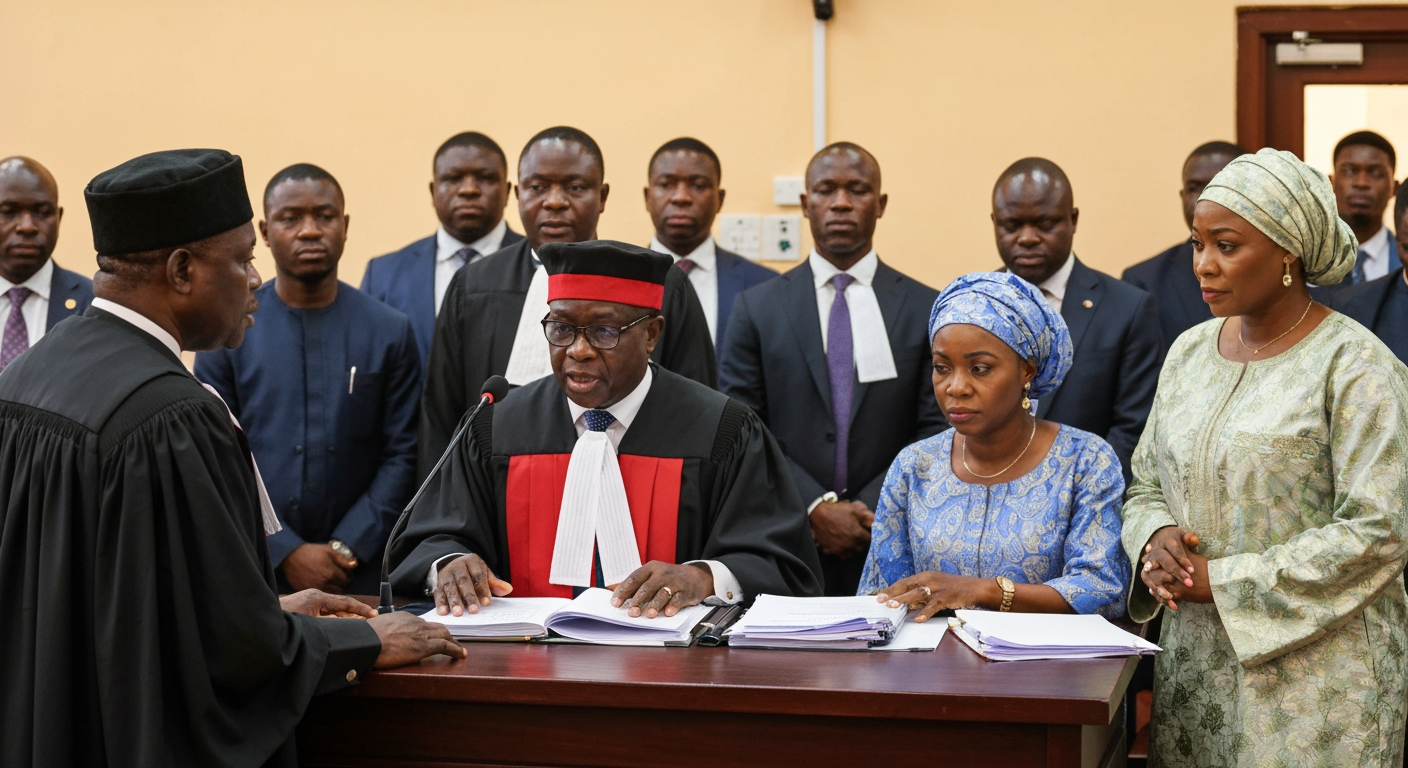
Abuja, Nigeria – In a landmark decision that underscores the delicate balance of power within Nigeria's democratic framework, the Supreme Court on Friday, December 12, 2025, nullified the presidential pardon granted to Maryam Sanda, who was convicted of murdering her husband. The nation's apex court reinstated the death sentence by hanging, affirming the earlier judgments of the lower courts and asserting the judiciary's authority over executive clemency when an appeal remains pending. This ruling sends a powerful message about the limits of presidential prerogative and its intersection with ongoing judicial processes, reigniting public discourse on justice, mercy, and constitutional governance in Nigeria.
The Apex Court's Resounding Verdict
The Supreme Court, in a split decision of four justices to one, decisively overturned President Bola Tinubu's October 2025 commutation of Maryam Sanda's death sentence to 12 years imprisonment. Justice Moore Adumein, delivering the lead judgment, stated unequivocally that the prosecution had proven the case of culpable homicide beyond a reasonable doubt, validating the Court of Appeal's earlier affirmation of the trial court's decision. Crucially, the Supreme Court lambasted the executive's intervention, noting that it was "improper" for the President to exercise the power of pardon in a capital offense case while an appeal was still active before the courts. The court emphasized that such an action violated the fundamental principle of separation of powers, where the executive cannot interfere with an ongoing judicial review of a case. Consequently, all issues raised in Sanda's appeal were dismissed for lacking merit, effectively sealing her fate and returning her to the original sentence of death by hanging.
The Tragic Case of Maryam Sanda
Maryam Sanda's legal saga began with a chilling domestic tragedy. In November 2017, she was accused of fatally stabbing her husband, Bilyaminu Bello, who was the nephew of a former national chairman of the Peoples Democratic Party (PDP), during a heated domestic dispute at their Abuja residence. The incident, which allegedly stemmed from infidelity accusations, quickly captured national attention, shedding light on issues of domestic violence and marital conflict.
After a protracted legal battle, an Abuja High Court in January 2020 found Sanda guilty of culpable homicide and sentenced her to death by hanging. Justice Yusuf Halilu, the trial judge, asserted that circumstantial evidence and Sanda's own testimony established her culpability, particularly under the "doctrine of last seen," which held her responsible as the last person with the deceased. The judge declared, "Whoever kills in cold blood shall die in cold blood... Maryam Sanda should reap what she has sown. It is blood for blood." Sanda's appeal to the Court of Appeal was subsequently dismissed in December 2020, which affirmed both her conviction and the death sentence, ruling that the prosecution had established the charge beyond a reasonable doubt.
The Controversial Presidential Pardon
The legal trajectory took an unexpected turn in October 2025 when President Bola Tinubu, as part of a broader clemency initiative, commuted Maryam Sanda's death sentence to 12 years imprisonment. The Presidency cited "compassionate grounds" and the "best interest of her children" as reasons for the reduction in sentence. This decision was part of a revised list of beneficiaries following recommendations by the Presidential Advisory Committee on the Prerogative of Mercy.
However, the inclusion of Sanda, alongside other high-profile individuals, on the clemency list sparked widespread public outrage and intense criticism. Many viewed the pardon as an affront to justice, particularly considering the gravity of her crime and the finality of the previous judicial pronouncements. The public outcry led to a partial reversal of some pardon decisions, with some names, including convicted drug peddlers, being removed from the list, though Sanda's commuted sentence remained until the Supreme Court's recent intervention.
Legal Precedent and Constitutional Ramifications
The Supreme Court's ruling on Maryam Sanda's case sets a significant legal precedent regarding the exercise of the presidential power of pardon in Nigeria. Under Section 175 of the 1999 Constitution, the President is vested with the power to grant pardons, reprieves, or commute sentences for federal offenses. While this power is considered a constitutional prerogative, Nigerian courts have consistently held that it cannot be properly exercised while an appeal against conviction is still pending before an appellate court.
Justice Adumein's judgment reinforced this established legal principle, stating that the executive's attempt to intervene in a case where the judiciary was still seized with the matter constituted an overreach. This decision serves as a powerful affirmation of the principle of separation of powers, ensuring that the executive does not usurp the functions of the judiciary, especially in matters of criminal justice where the finality of judicial pronouncements is paramount. The ruling effectively clarifies the boundaries of executive mercy, emphasizing that while the power to pardon is a constitutional tool, it must be exercised within the confines of established legal procedures and respect for the independence of the judicial arm of government.
Conclusion: A Defining Moment for Nigerian Justice
The Supreme Court's decision to overrule the presidential pardon and reinstate Maryam Sanda's death sentence marks a defining moment for Nigeria's justice system. It underscores the judiciary's role as the final arbiter of justice, even when confronted with executive actions. The ruling reinforces the sanctity of judicial processes and the principle that all legal avenues must be exhausted before executive clemency can be properly applied. This judgment will likely influence future considerations of presidential pardons, particularly in high-profile cases, by clearly demarcating the jurisdictional lines between the executive and judicial branches. As the nation reflects on this pivotal decision, the focus remains on upholding the rule of law and ensuring that justice, in its fullest sense, is served.
Related Articles


Ratko Mladić, "Butcher of Bosnia" and Convicted War Criminal, Dies at 84
THE HAGUE, Netherlands – Ratko Mladić, the former Bosnian Serb military commander known as the "Butcher of Bosnia" and convicted of genocide, war crimes, and crimes against humanity, has died at the age of 84. Serbian...


Long-Awaited 9/11 Mastermind Trial Set for 2028, Decades After Attacks
GUANTANAMO BAY, Cuba – Nearly a quarter-century after the devastating terror attacks of September 11, 2001, a military judge has finally set a trial date for Khalid Sheikh Mohammed, the alleged mastermind behind the...