Trump Declares US Control of Greenland "Unacceptable," Igniting Diplomatic Storm
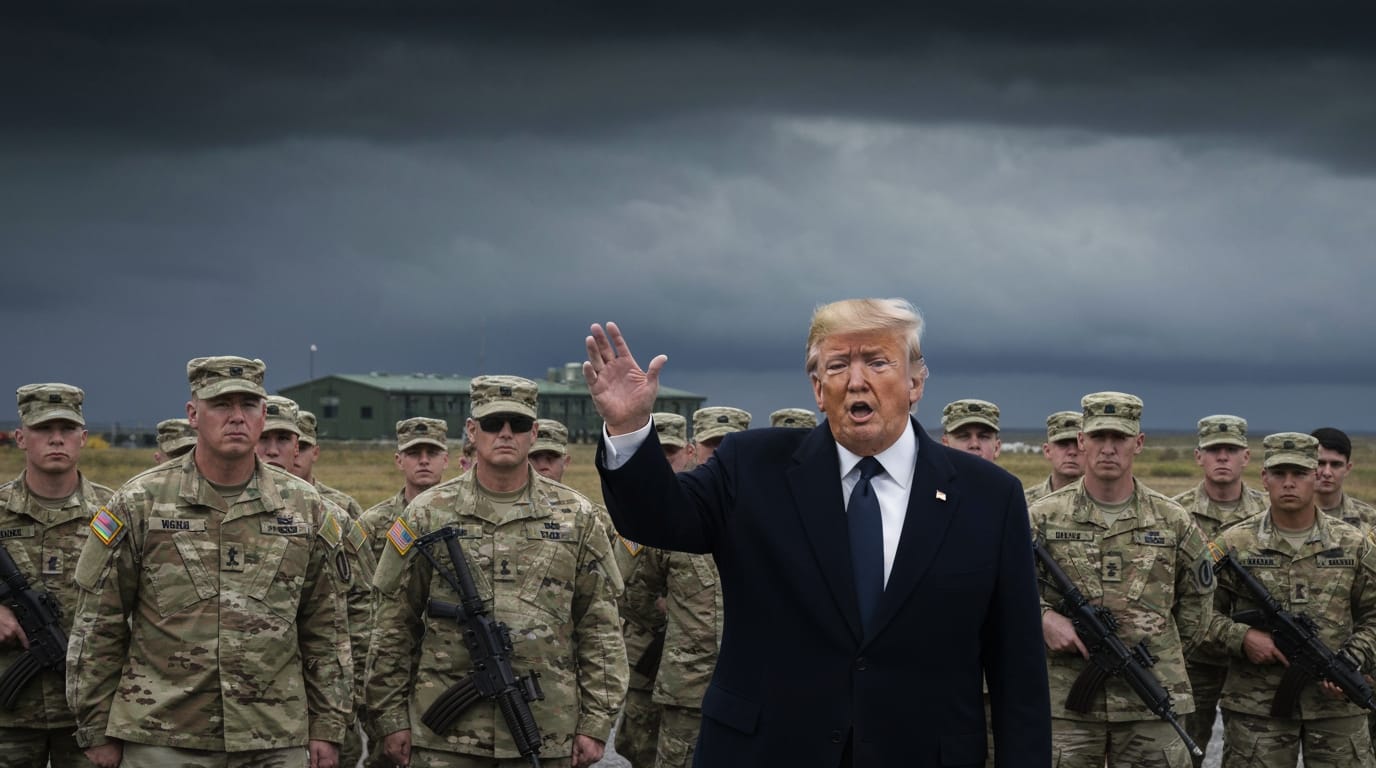
Washington D.C. — In a dramatic escalation of rhetoric, former President Donald Trump declared this week that anything short of direct U.S. control over Greenland would be "unacceptable," reigniting a contentious geopolitical debate and sending ripples through international alliances. The pronouncement comes as high-level Danish and Greenlandic officials were poised for talks in Washington, aiming to address mounting tensions over the Arctic island's future.
Trump, in posts on his social media platform, reiterated his belief that the United States "needs Greenland for national security" and suggested that NATO should facilitate its acquisition to prevent Russia or China from gaining influence in the strategically vital Arctic region. He asserted that NATO would become "far more formidable and effective with Greenland under US control." The White House has conspicuously declined to rule out the use of force to secure the semi-autonomous Danish territory, a stance that has alarmed international observers and America's European allies alike.
A Renewed Pursuit of Arctic Dominance
Trump's latest comments mark a significant amplification of his earlier interest in Greenland, which first surfaced during his initial presidency in 2019. At that time, he floated the idea of purchasing Greenland, characterizing it as "essentially a large real estate deal." However, his current pronouncements shift from a proposed transaction to an explicit demand for "ownership and control," linking it to a broader "American expansionism policy." This renewed focus has propelled Greenland, an island approximately the size of Saudi Arabia with a population of about 56,000, to the forefront of global geopolitical discussions.
The United States' strategic interest in Greenland is not novel, tracing back to the mid-19th century, particularly after the Alaska Purchase in 1867. Throughout history, various U.S. administrations have explored the possibility of acquiring the island. A notable attempt occurred in 1946 when President Harry Truman offered $100 million to Denmark for Greenland, an offer that was ultimately rejected. Despite the rejections of outright purchase, the U.S. has maintained a significant military presence on the island, notably the Pituffik Space Base (formerly Thule Air Base), which serves as a critical component of its missile warning and space surveillance systems under existing defense agreements with Denmark.
Greenland's Undeniable Strategic Value
Greenland's immense strategic importance stems from its unique geographical position at the intersection of North America, Europe, and the Arctic. Its location provides an unparalleled vantage point for monitoring civil and military developments in the air, sea, and space, making it crucial for continental defense and NATO's deterrence strategies.
The accelerating melting of Arctic ice due to climate change has further amplified Greenland's significance. This environmental shift is opening new shipping routes across the Arctic, potentially shortening global trade passages to Asia. Concurrently, it is facilitating access to the island's vast, untapped reserves of critical minerals, including rare-earth elements, zinc, iron, copper, nickel, and cobalt. These resources are essential for advanced technologies and defense industries, and the U.S. views Greenland as an opportunity to bolster economic security and reduce its dependence on existing supply chains, particularly those dominated by China. The island is also positioned at the heart of the intensifying competition for influence in the Arctic between the U.S., Russia, and China.
Adamant Rejection from Copenhagen and Nuuk
The assertive U.S. demands have been met with staunch and unequivocal rejection from both the Danish and Greenlandic governments. Greenland's Prime Minister, Múte Egede, categorically stated, "Greenland is ours. We are not for sale and will never be for sale. We must not lose our long struggle for freedom." This sentiment echoes the uniform response from Greenlandic officials, who have consistently emphasized the island's self-governing status within the Kingdom of Denmark.
Greenlandic Prime Minister Jens-Frederik Nielsen, addressing the crisis, declared that if forced to choose between the United States and Denmark, Greenland would stand with Denmark, NATO, and the European Union. He explicitly articulated, "Greenland does not want to be owned by the United States. Greenland does not want to be governed by the United States. Greenland does not want to be part of the United States." Danish Prime Minister Mette Frederiksen, in 2019, dismissed the discussion of a sale as "absurd." More recently, Denmark has stressed its status as a loyal NATO ally, emphasizing that any attack on Greenland, a crucial part of that alliance, would be considered an attack on NATO itself. In response to the U.S. pressure, Denmark has announced plans to increase its military presence in Greenland and engage in discussions with NATO regarding enhanced activities in the Arctic.
The human element of this diplomatic standoff is palpable in Greenland. Residents of the capital, Nuuk, have voiced their clear message: the island is not for sale. Reports indicate widespread "worry" and "fear" among the populace, with some experiencing sleep difficulties due to the unsettling rhetoric. An early 2025 poll revealed that a significant 85% of Greenlanders do not wish to become U.S. citizens.
International Fallout and Alliance Strains
The aggressive posture from Washington has not only strained bilateral relations with Denmark, a longstanding NATO ally, but has also elicited significant concern across Europe. French officials have openly denounced what they describe as U.S. "blackmail" over Greenland, signaling irritation among America's traditional partners. European Commission President Ursula von der Leyen has publicly backed Greenland's right to self-determination, affirming that the territory "belongs to its people" and that decisions concerning it rest solely with Denmark and Greenland.
The unfolding situation has also spurred discussions within NATO and the European Union regarding potential responses, with some considering the invocation of the EU's mutual defense clause (Article 42.7) if Denmark were to request aid following armed aggression on its territory. Domestically, some U.S. lawmakers have also expressed strong opposition to the notion of military action, with one senator describing the idea of invading Greenland, a fellow NATO country, as "weapons-grade stupid." This diplomatic maelstrom underscores the complexities of Arctic geopolitics and the delicate balance of international relations in an era of renewed great power competition.
A Concluding Standoff
As Danish and Greenlandic foreign ministers engage with U.S. Vice President JD Vance and Secretary of State Marco Rubio, the stark differences in perspective highlight a profound challenge to established international norms and alliances. While the U.S. reiterates its perceived national security imperatives, Denmark and Greenland remain resolute in their defense of sovereignty and self-determination. The episode has not only tested the bonds between allies but has also brought global attention to the strategic significance of the Arctic and the voices of its inhabitants, whose future hangs in the balance of a high-stakes geopolitical game. The enduring legacy of this diplomatic contention will likely shape future discussions on Arctic governance and the nature of international cooperation for years to come.


