Trump Renews Key African Trade Pact, Offering Temporary Relief and Signaling Policy Shift
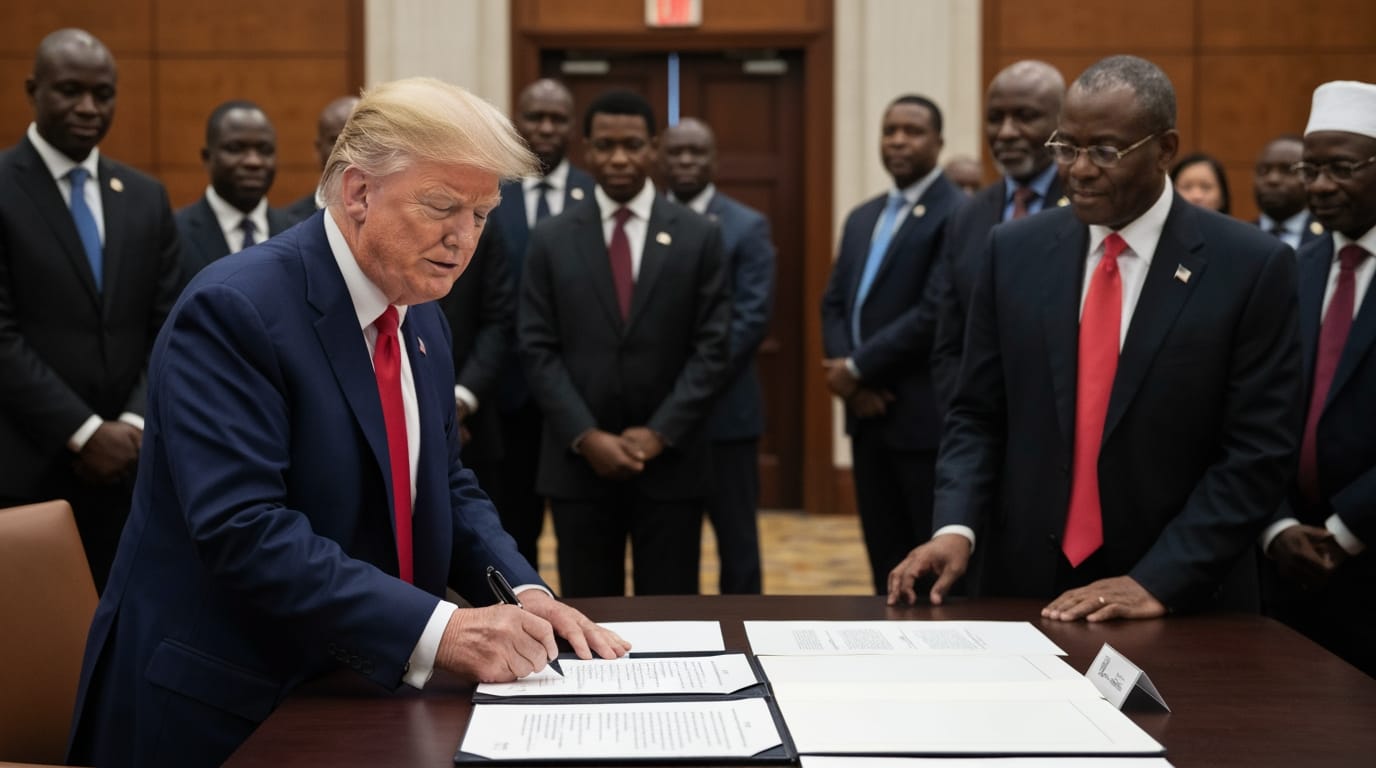
WASHINGTON D.C. – President Donald Trump has signed into law a one-year extension of the African Growth and Opportunity Act (AGOA), a crucial trade preference program that provides duty-free access to the U.S. market for eligible Sub-Saharan African nations. The move, enacted on Tuesday, February 3, 2026, comes after the program lapsed on September 30, 2025, creating months of uncertainty for African economies heavily reliant on U.S. trade. The extension is retroactive, covering the period since its expiration, and will now remain in effect through December 31, 2026.
The renewal, while providing immediate relief, is a short-term measure that underscores ongoing debates within Washington regarding the future of U.S.-Africa trade relations and the Trump administration's "America First" trade policy. It restores preferential access for over 1,800 products, aiming to bolster trade, investment, and employment across the continent, but leaves long-term stability in question.
A Cornerstone of U.S.-Africa Trade
The African Growth and Opportunity Act, first enacted in May 2000 under President Bill Clinton, has served as a pivotal instrument in U.S. foreign policy and economic engagement with Sub-Saharan Africa for over two decades. Designed to foster economic growth, promote market-based economies, and encourage good governance, AGOA grants eligible countries tariff-free access to the vast U.S. market for a wide array of goods, ranging from agricultural products to textiles, apparel, and automotive components. This unilateral trade program does not require African countries to reciprocate with reduced barriers for U.S. goods, though it incentivizes them to do so.
Over its lifespan, AGOA has been a significant driver of economic activity, fostering export-oriented industries and creating hundreds of thousands of jobs in beneficiary nations. For example, Kenya's textile and apparel exports to the U.S. reportedly surged from approximately $50 million at AGOA's inception to around $500 million. Lesotho has seen non-crude exports under AGOA account for a substantial 16% of its total Gross Domestic Product from 2001-2022, highlighting the program's critical role in certain economies. In 2023, U.S. imports under AGOA totaled nearly $10 billion, demonstrating the scale of its impact. Beyond goods, AGOA also facilitates the importation of critical minerals to the U.S., essential for industries like electric vehicle battery production.
The Lapse and the Legislative Scramble
AGOA's previous authorization was set to expire on September 30, 2025. Despite its acknowledged benefits and widespread calls from African leaders and U.S. businesses for its timely reauthorization, the program was allowed to lapse. This expiration plunged beneficiary countries into uncertainty, with fears of significant job losses and immediate tariffs reimposed on their exports to the U.S. The International Trade Centre had estimated that the expiry could reduce projected exports of AGOA beneficiaries by $189 million by 2029, with a notable impact on the apparel and textile sectors.
The push for renewal gained momentum in the U.S. Congress, with the House of Representatives initially passing a bill for a three-year extension in January 2026. However, the Trump administration, which has expressed skepticism towards international trade agreements and championed an "America First" approach, signaled support for a more limited one-year extension. The administration articulated a desire for this shorter timeframe to allow for a review and potential modernization of the program, aiming to align it with broader U.S. trade policy objectives. Ultimately, the Senate approved a one-year extension as part of a wider government funding package, which the House subsequently adopted before President Trump signed it into law. The extension, made retroactive to September 30, 2025, ensures continuity of preferential trade.
Implications for African Nations and U.S. Policy
The one-year extension provides a vital reprieve for the 32 Sub-Saharan African countries currently eligible for AGOA benefits. These nations must meet specific criteria, including progress toward market-based economies, rule of law, political pluralism, and protection of human rights. Non-compliance can lead to the stripping of privileges, as seen with Gabon, Niger, the Central African Republic, Uganda, Ethiopia, and Mali in recent years.
However, the short duration of the renewal raises concerns among investors and policymakers about long-term predictability. Critics argue that a one-year extension is merely a "holding pattern" and may deter significant new investments, which require greater policy certainty. This short-term solution also highlights a broader shift in U.S. trade policy, with the Trump administration's emphasis on bilateral deal-making and imposition of tariffs having already impacted some African nations. South Africa, for instance, has faced the possibility of exclusion or punitive tariffs, despite being a major beneficiary of AGOA, with its automotive exports seeing substantial growth under the program.
Geopolitical Context and Future Outlook
The renewal of AGOA also plays into a larger geopolitical landscape, where the U.S. competes for influence with other global powers. Some analysts view AGOA as a tool to counter China's growing economic presence in Africa. As Washington debates the program's future, African nations are increasingly diversifying their trade relationships, exploring opportunities with the European Union, China, and prioritizing intra-African trade through initiatives like the African Continental Free Trade Area (AfCFTA).
The current one-year extension sets the stage for intensive discussions in the coming months about the comprehensive reauthorization and potential modernization of AGOA. U.S. Trade Representative Jamieson Greer indicated that his office plans to work with Congress this year to update the program, aiming to increase market access for U.S. businesses, farmers, and ranchers while aligning it with the administration's "America First" trade policy. The nature of these updates, whether they introduce stricter eligibility criteria or significantly alter the program's structure, will be closely watched by African governments, businesses, and international trade observers. The outcome will significantly shape the trajectory of U.S.-Africa economic relations in the years ahead, determining whether AGOA continues to be a robust engine for mutual growth or transitions into a more conditional trade framework.


