Trump Unveils New Warship Class Bearing His Name Amidst Navy Modernization Drive
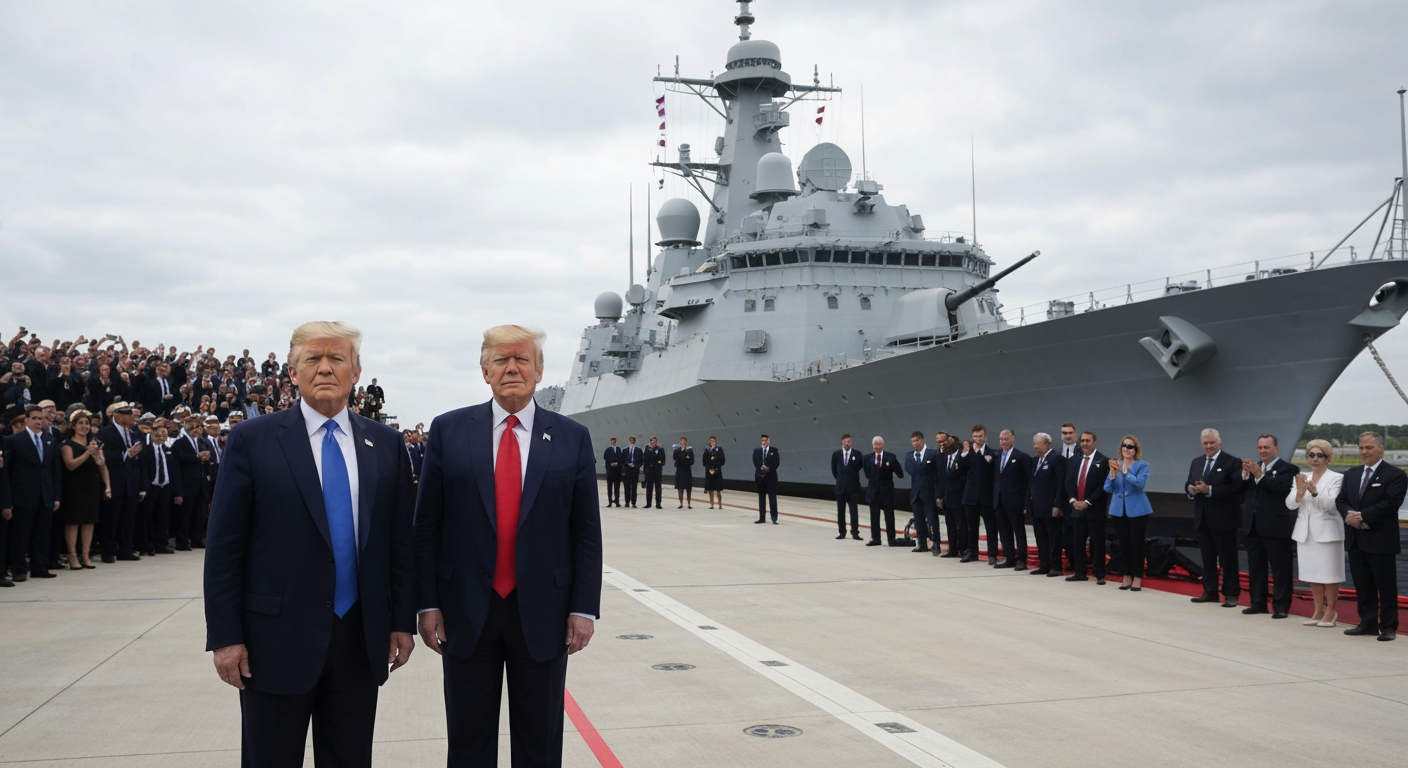
Washington, D.C. — Former President Donald Trump announced today a new class of U.S. warships to be named after himself, dubbed the "Trump-class" battleships, signaling an ambitious and unconventional direction for the nation's naval fleet. Speaking from his Mar-a-Lago residence, Trump described these vessels as set to become the "largest battleship in the history of our country, the largest battleship in the history of the world ever built," with aims for them to be the fastest and most lethal ships ever constructed. The announcement coincides with a broader U.S. Navy initiative to modernize its fleet, referred to by the administration as the "Golden Fleet".
The unveiling marks a significant departure from long-established naval naming traditions and comes at a critical juncture for the U.S. Navy, which has been grappling with fleet readiness, shipbuilding delays, and evolving global maritime threats. While Trump's pronouncement emphasized a new era of imposing "battleships," the Navy, through Secretary John Phelan, had recently detailed plans for a new class of smaller, agile combatant ships, the FF(X) frigate, under the same "Golden Fleet" umbrella, creating a layered narrative around the future of American sea power.
The "Trump-Class" Vision and the "Golden Fleet"
Former President Trump's declaration outlined a vision for a formidable "Trump-class" of warships, characterized by their immense size and unparalleled combat capabilities. He asserted that these ships, potentially weighing between 30,000 to 40,000 tons, would surpass current large surface combatants, including Russia's Kirov-class nuclear-powered battlecruisers. Renderings displayed alongside the announcement suggested advanced features, including large SPY-6 radar arrays, directed energy weapons, and a substantial number of vertical launch system (VLS) cells capable of firing both standard missiles and advanced hypersonic weapons. The "Trump-class" is presented as a cornerstone of the broader "Golden Fleet," an initiative also supported by the Secretary of War, aimed at modernizing the U.S. military's naval assets.
The emphasis on building a new generation of "battleships" comes as the U.S. Navy has largely moved away from such classifications, favoring multi-mission destroyers, cruisers, and aircraft carriers. This conceptual shift, spearheaded by Trump, suggests a strategic pivot towards larger, potentially more heavily armed surface combatants than those recently emphasized by the Navy's official procurement plans. The sheer scale and purported power of these "Trump-class" vessels, as described by the former President, suggest an intent to project an image of overwhelming naval dominance on the global stage.
The Navy's Agile Frigate Program: The FF(X) Class
Just days before Trump's announcement, on December 19, 2025, Secretary of the Navy John Phelan detailed plans for a new class of "smaller, more agile combatant ships" designated the FF(X) class. These frigates are slated to be a "critical component of the Navy's fleet of the future," designed to complement larger warships and enhance operational flexibility. The FF(X) class will be based on the U.S. Coast Guard's proven Legend-class National Security Cutter design, a strategic choice aimed at reducing cost, scheduling risks, and accelerating delivery. The first hull of the FF(X) class is expected to be in the water by 2028.
The FF(X) frigates are envisioned as highly adaptable vessels, capable of surface warfare missions, modular payload transport, and operating unmanned systems across a broad spectrum of operations. This initiative directly addresses a recognized shortfall in the Navy's small surface combatant inventory, which Chief of Naval Operations Adm. Daryl Caudle noted is "a third of what we need". The decision to leverage an existing, American-built design like the Legend-class cutter is a response to decades of "lackluster performance" and delays plaguing U.S. shipyards, as highlighted in a March 2025 Government Accountability Office report. Secretary Phelan stated that President Trump and the Secretary of War had approved the FF(X) program as part of the "Golden Fleet", indicating that these smaller frigates are an integral part of the broader modernization effort, even as Trump's public statements focused on a larger battleship concept.
Divergent Descriptions and Naming Convention Scrutiny
The two announcements—Trump's emphasis on immense "battleships" and the Navy's detailed plans for "smaller, agile frigates"—present a nuanced picture of the "Trump-class" and "Golden Fleet" initiative. While both stem from the same administration, the descriptions of the vessels' size and type appear to differ significantly. Trump's portrayal of a 30,000-40,000 ton "battleship" class contrasts with the FF(X) frigates, which, based on the Legend-class cutter, displace around 4,500 tonnes. This suggests either that the "Trump-class" is a broader conceptual framework encompassing various ship types, including the FF(X), or that the former President's public announcement leans into a more grandiose interpretation of the naval expansion. One report suggests the "Golden Fleet" will comprise both "a number of large warships" and the new frigate class.
Furthermore, the decision to name an entire class of warships after a living or recently serving president, especially one with a polarizing public image, represents a notable deviation from traditional U.S. Navy ship-naming conventions. Historically, the Secretary of the Navy, under presidential direction, names ships based on established guidelines. Battleships were typically named after states, aircraft carriers often after past presidents, and frigates after naval heroes. While naming exceptions exist, particularly for aircraft carriers after prominent figures, naming a class of combatants directly after a sitting or very recent president is uncommon and subject to scrutiny regarding precedent, propriety, and the Navy's non-political stance. The Navy's ship-naming process typically balances tradition with current values and the message a namesake conveys. Earlier in 2025, there were reports of the Trump administration reviewing ship names to align with a "warrior culture," indicating a willingness to alter established naming practices.
Strategic Context and Industrial Impact
The push for the "Trump-class" and the FF(X) frigates arrives in the wake of the Navy's recent decision to terminate the Constellation-class frigate program after only two ships, shifting resources towards new classes that can be built faster and across more shipyards. This highlights an urgent need for fleet expansion and modernization, driven by geopolitical realities and the increasing demands on U.S. naval presence worldwide, particularly in contested regions like the Red Sea and Caribbean. The Navy's Chief of Naval Operations emphasized the need for "more capable blue-water small combatants to close the gap and keep our guided missile destroyers focused on the high-end fight".
The FF(X) program, by utilizing a proven design from Huntington Ingalls Industries (HII) for the Legend-class National Security Cutter, aims to mitigate the production and technical risks that have hampered previous shipbuilding efforts. HII's Ingalls Shipbuilding has been selected to design and build the future small surface combatant, a move lauded for its potential to deliver combat power to the fleet "as fast as possible". The acquisition strategy involves a lead shipyard with a competitive follow-on approach for multi-yard construction, aiming to expand production across the maritime industrial base. This strategy seeks to infuse efficiency and speed into a shipbuilding enterprise that has often been criticized for delays and cost overruns.
A New Era of Naval Development
The announcement of the "Trump-class" warship, as part of the broader "Golden Fleet" initiative, signals a potentially transformative period for the U.S. Navy. It embodies a blend of political symbolism and strategic necessity, aiming to address critical fleet gaps while simultaneously making a bold statement about American power. While the specifics of the "Trump-class" battleships, particularly their size and direct relationship to the more agile FF(X) frigates, continue to unfold, the overarching message is clear: the U.S. Navy is embarking on a significant modernization effort with a distinctive brand. This new direction challenges conventional naming practices and prioritizes accelerated shipbuilding, reflecting a determined effort to reshape the future of U.S. naval capabilities in a rapidly evolving global environment.
Related Articles


Ratko Mladić, "Butcher of Bosnia" and Convicted War Criminal, Dies at 84
THE HAGUE, Netherlands – Ratko Mladić, the former Bosnian Serb military commander known as the "Butcher of Bosnia" and convicted of genocide, war crimes, and crimes against humanity, has died at the age of 84. Serbian...


Long-Awaited 9/11 Mastermind Trial Set for 2028, Decades After Attacks
GUANTANAMO BAY, Cuba – Nearly a quarter-century after the devastating terror attacks of September 11, 2001, a military judge has finally set a trial date for Khalid Sheikh Mohammed, the alleged mastermind behind the...