US and Japan Project Unified Front After China-Russia Drills Escalate Indo-Pacific Tensions
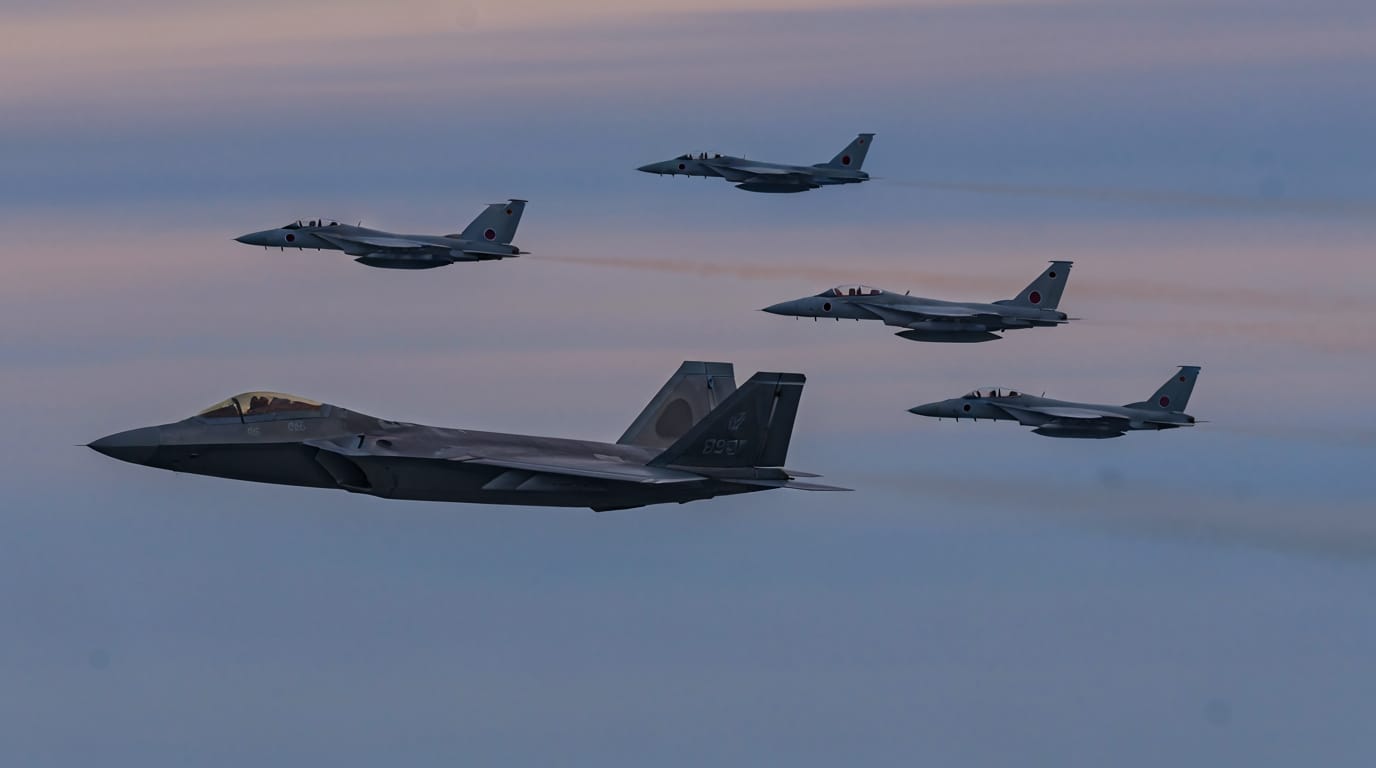
TOKYO, Japan – In a swift and significant display of allied strength, United States strategic bombers joined Japanese fighter jets in joint exercises over the Sea of Japan this week, directly countering a prominent joint air patrol conducted days earlier by Chinese and Russian military aircraft. This rapid sequence of high-stakes aerial maneuvers underscores an intensifying geopolitical competition in the Indo-Pacific, with both sides signaling resolve amidst growing regional friction. The allied response, featuring nuclear-capable B-52 bombers, was an explicit message aimed at deterring any unilateral attempts to alter the status quo by force in a region increasingly vital to global stability.
The aerial dance began on Tuesday, December 9, 2025, when Russian Tu-95 strategic bombers and Chinese H-6 bombers executed their tenth joint strategic air patrol since 2019. This coordinated flight, part of an annual military cooperation plan between Beijing and Moscow, traversed sensitive international airspace over the East China Sea and Western Pacific. The contingent included a formidable escort of fighter jets, with Chinese J-11, Su-30, and J-16 aircraft, as well as Russian Su-30s and A-50 early-warning aircraft accompanying the bombers. The flight path reportedly extended from the Sea of Japan to the East China Sea, and then into the Pacific Ocean off the coast of Japan's Shikoku island. Specific segments of the patrol saw Chinese J-16 fighters operating between Okinawa and Miyako Island. This substantial demonstration of combined air power prompted both Japan and South Korea to scramble their own fighter jets to monitor the foreign aircraft, with South Korea's Joint Chiefs of Staff confirming that seven Russian and two Chinese military aircraft entered the Korean Air Defense Identification Zone (KADIZ) over the Sea of Japan.
Allied Air Response: A Clear Message of Deterrence
Barely a day after the China-Russia joint display, the United States and Japan launched their own counter-maneuvers. On Wednesday, December 10, and Thursday, December 11, 2025, two U.S. Air Force B-52 strategic bombers, known for their nuclear-capable payload, integrated with a formation of Japanese fighter jets. The Japanese contingent included three F-35 stealth fighters and three F-15 air-superiority jets, flying in coordinated patterns over the Sea of Japan. Tokyo's defense ministry explicitly framed this joint exercise as a "show of force" and a reaffirmation of the "strong resolve of Japan and the United States not to allow any unilateral change of the status quo by force." The mission was described by Japanese officials as an "unmistakable signal of alliance cohesion" in response to the recent actions by Chinese and Russian bombers.
This rapid and robust allied response highlights the deepening defense cooperation and interoperability between the U.S. and Japan, particularly in the face of what they perceive as increasing challenges to regional security. The exercises aim to enhance the collective mine countermeasures capabilities and ensure the readiness of both nations' forces to respond effectively to threats, preserving a free and open Indo-Pacific. U.S. Navy Captain Peter W. Haynes, commodore, Mine Countermeasures Group 7, previously emphasized that "Strong alliances are critical in today's world, perhaps more so now than they have ever been," underscoring the value of such joint training.
A Shifting Geopolitical Landscape and Heightened Tensions
The recent aerial confrontations are not isolated incidents but rather symptomatic of an evolving and increasingly tense geopolitical landscape in the Indo-Pacific. The regular joint patrols by China and Russia, with the December 9 flight being the tenth since 2019, signify an institutionalized military partnership aimed at projecting power and challenging established regional security architectures. This growing military collaboration between Beijing and Moscow is often viewed as a counterweight to the U.S. and its allies in the region.
Tensions between China and Japan have been particularly high in recent weeks. Just prior to these bomber patrols, an incident involving China's Liaoning aircraft carrier group and Japanese F-15 fighters further frayed nerves. Tokyo accused Chinese J-15 fighters, launched from the Liaoning, of targeting Japanese jets with radar beams, an assertion China denies, claiming the Japanese aircraft interfered with its training operations. Such incidents, alongside increased Chinese naval activity near Okinawa, underscore the volatility of the region. The timing of these events, amidst ongoing far-seas training by the Liaoning aircraft carrier formation, suggests a concerted effort by China and Russia to demonstrate their operational reach and coordination.
Strategic Messaging and the Contest for Regional Influence
The joint military activities by both sides are replete with strategic messaging. For China and Russia, their combined air patrols serve to underscore their "no-limits" strategic partnership and their ability to operate seamlessly across vast distances. Chinese military experts cited in state media suggest that these patrols are a form of "strategic deterrence" against those who seek to undermine peace and stability, and highlight the enhanced pragmatic defense cooperation between the two nations. The inclusion of fighter escorts for bombers, lacking self-defense capabilities, is seen as crucial for long-distance deterrence missions.
Conversely, the U.S.-Japan joint flight with nuclear-capable B-52s sends an unambiguous message of collective resolve and credible deterrence. It signals to potential adversaries that any aggressive moves or attempts to unilaterally alter the regional status quo will be met with a unified and robust response from the U.S. and its allies. The exercise aims to reinforce the credibility of the U.S.-Japan alliance and its readiness to defend shared interests and uphold international law in the Indo-Pacific. The United States maintains a significant military presence in Japan, including an aircraft carrier strike group, further demonstrating its commitment to regional security.
Conclusion: A Precarious Balance
The recent tit-for-tat military exercises in the Indo-Pacific encapsulate the precarious balance of power and the escalating competition for influence in the region. The deepening military alignment between China and Russia, manifested through increasingly frequent and complex joint drills, is being met with enhanced cooperation and deterrence displays by the United States and its allies, particularly Japan. This dynamic interaction creates a complex security environment where military maneuvers are not merely training exercises but potent political statements. As all parties continue to hone their capabilities and project their intentions, the stability of the Indo-Pacific hinges on these intricate and often tense demonstrations of strength, with alliances proving to be the linchpin in maintaining a fragile regional equilibrium.


